Falling seriously ill, like falling in love, can happen all of a sudden – although Ryusuke Hamaguchi's new film is not exactly about either. The 'Drive My Car' director's latest movie, co-scripted with Franco-Japanese screenwriter Léa Le Dimna and his first not set entirely in Japan, is a bold, high-minded, and rather pedagogic work that spans three hours. It is tender and sometimes beautifully made, but also contrived, featuring some too-good-to-be-true caring characters. Frankly, it is rather precious.
Hamaguchi and Le Dimna have taken as their starting point the nonfiction book 'You and I: The Illness Suddenly Get Worse' by Makiko Miyano and Maho Isono, a meditative correspondence between a philosopher and a medical professional on love and mortality. Hamaguchi has expanded this into a drama set in Paris and Kyoto, and it is hard not to suspect that the director, like many celebrated filmmakers spending time on the international festival circuit, has created an uneasy international mixture.
Marie-Lou (Virginie Efira) is the director of a private care home in Paris called the Garden of Freedom, where they practice a care technique called 'humanitude,' a time-consuming, patient-centered approach that exasperates old-fashioned nurse Sophie (Marie Bunel). The home is understaffed, and Marie-Lou often patronizes those who question her methods. However, there are lovely scenes with caregivers and patients, and these observant, compassionate moments are where the film works best.

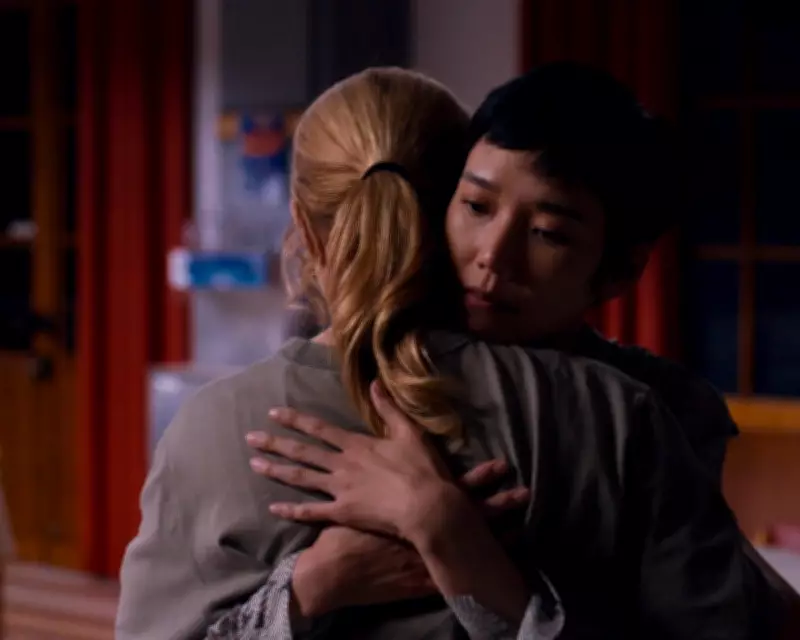
Marie-Lou is stressed and overworked, and her life is upended when she encounters an autistic Japanese teen named Tomoki (Kodai Kurosaki) in the street, apparently lost. He is cared for by his grandfather, Gorô (Kyōzō Nagatsuka), an actor performing in an experimental piece about psychiatric care in which Tomoki is encouraged to participate. The show is directed by Mari (Tao Okamoto), whose stylish calm and intelligence entrance Marie-Lou; they are on the verge of an intense friendship, though the film is reticent about deeper implications.
Marie-Lou attends a performance, stays for the Q&A, and reveals she is fluent in Japanese, questioning Mari about her serious illness. Some audience members call for the conversation to be in French, but Gorô solemnly declares that their exchange is so intimate that the audience should be content with sensing its meaning. This scene comes close to being insufferable.
Mari and Marie-Lou talk all night and visit the care home, where they have a long conversation in the break-room, complete with teacherly notes on a whiteboard about how capitalism works against care, destroys the environment, and will eventually destroy itself. They then travel together to Kyoto, where Mari's condition – with a foretold suddenness – worsens. Marie-Lou invites her to live in the care home as their physical therapy director, seemingly unaware of any issues with hiring someone about to die or encouraging residents to bond with her.
'All of a Sudden' works best outside the overwritten bond between Mari and Marie-Lou. The realist set pieces are very moving, showing patients with dementia surrounded by families, and often using photos of their younger selves in demanding jobs to illustrate how they have changed. The film's high concept feels self-conscious. 'All of a Sudden' screened at the Cannes film festival.