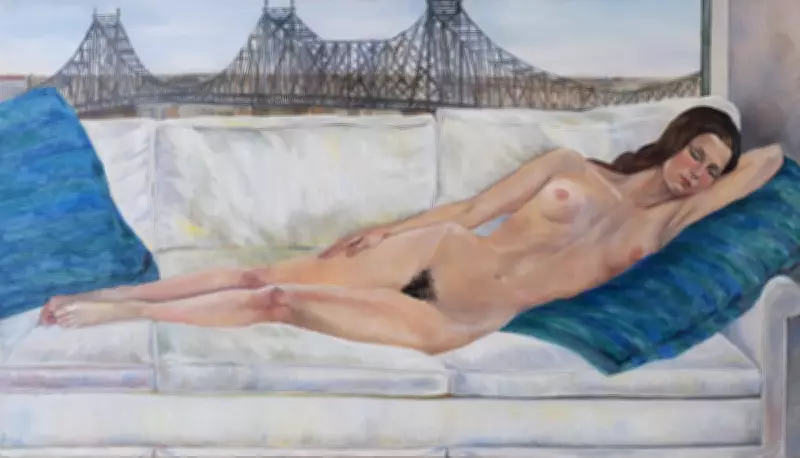
A new exhibition of Sylvia Sleigh's captivating portraits is a must-see, largely due to one extraordinary painting: The Bridge, a monumental nude depicting an elegant brunette with closed eyes and long legs, inspired by Giorgione's Sleeping Venus.
Sylvia Sleigh only painted people she found interesting, which meant attractive. Unlike the old masters, she did not idealise nudes; her naked bodies were genuinely beautiful. Many subjects were friends, including artists and critics, while others were paid models. Scrolling through her radical, realist artworks online, one might hum along to REM's 'Shiny Happy People'.
The painting The Bridge (1963) features Johanna Lawrenson, an elegant brunette with enviably long legs. Few exhibitions are worth visiting for a single artwork, but this canvas is special. Sleigh kept it until her death in 2010, when it was donated to a not-for-profit theatre company in New York. Now for sale, it is on rare display at Malarkey, a small space overlooking Russell Square in London.
The exhibition includes seven other paintings by Sleigh, curated by Daniel Malarkey. Among them are her first commission, a view of Hampstead Heath from 1946, and her earliest-known self-portrait from 1941, showing her inquisitive in a green net turban. This is a homecoming for the artist, born in Wales in 1916, who studied at Brighton School of Art and later moved to London with her first husband, painter Michael Greenwood. She attended evening art history classes and met her second husband, art critic Lawrence Alloway, with whom she moved to New York in 1961.
The Bridge shows Lawrenson reclining on a cream sofa, propped on bluish-green cushions, before a window overlooking the 59th Street Bridge. Painted in Sleigh and Alloway's Upper East Side apartment facing the East River, Lawrenson's left arm is bent, her cheek resting on it; her right arm extends along her body, palm to thigh; her legs are pressed together, eyes closed. Sleigh reversed the direction of Giorgione's nude, placing the drowsy woman in a modern setting with a daring flash of pubic hair, unusual even in the 1960s. The bridge parallels Lawrenson's slender figure, its steel framework echoing her neck, shoulder, and hip.
Sleigh, whose interest in art history began with her mother showing her books, was aware of the objectification of women in art. She painted nude men and women to offer her perspective, 'portraying both sexes with dignity and humanism'. She said, 'It was very necessary to do this because women had often been painted as objects of desire in humiliating poses. I don't mind the desire part, it's the object that's not very nice.'
According to Andrew Hottle, who is writing a monograph on Sleigh, she was not an overt feminist but an artist experimenting with the nude. Even when she helped found the all-female SoHo20 Gallery, she never marched with picket signs. Her feminism was intellectual. 'She was around 47 when she painted this, and she'd been exploring the nude model for years. It was her largest painting up to that point, and a culmination of her experiments.'
Lawrenson, later the partner of activist Abbie Hoffman, worked as an artist's model, posing for high-fashion photographers and participating in Claes Oldenburg's performances. This was the only time Sleigh painted her, and since Lawrenson was not a friend, she was probably paid. Sleigh talked as she worked, interested in people and chatty.
Sleigh painted slowly with thin layers of oil paint, building up bodies with seven layers of subtly different flesh tones, reflecting the seven layers of skin. This gives Lawrenson's face a dewy quality and her legs luminosity; against the flat cushions, her body pops. Sleigh often worked on two or three paintings at once, moving between them as layers dried. For The Bridge, she recorded eight sessions with Lawrenson, totalling about 30 hours.
Sleigh is known for her male nudes, such as The Turkish Bath (1973), a modern take on Ingres's painting with male bathers, and many nude portraits of Paul Rosano. At Malarkey, a small painting of a topless young man named Robert, with peachy lips and grey-blue eyes, hangs opposite The Bridge. Hottle notes that for Sleigh, 'nude, clothed – to her, it was all just the human condition'. She thought of herself as a portraitist who showed people at their best. The result with The Bridge is a sensuous but not sexual painting, an ideal in reality: a real woman who is truly beautiful.
Sylvia Sleigh: The Bridge is at Malarkey, London, from 8 May to 15 July.