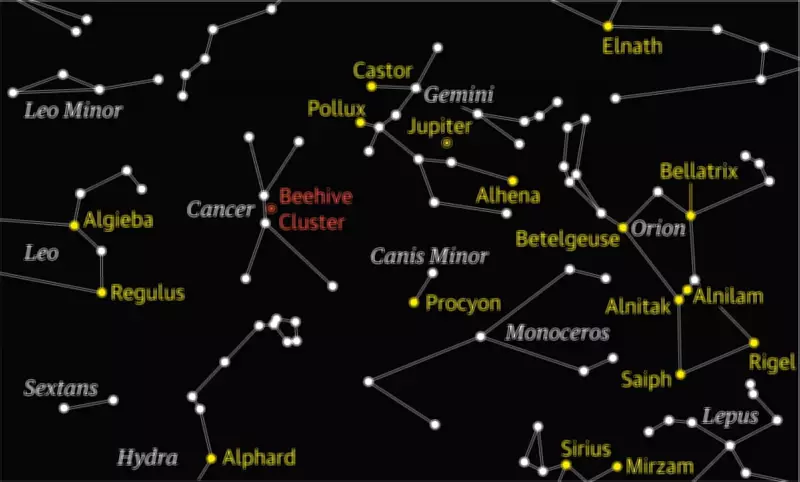
The constellation of Cancer, often depicted as a crab, currently dominates the southern sky during the late evening hours. While it lacks the brilliant stars that make other constellations easily recognizable, Cancer holds a celestial treasure for dedicated observers: the star cluster M44, famously known as the Beehive cluster.
Locating the Elusive Constellation
Finding Cancer requires a bit of celestial navigation. It is positioned approximately halfway between two more prominent constellations: Gemini, representing the twins, and Leo, symbolized by the lion. For observers in London, the optimal viewing time is around 10 PM UK time on March 9, looking southward.
The Reward: M44 Beehive Cluster
At the heart of Cancer lies M44, a star cluster that spans an area of the sky about three times the apparent diameter of a full Moon. This cluster has been documented since ancient times, adding a historical dimension to your stargazing experience.
Observation Tips for Success
To successfully spot M44, patience and preparation are key. Although visible to the naked eye, the cluster appears as a faint, nebulous patch of light. Follow these steps for the best chance of observation:
- Find a Dark Location: Escape urban light pollution by positioning yourself away from streetlights and other artificial light sources.
- Allow Eye Adjustment: Give your eyes at least 20 minutes to adapt to the darkness, enhancing your ability to detect faint celestial objects.
- Use Landmark Constellations: Identify the bright stars Castor and Pollux in Gemini, then look eastward toward Leo, recognizable by its distinctive backward question mark asterism known as the Sickle.
- Scan the Midpoint: Direct your gaze to the area halfway between Gemini and Leo, where M44 should emerge as a subtle glow.
Viewing from the Southern Hemisphere
For stargazers in the southern hemisphere, Cancer presents a different orientation. It appears lower in the sky and is positioned in the northwestern quadrant, requiring adjusted viewing angles but offering the same observational challenge and reward.
This stargazing endeavor exemplifies the beauty of astronomy: sometimes, the most rewarding celestial sights demand patience, a dark sky, and a keen eye. Whether you're a novice or an experienced observer, the hunt for Cancer's Beehive cluster offers a connection to both the cosmos and astronomical history.