The Milky Way Photographer of the Year 2026 competition showcases stunning images of the galaxy captured in the most remote landscapes on Earth. Photographers venture to dark sky locations, far from light pollution, to reveal the extraordinary clarity of the Milky Way. They share not only their breathtaking results but also the methods, trials, and adventures behind each shot.
Stargazing in New Zealand's First Dark Sky Community
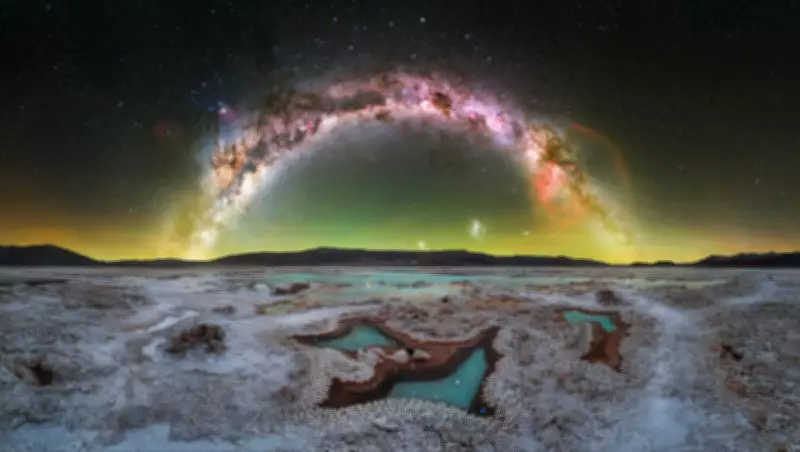
Daniel Viñe Garcia traveled deep into the Puna de Atacama in Argentina, accessible only by 4x4 vehicles on rough dirt tracks, far from any light pollution. The nearest settlement, Antofalla, has about 60 inhabitants, with electricity generated locally and turned off at night. He had never seen photographs of this salt flat before, and its untouched character and minimalist landscape immediately stood out.
The Milky Way Over a Field of Lupines
Alvin Wu captured the Milky Way rising above a blooming field of lupines in New Zealand during November, when spring wildflowers transform the landscape beneath the night sky. Using a fisheye perspective, the flowers encircle the scene, forming a natural frame that draws the viewer into the celestial sphere above.
Geminid Symphony Over La Palma's Guardian of the Sky
Uroš Fink captured a winter Milky Way panorama filled with Geminid meteors above the Gran Telescopio Canarias, the largest optical telescope in the world, on La Palma, Spain. The final image results from an extensive post-processing workflow, combining meteor data from six cameras over five nights. All RGB frames were captured using the Capture the Night Astro filter by Capture the Atlas.
Aoraki Mount Cook
Owain Scullion photographed the Milky Way arch above Aoraki/Mount Cook in New Zealand. Reaching this location required mountaineering experience, navigating steep rocky terrain and snow-covered slopes under winter conditions. The route presented constant challenges, including large washouts, unstable snow, and winter camping at altitude. As night fell, the Milky Way and zodiacal light appeared with exceptional clarity, enhanced by the cold, stable air.
Sodium Milky Way
Julien Looten captured this scene at the Very Large Telescope on Cerro Paranal, Chile, under exceptionally pure observing conditions. At 2,635 meters above sea level, the site benefits from extremely dry conditions, stable atmospheric layers, and minimal light pollution, resulting in more than 300 clear nights each year.
Celestial Light Over Sea Cliffs
Anthony Lopez captured this image by sea cliffs in the south of France. The night sky takes on a distinctly different character during winter, with cooler tones, sharper air, and Orion rising prominently above the horizon, becoming the centerpiece of the scene.
Night at the Remarkables
Tom Rae captured the galactic center of the Milky Way rising above an icy, ancient landscape in Aoraki/Mount Cook National Park, New Zealand, part of the largest Gold Tier Dark Sky Reserve in the world. He described it as one of the most remarkable scenes in over seven years of astrophotography, with stillness and clarity contrasting the wild and unpredictable nature of the place.
Firewater
Baillie Farley photographed the Grand Prismatic Spring in Yellowstone National Park, USA, where the raw energy of the planet meets the quiet vastness of the night sky. Constantly shifting steam transformed the scene, briefly revealing stars before concealing them again.
Lost in the Ripples of Space and Time
Leonel Padrón captured this image in the Pinnacles Desert, Western Australia, which offers some of the finest night skies in the world. The main limestone pillar aligns almost perfectly with the south celestial pole, anchoring the image beneath the rotating sky. To the right, the faint red glow of the Gum Nebula, a vast supernova remnant, adds depth and scale.
Perseid Meteors Over Durdle Door
Josh Dury photographed 'ancient fireworks' from Comet Swift-Tuttle hurtling through the atmosphere with an ultra-wide angle lens, including the natural limestone arch of Durdle Door, Dorset, UK. In the foreground, a glow worm was documented among reeds along the sea cliff edge. As astrophotography grows in demand, beauty hotspots and world heritage sites like Durdle Door are getting busy, and photographers must set an example in protecting these areas and local ecology.
Galaxy on the Rise
Anastasia Gulova scouted for nearly four hours to locate a cave in Tenerife, Canary Islands, Spain, only a few minutes from the parking area. Capturing the image required careful positioning and focus stacking across different planes in near-total darkness, with the brief blue hour offering little assistance.
Divinity
Kavan Chay captured a setting Milky Way core from a beach on the west coast of New Zealand, with a starfish-covered reef offering a distinctive foreground. The terrain was hazardous, with gaps between rocks and rapidly rising tide adding pressure. He captured necessary frames and returned to shore just in time, using a composite of sky and foreground rows to maintain alignment.
Milky Way Over Tatra Mountains
Łukasz Remkowicz captured this image in the Białka Gorge in Jurgów, Poland. The river creates a natural leading line, guiding the eye from Earth towards the mountains and into the night sky, connecting terrestrial and cosmic. Beyond the final image, astrophotography is about the shared experience in the field.
Double Milky Way Over Monfragüe National Park
Luis Cajete captured this image in Monfragüe National Park, Spain, during one of the few nights when both the winter and summer Milky Way can be seen in the same sky. It is a composite capturing the transition over several hours, combining the winter Milky Way after dusk with the summer Milky Way before dawn.
Salto del Agrio
Alejandra Heis captured this image at Salto del Agrio, Neuquén, Argentina. The 45-meter waterfall plunges into a canyon carved by ancient lava flows from the Copahue volcano, with vivid colors from minerals like iron and sulfur. Working with the tripod close to the ground and repeating exposures, she finally captured the scene she had envisioned.
Galactic Spine
Andrew Imhoff is drawn to Milky Way photography for its ability to spark curiosity. He aims to inspire that same sense of wonder, encouraging others to imagine standing beneath a sky like this.
Valle de la Luna, Universo Triassico Ischigualasto
Gonzalo Javier Santile captured this photograph in Argentina, a UNESCO World Heritage site. Cancha de bochas is geologically important as the only place on Earth with a complete Triassic sequence, preserving key fossils from earliest dinosaurs. Access required extreme care to avoid damaging the irreplaceable environment, reminding us of the responsibility to preserve such places.
Fireball in Paradise
Jason Rice captured a single-exposure image of a large meteor while shooting a time-lapse in Florida. After setting up the sequence, he returned to his vehicle. Shortly after midnight, the ground suddenly illuminated by a green glow, and he looked up to witness the largest meteor he had ever seen.
Caldera Galaxy Panorama
Max Terwindt captured this panorama at the highest point of La Palma, a location defined by unique terrain and exceptional night sky conditions. The lack of ambient light made the process demanding, requiring extensive focus stacking to achieve sharpness across the entire scene.
Il giardino delle stelle
Luca Fornaciari captured rows of blooming lavender with fireflies appearing like small lanterns beneath the summer Milky Way, a perfect meeting between Earth's wonders and the night sky.
Standing on the Shoulders of Giants
Nacho Peláez captured this photograph from the Sierra La Giganta in Baja California Sur, Mexico, after a two-day expedition from San Juan Londo. The final approach required an ascent of over 800 meters by mule along a forgotten section of the historic Camino Real, untouched for nearly 80 years. The image is part of a project documenting dark skies for astrotourism.
Botswana Baobabs by Night
Stefano Pellegrini spent 10 days traveling through Botswana, living out of his car and moving through remote desert landscapes in complete isolation, focused on photographing the night sky. The highlight was a small, ancient island rising from the middle of a vast salt pan.
Where Earth Meets the Cosmos
Andrea Curzi captured this image during a two-week camper trip along the coasts of Normandy and Brittany, struggling against wind and cloud cover until a single clear night revealed an unexpected red glow: aurora. The composition captured airglow, the winter arc of the Milky Way, Orion with Barnard's Loop, the Pleiades, the Rosette and California nebulae, Andromeda, Jupiter, zodiacal light, and aurora borealis.
Milky Way Over Syme Hut and Mount Taranaki
Brendan Larsen hiked over five hours through deep snow and ice to reach Mount Taranaki, New Zealand, in extreme conditions with windchill around -15C and a 20kg pack. The image is a large-scale panorama of 78 individual frames captured over about one hour and 15 minutes.