Mark Gerson, the photographer whose perceptive portraits of writers captured the essence of literary giants for over half a century, has died at the age of 104. His work, which includes well-known images of Evelyn Waugh, Doris Lessing, and the Faber poets of the 1960s, is celebrated for its intimacy and trust.
The Art of Portraiture
For around 50 years, whenever a British publisher needed a new photograph for a major author's book, they often turned to Mark Gerson. He possessed all the gifts of a great photographer, with a special knack for gaining his subjects' trust. Mark always preferred to visit people in their own surroundings, keeping sessions as informal as possible. He read their books and, as he put it, read their minds.
His career began soon after the Second World War, when informality was not always easy for his early sitters. One of his first subjects, in 1953, was the octogenarian Walter de la Mare, who posed in a dark suit, waistcoat, and with a stern visage, but with warm sunlight streaming through a window. Over time, his sitters became more at ease with his approach.
Famous Portraits
Perhaps his most famous image is of the notoriously grumpy Evelyn Waugh on his 60th birthday. Mark was plied with so much wine at lunch that he needed a lie-down. Waugh found this so amusing that he became completely cooperative and posed in his garden between two unusually busty sphinxes.
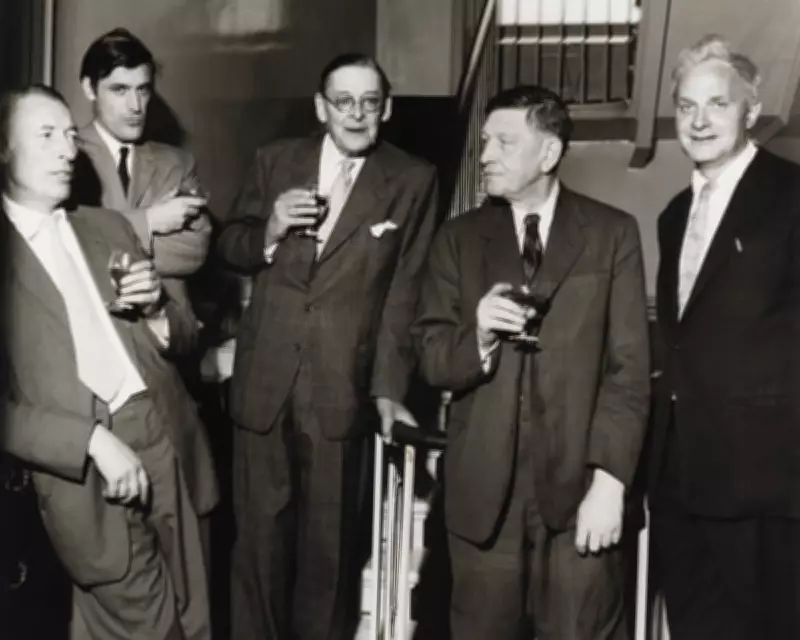
Another iconic photograph came from a party in 1960 hosted by the publishers Faber & Faber for their unmatched roster of poets. The image shows Stephen Spender, W.H. Auden, T.S. Eliot, Louis MacNeice, and Ted Hughes. Notably absent was Sylvia Plath, Hughes's wife, who was not yet famous in her own right; Mark did not spot her. It was said she was making the tea.
There was also a delightful photo of Doris Lessing in 1956, stroking her cat next to her typewriter. Later subjects included William Golding staring at a chessboard, a thoughtful Tom Stoppard sucking his fingers, Alan Sillitoe with a cup of tea, and Martin Amis leaning against a pinball machine. Many of his subjects were smoking, a common way to handle the slight stress of being photographed.
Early Life and Career
Mark was born in London into a Jewish family. His father, Bernard, emigrated from Poland via South Africa, where he fought in the Boer War, to Britain, and opened a silverware shop. He married Esther (née Miller), whose family was of Lithuanian descent. Mark, the youngest of three children, grew up in Stamford Hill in the 1930s, where his childhood was marred by jeers and insults from supporters of Oswald Mosley's fascists.
Fascinated by photography, he studied the subject at Regent Street Polytechnic after leaving Central Foundation boys' school. When he volunteered for the RAF in 1940, he hoped to use his skills, but was made a radio operator. After VE Day, his unit visited Buchenwald concentration camp, which had been opened to show local Germans the atrocities committed in their name. Mark was devastated that he could not speak enough Yiddish to communicate with the survivors.
After the war, he began to find his path. With his demobilisation money, he leased a war-damaged studio near Marble Arch. In 1949, he met and married Renee Cohen, a would-be historian who overcame misogyny to become a senior figure at London Guildhall University (now London Metropolitan University), specialising in 18th-century Netherlands.
Rise to Prominence
Mark's career progressed smoothly. His aunt Betty Miller was an author (and mother of polymath Jonathan Miller). Mark took her picture, which was published in the literary magazine John O'London's Weekly, launching his career devoted to authors.
By the 1960s, photography was gaining recognition as an art form. When Roy Strong became director of the National Portrait Gallery in 1967, he championed the genre. He highly rated Mark's work and added much of it to the gallery's collection. In 1996, the gallery held a major exhibition, Literati, dedicated to Mark's work. The curator, Terence Pepper, remains an admirer, noting that Mark was "doing stuff that was very rare at the time."
By then, Mark was past retirement age, and photography was about to undergo a revolution. He preferred old-fashioned methods: "in his old Austin mini carting a tripod, lighting equipment and a couple of Rolleiflex cameras," as his daughter Jane described, then heading back to his darkroom at home in St John's Wood to develop the film. He always favoured black and white, and his craftsmanship now seems quaint.
Personal Life and Legacy
Mark was a gentle man. In 1967, he found enough forgiveness, professionalism, or curiosity to photograph Oswald Mosley, who told Mark he was never an antisemite. Throughout his long life, Mark remained without anger, firmly on the left, and lucid until his final moments. He leaves a vast legacy of fascinating portraits, many of which can be viewed on the National Portrait Gallery's website.
Renee died in 2024. Mark is survived by their daughters, Ruth and Jane, two grandchildren, and four great-grandchildren. His two elder sisters and a grandson predeceased him.
Cecil Mark Gerson, photographer, born 3 October 1921; died 14 April 2026.