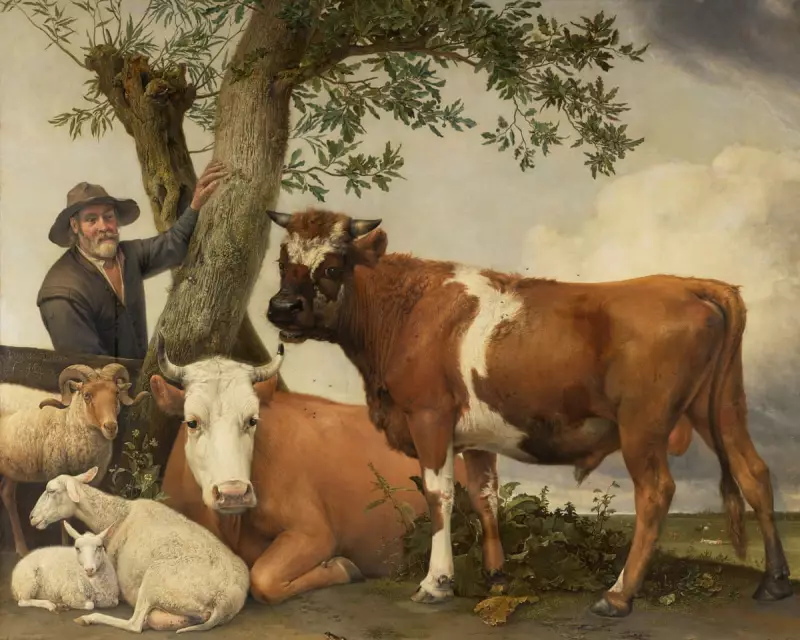
One of the Netherlands' most celebrated animal paintings, a bucolic scene of farm life, has been found to contain a surprising anatomical secret. Experts at the Mauritshuis museum in The Hague have discovered that the bull depicted in Paulus Potter's 1647 masterpiece The Bull was originally painted with significantly larger and lower-hanging testicles.
A Modest Revision
This unexpected detail came to light during an extensive 18-month restoration project. Conservators used X-ray imaging to examine the layers beneath the painting's surface, revealing Potter's initial preparatory sketches. Abbie Vandivere, a paintings conservator at the Mauritshuis, explained the find. "We found that Potter made lots of changes as he worked," she said. "[The bull's] balls were bigger and lower, his whole back end was shifted – but, indeed, the balls are the biggest change."
The prevailing theory is that the artist deliberately altered the anatomy to conform to the more restrained sensibilities of polite 17th-century society. Research confirmed that contemporary cattle breeds did possess what experts describe as "giant, pendulous testicles," making Potter's initial sketch accurate. However, the finished work presents a more modest animal.
A History of Controversy
This discovery aligns with another known incident from Potter's career around the same time. He created an etching for Amalia van Solms, Princess of Orange, titled Pissing Cow, intended for a palace mantelpiece. Jolijn Schilder, another conservator on the project, noted, "It was turned down by her because she thought it was too filthy a subject." This context suggests Potter may have been acutely aware of the boundaries of acceptable subject matter for his patrons.
The research forms part of a broader effort to understand the short life and work of Paulus Potter, who died of tuberculosis in 1654 at just 28 years old. His large-scale focus on a simple farm animal was revolutionary for its time, typically reserved for grand historical or royal portraits.
A Painting's Turbulent Journey
The artwork's own history is as dramatic as its hidden detail. When the Netherlands became a French vassal state in the late 18th century, Napoleonic troops looted 192 of Potter's works, considering The Bull a particular prize. It was taken to Paris, where its life-sized depiction of a common cow captivated French audiences.
Following Napoleon's defeat at Waterloo in 1815, the Dutch demanded its return. Quentin Buvelot, a senior curator at the Mauritshuis, found that French officials attempted to thwart the repossession by hiding all the tall ladders in the Louvre. Despite this, the monumental painting, measuring 236cm by 339cm, was eventually returned to the Netherlands in a triumphal procession.
The recent restoration was conducted in a public gallery behind a glass box, allowing visitors to witness the process. While the X-ray images showing the bull's original form are now on display, the painter's final, more discreet layers of paint remain in place, keeping the animal's full historical glory quietly hidden from view.