It is hard to imagine now, but there was a time when rooftop bars were not really a thing. A time before pop-ups and contemporary outdoor sculpture parks. A time even, before immersive art. Back in 2007, the UK was an experiential art wasteland. Then Bold Tendencies appeared, filled a multi-storey Peckham car park with sculptures, painted a staircase bright pink, built a cocktail bar on the roof, and changed everything.
Two Decades of Bold Tendencies
Now entering its 20th summer season, Bold Tendencies celebrates two decades of arts programming, often sun-drenched but also windswept and drizzly. It has welcomed over 3 million visitors to its concrete edifice behind Peckhamplex cinema, commissioned dozens of new artworks, hosted countless recitals and performances, built an auditorium and concert hall, and inspired many art experiences that followed.
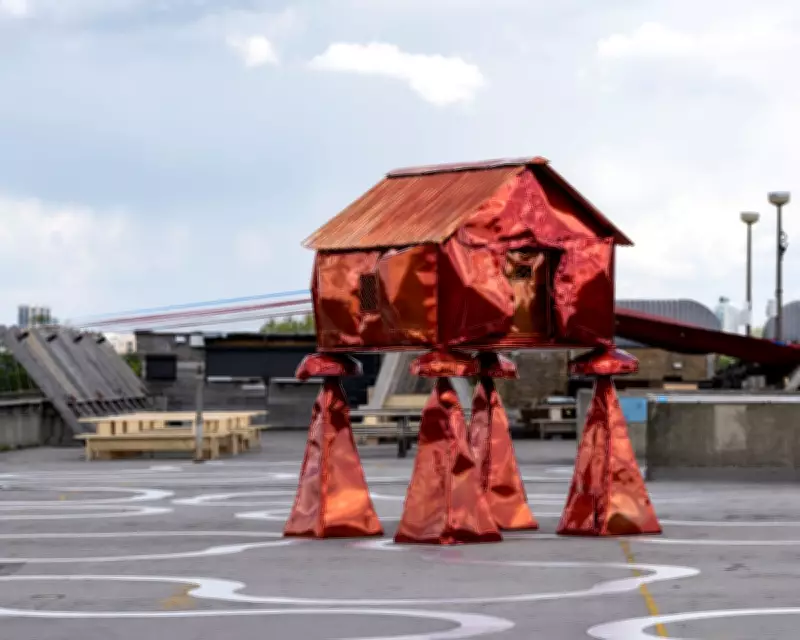
The art has been remarkable. Anthea Hamilton built a doorway to heaven through a man's splayed legs in 2010. Jess Flood-Paddock parked Del Boy's three-wheeled van on the roof in 2011. James Bridle flew a black balloon filled with wifi routers from the roof in 2014. Adam Farah-Saad installed a decorative retro water fountain in 2024. There have been piles of raw pigment, fluttering flags, wobbly walkways, and heads on spikes. Almost all were newly commissioned and free to see.
A Place of Great Possibility
"Part of our responsibility is to offer the joy of feeling welcome to as many people as possible," says Hannah Barry, the driving force behind Bold Tendencies and owner of Hannah Barry Gallery. "People come for different reasons and may stay short or long. What matters is that they are curious enough to come."
In 2007, Peckham and the cultural landscape were vastly different. This was years before The Vinyl Factory, Frameless, or the Hayward and Tate racing to create TikTok-ready exhibitions. The only large-scale sculptural commissions were the fourth plinth and Tate's Turbine Hall projects. There was little space for new work by young artists.
Peckham had few attractions: a handful of project spaces, a dive bar called Bar Story, cheap rents, and many artists from nearby Camberwell College of Arts and Goldsmiths. The area felt isolated before the London Overground. "I found it a place of great possibility," says Barry. "It still feels like that."
From Derelict Houses to Car Parks
Barry had exhibited in a semi-derelict house on Lyndhurst Way and connected with Southwark council property managers. The council realized artists could act as caretakers for empty buildings awaiting redevelopment, a model still used today by other cultural charities, sometimes seen as the forward battalion of gentrification.
"We looked at many interesting buildings, but none were usable. Then one wintry afternoon, we went to the top of the car park. I saw how long and tall it was," says Barry. "It was a simple yet great expanse of space with a spectacular context. Changing light, weather, the outdoors, the city life – all of that was exciting."
Permanent Installations: Frank's Cafe and the Pink Staircase
Two permanent installations anchor Bold Tendencies: Frank's Cafe, a rooftop bar, and Simon Whybray's iconic pink staircase. Frank's solved the problem of getting Londoners to linger in a cold, windy sculpture park – by serving cocktails. It also provided an opportunity for early-career architects. "Why were there no big public projects for them?" Barry asks. "Frank's was about creating an opportunity."
Whybray's bubble-gum pink staircase, titled hi boo i love you, was ahead of its time. Many galleries now try to create Instagram moments, but Whybray's work was among the first viral art installations in London. The public reaction was "utterly overwhelming," he says. "No other large institution has been brave enough to commission me. Bold Tendencies is a powerful reminder that transcendent experiences are possible in non-traditional spaces."
Challenges and Future
Despite its success, Bold Tendencies faces ongoing difficulties. "The honest truth is it has been hard since the beginning and remains hard," says Barry. "Starting every year is difficult. Wanting to make it better is difficult. Logistical challenges are difficult."
Financial reserves are a major concern. Asked if Bold Tendencies will continue for another 20 years, Barry says, "The sensible answer is that if I had reserves for five years of operational and programme costs, then yes. But we don't have any reserves." She pauses. "There are many considerations and difficulties. But what supersedes them is the joy of doing it. I've kept doing it because I felt every year it could get better. When there is progress ahead, I find it difficult not to want to get there."