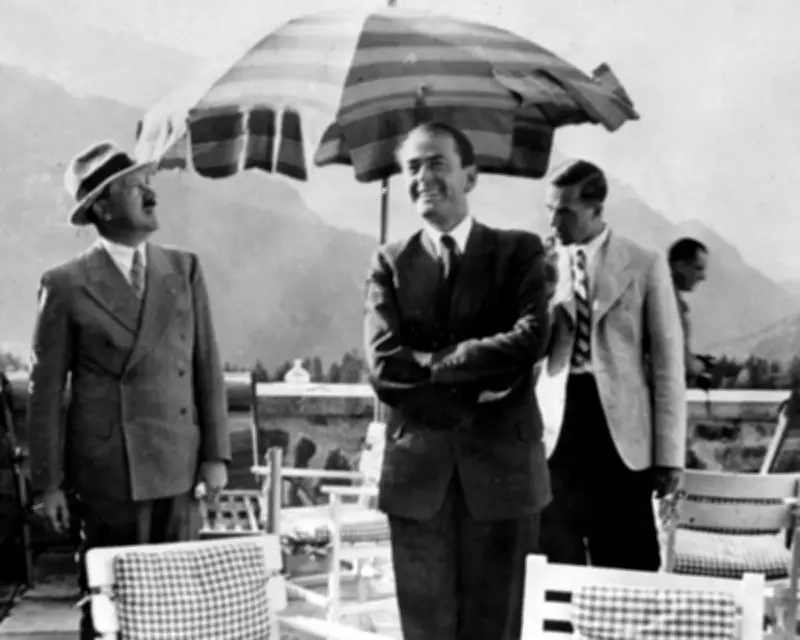
Unconventional Exploration of Nazi Duplicity
In April 1975, Simon Wiesenthal, the Holocaust survivor renowned as a Nazi hunter, wrote a personal letter to Albert Speer, the convicted Nazi war criminal. Wiesenthal expressed gratitude for a psychology book Speer had sent him and forwarded a copy of his own memoir in French. Their decade-long correspondence included holiday postcards and birthday greetings, concluding with a heartfelt note from Speer's widow Margarete in 1981, following his death, emphasizing the profound significance of their friendship.
Speer's Extraordinary Rehabilitation
Wiesenthal's private friendship mirrored the remarkably warm international reception Speer enjoyed as a public intellectual after his release from Spandau prison in 1966. Despite serving as minister of armaments in wartime Nazi Germany and being convicted of crimes against humanity, Speer died in London while promoting his new book on the BBC. His rehabilitation was a masterclass in deception. At the Nuremberg trials and in subsequent books and interviews, Speer uniquely accepted full responsibility for Nazi atrocities, which lent credibility to his false claim of ignorance regarding the extermination camps. Evidence to the contrary only emerged posthumously, leading Wiesenthal and others to acknowledge they had been deceived.
Orengo's Masterful Character Study
French author Jean-Noël Orengo's You Are the Führer's Unrequited Love delves into Speer's dual existence: as Hitler's personal architect, ally, and confidant, and as the world's idealized 'good Nazi'—articulate, repentant, and seemingly less monstrous than his peers. The book is not a conventional biography or novel; it avoids exhaustive detail and narrative invention, instead offering a character study of a man who manipulated Hitler and later his victors into perceiving him as they desired. The title, derived from an SS officer's remark, reflects the intense, tumultuous nature of Hitler and Speer's relationship, though historians have not taken it literally.

Psychology of Seduction and Ambition
The narrative traces Speer's rapid rise from a young stage designer to minister of armaments within a decade, highlighting key moments of intimacy, conflict, and reconciliation between the two men. Orengo focuses on the psychological dynamics: Speer, renowned for his looks, provided Hitler with a link to art and cultural validation, while Hitler fueled Speer's immense ambition. Told in a lyrical, inquisitive voice, the book uses historical facts as a backdrop for exploring Speer's inner motivations—whether ruthless narcissism, deep insecurity, or sheer ambition—that enabled him to gain and betray Hitler's trust.
Post-War Manipulation and Truth
In the second part of Speer's life, Orengo portrays him as a 'merry widower,' focusing on his friendship with writer Gitta Sereny, a former French resistance member. Sereny initially interviewed Speer for the Times and became a witness to his purported good faith, though not entirely convinced. Orengo illustrates how Speer adeptly sensed and catered to Sereny's expectations, reinventing himself to maintain success. Sereny's book, His Battle with Truth, aligns with Orengo's theme of truth versus lies, as Speer's autobiographical accounts are described as history's most significant piece of autofiction, where he manipulated facts to enhance his fame.
Forewarning of the Post-Truth Era
Orengo posits that Speer's trajectory symbolizes the dangers of a society blurring the lines between invention and reality, serving as a precursor to the post-truth era. He reflects that recognizing this reality leads to pessimism as the only wisdom. You Are the Führer's Unrequited Love, translated by David Watson, is published by Penguin Classics, offering a profound critique of historical manipulation and its modern implications.