The End of an Era: America Bids Farewell to the Mass-Market Paperback
For generations of American readers, the gateway to literature wasn't found in hushed libraries or polished bookstores, but rather in the most ordinary of places: supermarket aisles, pharmacy counters, and railway station kiosks. The mass-market paperback—those squat, roughly 4-inch by 7-inch books that sold for pocket change—represented a democratic approach to reading that's now disappearing from the American landscape.
A Working-Class Gateway to Reading
Shelly Romero, now a New York-based literary agent, recalls her childhood in Hialeah, Florida, where access to books meant visiting the local Publix supermarket rather than a traditional bookstore. "We were very working class; my mom was working two jobs sometimes," Romero remembers. "The appeal of books being cheaper and smaller and able to be carried around was definitely a thing."
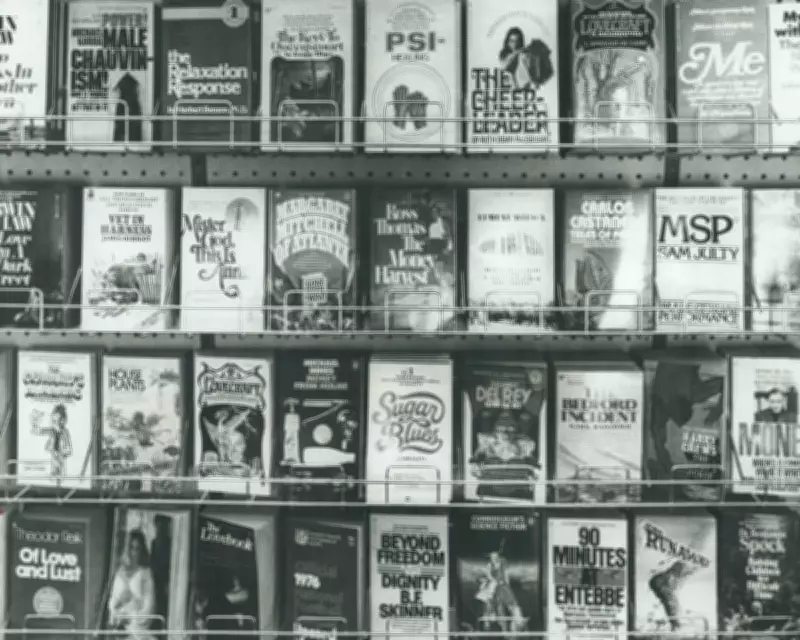
These paperbacks occupied wire spinner racks positioned alongside chewing gum and cigarettes, creating what Romero describes as "the pick 'n' mix candy-type store where there is something here for everyone, whether it's the Harlequin romance novel or something very pulpy like a sci-fi or horror novel that you could quickly get."

The Numbers Tell the Story
The decline has been dramatic and sustained. According to industry data, mass-market paperback sales have plummeted from 131 million units in 2004 to just 21 million in 2024. This precipitous drop prompted ReaderLink, the largest book distributor in the United States, to announce recently that it will stop distributing mass-market paperbacks entirely.
"We're definitely losing accessibility and that's a huge thing right now," Romero laments. "At the same time when you're looking, for example, at kid lit, a 14- or 15-year-old is not going to be able to buy maybe a $19.99 or $21.99 hardcover YA book, especially if they're working a minimum-wage or babysitting job, so it becomes fully inaccessible whereas they could have just gone and picked something up like a mass-market paperback."
Historical Roots and Cultural Impact
The mass-market paperback revolution began in 1935 with Allen Lane's Penguin Books in Britain, purportedly inspired by his frustration at finding nothing decent to read at a railway station. The format migrated to the United States in 1939 with Pocket Books and took off during World War II when the U.S. military distributed millions of "Armed Services Editions" to troops.
Paula Rabinowitz, professor emerita of English at the University of Minnesota and author of "American Pulp," argues the format's genius was its physical intimacy and portability. "It generated a new technological explosion of this form of mass reading," she says. "The whole idea was to make the books no more expensive than a package of cigarettes at 25 cents and they were often sold outside of bookstores."
This distribution model proved revolutionary. Unlike hardcovers confined to bookstores, mass-market paperbacks were treated like magazines, stocked by wholesalers who replenished racks in tens of thousands of non-book outlets. This ubiquity meant books suddenly became available to people who might never cross the threshold of a literary establishment.
Multiple Factors Behind the Decline
The causes of the format's demise are manifold and interconnected:
- The rise of trade paperbacks: These larger, higher-quality paperbacks offer publishers better profit margins
- Industry consolidation: Distributors have merged and streamlined operations
- The digital revolution: Smartphones and e-readers have replaced paperbacks as default time-killers
- Changing consumer preferences: Readers increasingly prize books as aesthetic artifacts rather than disposable items
Brenna Connor, director and book industry analyst for U.S. books at Circana, notes that the very utility that made mass-market paperbacks successful has been usurped by technology. "When you think about the needs of what brought the mass-market paperback book to the market and then fast forward to 2026 and where we're living in an age where it's no longer as relevant today and that's contributing to their demise."

Economic Realities and Cultural Loss
Bethanne Patrick, a book critic at the Los Angeles Times, points out that the economic logic of the mass-market format has simply evaporated. "Now, there isn't a need for the mass-market paperback because it isn't that much cheaper to make than the trade paperback," she explains. "That's something a lot of people are missing."
Patrick, who grew up during the mass-market paperback's heyday, recognizes the cultural loss. "We all knew that the general public had a certain interest or some skin in the game for what was going on in books and reading and now we've lost some of that to people who are watching videos or gaming."
The Final Chapter
The writing is literally on the wall for the format. Airport retail company Hudson began phasing out mass-market books from its convenience stores last year, limiting them only to a few dedicated bookstore locations. Even major properties like the Bridgerton series are no longer being replenished in the mass-market format; once current stock is exhausted, they will only be available in trade paperback or hardcover editions.
For Steve Zacharius, chief executive of Kensington Publishing—the biggest independent publisher of the format in the United States—the decline represents more than just business. His father founded the company in 1974, initially publishing only mass-market titles.
"When January came around, my production manager, who's been here 35 years, called me and said: 'This is sad, it's the first month we don't have a mass-market book ever,'" Zacharius reveals. "When the company started, we were entirely mass market. We didn't have hardcover or trade paperback when my father started in '74; it was entirely mass market and the print runs for each book were enormous."
As the market has spoken and consumers have shifted their preferences, America's relationship with reading continues to evolve, leaving behind a format that once democratized literature for millions while creating new challenges for accessibility in an increasingly digital age.