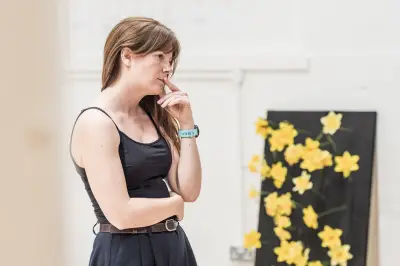
Gwendoline Riley's Unimaginable Windham-Campbell Prize Triumph
British novelist Gwendoline Riley, celebrated for her darkly humorous explorations of failed relationships and human complexity, has received the prestigious Windham-Campbell prize, an award providing $175,000 (£135,000) to support writers' creative work. Speaking from her London accommodation early on Good Friday morning, Riley described the moment she learned of her selection as "unimaginable" and emotionally overwhelming.
A Transformative Recognition for Literary Excellence
The Windham-Campbell prizes represent a distinctive approach to literary recognition, focusing on providing financial security rather than generating media spectacle. Each year, eight writers across fiction, nonfiction, drama, and poetry receive the substantial award, selected by an anonymous jury based on excellence across their body of work. Previous recipients include acclaimed authors Anne Enright, Margo Jefferson, and Yiyun Li.
"It was just an ordinary, wet Wednesday, and I had an email through," Riley recalled of the notification. "I hadn't heard of it, but then I did remember seeing Anne Enright getting it, because I remember some of the language she used to describe what it was like to get exactly this kind of call."

Financial Security After Decades of Precarious Writing
Riley's writing career has followed a challenging path since her debut novel Cold Water was published when she was just 23 years old. Now 47, she has produced seven novels, each taking approximately four years to complete. Aside from occasional teaching work, she has maintained that writing represents her sole means of income generation.
"I was never going to stop writing," Riley explained, describing the "sticky spot" she has navigated throughout her career. "My adrenaline or cortisol levels, or whatever it is, have been so high for as long as I can remember, so to suddenly have the prospect of that being taken away when the money arrives ... It's very odd, because suddenly a sort of counter life opens up."
The Literary World Through Riley's Distinctive Lens
Riley's latest novel, The Palm House, continues her exploration of intelligent women navigating complex social environments, often with backgrounds of family dysfunction. Her protagonists typically hail from northern England, like Riley herself, who was born in London but grew up in Wirral on Merseyside before studying in Manchester and eventually returning to London.
Her writing style is characterized by compact narratives, minimal plot, and a distinctive approach that reveals essential information through careful withholding. Critics frequently describe her work as pitiless, horrifying, and brutally funny, with relationships portrayed in unflinching detail.
Monsters, Predators, and Human Complication
Riley's fiction often explores what she describes as "monsters around us, you know, predators and parasites" within human relationships. In The Palm House, protagonist Laura navigates a literary magazine world while confronting past trauma, including childhood neglect and abusive relationships with predatory figures.
"There are monsters around us, you know, predators and parasites and, of course, my whole bent is toward human complication," Riley explained, highlighting her interest in how vulnerable individuals become exploited "whether sexually, socially or professionally."
England as a Damp, Frightened Space
The author offered a striking characterization of contemporary England through her literary perspective: "It's just this sort of damp, frightened space where people cower and tell themselves that they're the civilised ones." This observation emerged from her realization that characters in The Palm House consistently seek "little alcoves because they're frightened of the world."
Future Possibilities and Evolving Prose
With financial pressures potentially easing, Riley anticipates possible changes in her writing approach. "I think that will affect how I write, definitely," she noted regarding the prospect of reduced stress. However, she remains characteristically uncertain about specific directions: "I never know what's happening till I do it. I've just got a strong sense that it'll be different."

She described recently observing a young boy on the London Underground maintaining his balance without holding rails, declaring he was "holding my stance so I don't get flung," which prompted reflection on whether her own prose might contain "a little bit of that flavour" of determined resilience against external forces.
A Career Defined by Persistence and Precision
Riley's literary journey has been marked by persistence through financial uncertainty and dedication to her distinctive voice. Her novels, including the critically praised My Phantoms and First Love, have established her as a unique presence in contemporary British fiction, exploring difficult relationships with both horror and humor.
The Windham-Campbell prize now offers not just financial relief but creative possibilities. "There's lots," Riley acknowledged, "that I haven't been able to find a place for in my novels yet, partly because I've felt so 'under the cosh.' Now I'm intrigued to find out what else might be possible."
As she continues writing from what she describes as "a literal garret" in London, Riley maintains the taut, exhilarating quality that characterizes both her conversation and her prose, even as she contemplates how newfound security might influence her future literary explorations.