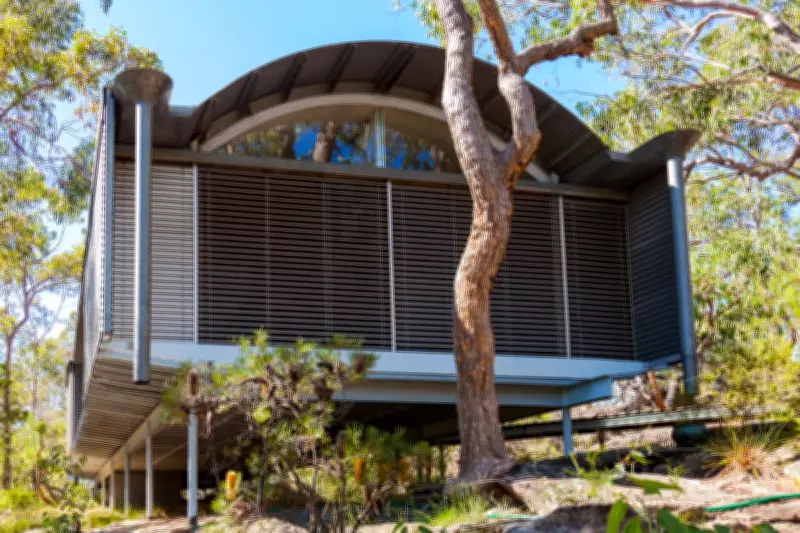
The Ball-Eastaway House, designed by Australian architect Glenn Murcutt, is a masterpiece of sustainable architecture that appears to float above the landscape. Photograph: Paul Lovelace/Alamy
A House That Teaches
Lynne Eastaway describes her home as a teacher. A choir of cicadas fills the scrub with a rhythm that rises and falls. On other days, birds, goannas, echidnas, wombats, wallabies, and kangaroos visit. 'The bush ends, and the house begins,' she says. 'You're not the centre; you're just part of it. That's the thing you learn.'
This is the experience of living in a house designed by pioneering architect Glenn Murcutt. The Ball-Eastaway House, on a 10-hectare block of dry sclerophyll forest north-west of Sydney, was built in 1983 for Eastaway and her former partner, artist Sydney Ball. At the time, Murcutt was early in his career.
Pioneering Sustainable Design
Since then, Murcutt has won architecture's most prestigious award, the Pritzker Prize, and is celebrated as a pioneer of modern sustainable architecture. The commission came from Ball, who had lost a studio to fire in New York and was evicted from another in Sydney in 1976. With a modest budget, they sought a place to live and paint. Ball's only demand was a single, gallery-style wall for hanging artwork.
A friend suggested Murcutt. After lunch, they visited the land where the couple had been camping. Murcutt walked off into the bush for hours. 'It was an amazing site,' he recalls. 'It was just so beautiful. We were so careful about how we sited that house.'
Designing with Nature
The key feature was a sandstone rock shelf, an obvious building site. However, Murcutt avoided a heavy-handed approach. 'I thought closing it to the ground would destroy the rock and the topography,' he says. His solution: 14 steel columns sunk into the rock, suspending the structure above as if floating. If dismantled, the house would leave almost no trace—a hallmark of Murcutt's style.
As the Pritzker jury citation states, 'his structures are said to float above the landscape, or in the words of the Aboriginal people of Western Australia that he is fond of quoting, they 'touch the earth lightly'.'
Functional Flourishes
Lifting the building on stilts allows air to circulate, cooling the house in warm months and sheltering wildlife. Eastaway recalls Murcutt measuring eucalypt leaves to find the biggest, which determined the gutter slope. Leaves wash down and form a birds'-nest shape at the base of the downpipe.
Built from corrugated iron—a common but underappreciated material—the exterior belies a light-filled interior with hardwood floors. The house includes two bedrooms, living and dining areas, kitchen, amenities, and two verandas: one social, another enclosed on three sides opening to the bush.
'The house is not taking you away from the environment,' Murcutt says. 'There are parts where you can remove yourself from the environment, or you can thrust yourself into it.'
Influence on Modern Architecture
Murcutt's approach was out of step with Australian building practices in the 1970s and 80s, but today, new generations of architects are influenced by his work. Francis Kéré, a subsequent Pritzker winner, recalls seeing one of Murcutt's designs early in his career: 'The simplicity, the openness, the comfort it created, it stayed with me. His work shows that thoughtful architecture can honour culture, place and the environment all at once.'
Murcutt rejects political labels. What matters is that everything is done for a reason—'logical and sensible.' He believes listening to the landscape and considering environment, climate, and nature is as fundamental as thinking about water supply and sewerage. 'Why shouldn't all buildings be prized for sustainability?' he asks. 'If you get the basics right, if you start to work with nature, not manipulating nature, it starts to offer you the most beautiful solutions.'
A Legacy to Pass On
Now 77, Eastaway is preparing to leave the house. Over the years, renovations were made with help from Downie North architects, and in February, the house received heritage listing from the New South Wales state government. 'The bush never stays the same,' she says. 'The older you get the more you realise you're not going to live forever. You can leave things as they are, you can change things, but hopefully you change things in a way that leaves the world better.'