Chicago Mourns Civil Rights Legend Jesse Jackson with Emotional Public Visitation
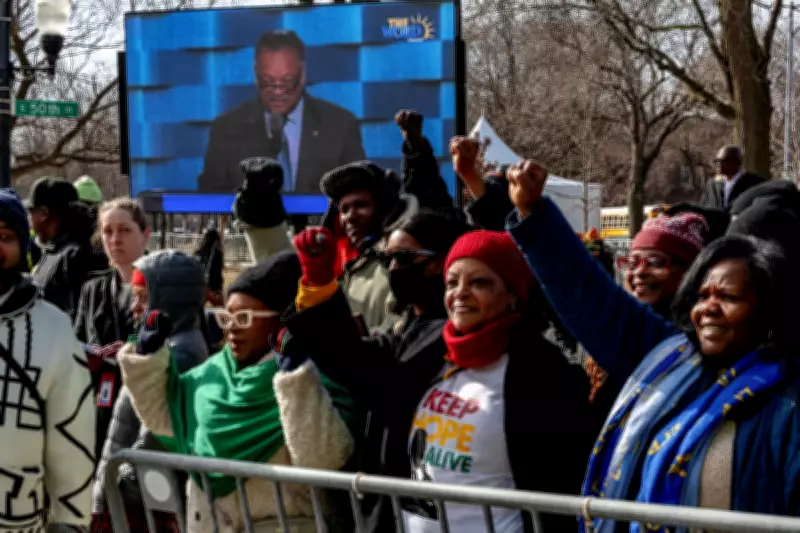
On a mercifully mild late February day in Chicago, thousands of people from all walks of life lined up down city blocks for a final chance to pay their respects to civil rights leader Jesse Jackson. The iconic activist, who died on February 17, 2026, at age 84, lay in repose at the headquarters of his Rainbow/Push Coalition political activism organization on February 26, marking the last day of public visitation in his hometown.
A Diverse Crowd United in Remembrance
The gathering represented a cross-section of Chicago society—older generations who witnessed Jackson's work firsthand, younger people inspired by his legacy, and even strangers drawn by his monumental impact. Among them stood Marva Watts, 85, a retired college professor from Chicago's South Side whose late husband, Reverend William "Bill" Watts, had worked closely with Jackson for many years.
"I came in memory of my husband and in recognition of all the work Reverend Jackson and his organization have done for our people and our country," Watts told reporters under partly sunny skies with unseasonably warm temperatures following a recent deep freeze. "I remember even some sermons my husband preached with that theme of 'I am somebody' and 'keep hope alive'—always reminding us of Reverend Jackson."
From Chance Encounter to Lasting Inspiration
Seventeen-year-old Ethan Davis, a high school student from Chicago's west suburbs, recalled a chance meeting with Jackson at O'Hare Airport in 2017 when he was just a child. "My mother explained that this man was very important—he worked with Martin Luther King Jr. and was a crucial figure in the civil rights movement," Davis remembered. "He had a radiating aura about him. When he walked toward us to ask how we were doing, it felt like a guardian angel approaching."
Davis described shaking Jackson's hand and thanking him for his service protecting human rights in America, an encounter that left a profound impression on the young man. "Even as a boy who didn't fully understand everything, I could feel a large presence from him," he said.
Final Journey and Lasting Legacy
Jackson's body began its final journey on Saturday, traveling by road from Chicago near Lake Michigan to his birth state of South Carolina, where he would lie in repose at the state capitol in Columbia ahead of funeral services on Monday. The civil rights leader had only retired in 2023 from the Rainbow/Push Coalition—a merger of two non-profit organizations he founded to focus on civil rights and political activism—stepping aside due to ill health after more than six decades in national and international racial and social justice movements.
Outside the visitation site, stallholders sold commemorative T-shirts, pan-African flags, and art prints, while a pop-up screen played Jackson's most famous speeches on repeat, particularly his memorable 1988 Democratic convention address where he urged Americans suffering inequality to "keep hope alive!"
Personal Stories of Impact and Influence
Kenneth LeDale, 40, a military veteran from Chicago's South Side, reflected on Jackson's legacy: "Jesse Jackson has done so much for us as a people, and even more so for me personally as a young Black man. I'm so fortunate to never know the battles that I never had to fight personally because they did it for me—the fight for desegregation and knowing that I can't even fathom a world where I can't just walk in and sit down and eat or drink at a water fountain."
Diallo Ismail, 60, a Chicago business owner who first learned about Jackson while living in Guinea, West Africa, described him as a "worldwide icon" who fought for freedom for everyone. "We're gonna miss him," Ismail said simply.
From Classroom Encounter to Life-Changing Mentor
Adele Stichel, 36, a lawyer and former Democratic congressional candidate from Virginia, first met Jackson when he visited her class at the University of Chicago. "I had this understanding of him that I think was really shaped by a pretty inaccurate sense that he'd be loud or radical," Stichel recalled. "But he was actually really soft-spoken, and he had all these thoughts about policy."
Intrigued by his ideas, Stichel began volunteering at Rainbow/Push, eventually working there as an assistant. "Then he officiated my wedding," she revealed. "I think about him all the time. I quit my job working for a big firm recently and I ran for Congress in large part because of working for the reverend."
Stichel remembered Jackson as "incredibly kind," noting that while people knew he was brilliant and impactful, "he was also just a really kind person."
As Chicago said goodbye to one of its most influential native sons, the diverse crowd of mourners reflected the broad reach of Jackson's work—from local community organizing to international civil rights advocacy, leaving behind a legacy that continues to inspire generations across racial, geographic, and political boundaries.