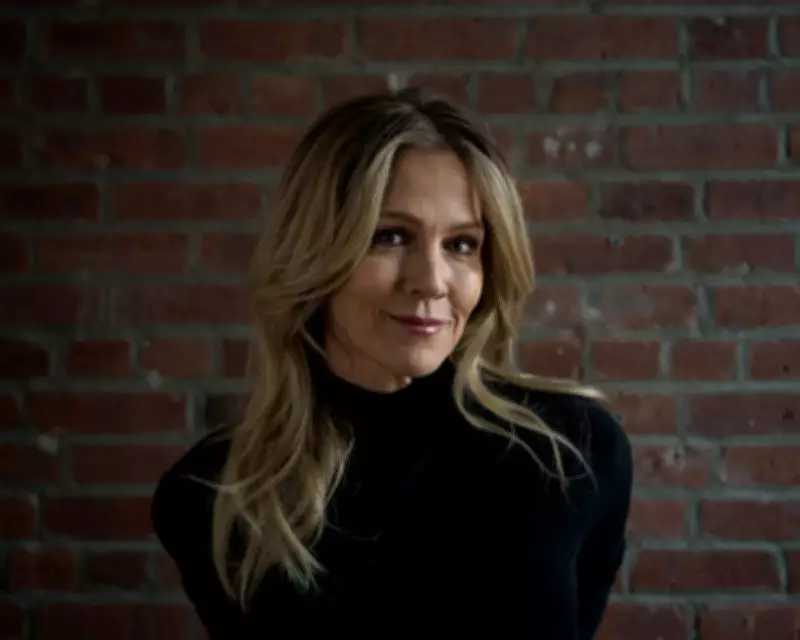
A few years ago, Jennie Garth was feeling lost. Her three daughters were growing up, with the eldest having already left home, and Garth was bored and unfulfilled. In March 2023, she noted in her diary that potential acting jobs were “few and far between, if at all really.” She rarely heard from her agent and didn’t want to reach out “just to hear how different the business has become, how they just aren’t looking for a woman my age, with my stereotyped abilities.” As an actor who had been particularly typecast, she was used to rejection, “but this is getting a little scary.”
From Teen Star to Midlife Crossroads
In the 1990s, Garth was a TV superstar. She was 18 when the teen drama Beverly Hills, 90210 premiered, in which she played Kelly Taylor—rich and spoiled on the surface, traumatized underneath. Although she continued to work after the show ended in 2000, including on spin-offs, hitting a career high in her first job was challenging. More fulfillment came from motherhood, though the end of her marriage to actor Peter Facinelli was so traumatic that it led to an accidental overdose and a stint in rehab.
Approaching 50, Garth had a vantage point on her life and experienced that classic midlife thought: is this it? “I was feeling stuck and I thought, how am I going to get out of this?” she says. “What do I do next, and how will I know what I’m meant to do?” A new sense of urgency also emerged. Her 90210 co-star and first love, Luke Perry, died in 2019, and Shannen Doherty, another co-star, was diagnosed with breast cancer and passed away in 2024. “There’s that sense of mortality. Having it happen around me made me feel like it was time to do what I know I’m here to do,” says Garth.

Turning Pain into Purpose
After extensive therapy and reading many self-help books, Garth realized that her purpose might lie in sharing what she learned with other women facing similar standstills. She launched a podcast and now a book—part memoir, part self-help—both titled I Choose Me. The title references an iconic line from 90210 where Kelly, faced with choosing between two hunks, declares a third option: “Me.” Though the show didn’t fully deliver on that feminist awakening, Garth embraces the message now.
Garth grew up on a farm in Illinois, the youngest of seven, with parents who were both teachers and built their own house on eight hectares of land. Her childhood involved animals and biking in the woods. “I didn’t know this world whatsoever when I entered into it,” she says of Hollywood. “That was like a crash course in survival, just seeing what was going on around me and trying to keep speed with that, but also be discerning about whether I wanted to be involved in certain things.”
The Toll of Early Fame
Beverly Hills, 90210 was the first massive teen drama hit and influenced every one that followed. It made its stars, including Doherty, Perry, and Jason Priestley, hugely famous. What does that do to someone that age? “It really does screw with your mind,” says Garth, now 54. “I felt like I spent a good 20 years of my life, the 10 of the show and the 10 after, just trying to keep my head above water.” She avoided the worst effects—partying, wild times—by spending most weekends at the ranch she bought two hours north of LA, where her parents moved.
But the experience of spending her formative years on a TV show was a weird way to grow up. “I felt, developmentally, I was held back from the realities of the world,” she says. “Even though I was trying to have normal relationships and a normal life, I didn’t know how.” She watched others leave school and go to college—slow steps toward independence. “Whereas I was slammed into it at 18. I think famous people really don’t realize the effect it has on them, because that becomes normal to them, but once you get to the other side, and maybe slow down a little, you realize: ‘My young adulthood was not normal.’ And then you start to ask questions: is what I didn’t, or did, learn what caused those bumps in my life, five, 10 years later?”
It has felt like catching up, she says. “I finally feel like I am my age now, as far as my ability to handle whatever comes my way, to not be so affected by everything.”

Sexism and Competition in Hollywood
As a young actor, Garth wasn’t ever “in a position of grave concern,” but the sexism was unavoidable. “Girls my age on every set in the 90s were exposed to far more than they should—more sexualization, more discrimination.” What did that look like? “Boys being treated a different way than the girls on the show, different salaries. There were no expectations on the boys to be in a bathing suit, or look a certain way or always be perfect.” Had she spoken up, she says, “I can imagine I would have been labeled as something. Those weren’t conversations that women were having yet, standing up for themselves and using their voice when they needed to.”
There were unspoken expectations. “If you wanted this job, you had to look a certain way, you had to maintain what was deemed sexy or cute or beautiful to whoever the men were that were hiring us,” Garth says. She would starve herself or take diet pills, and at 24, she had a breast enhancement. As a mother of young women now, she says, “I think, ‘Oh my God no, you absolutely are not getting a boob job at 24,’ like, let’s talk about why you want it, dig into those feelings of inadequacy, and explore it more.”
The pressure, she says, became all about competition. “You have to fight to get the prize—and a lot of times back then, the prize was attention from men, acceptance from men and a job from men.” This affected her ability to form female friendships. The show and media pitted Garth and Doherty’s characters against each other, blurring into real-life drama. “In me, it affected that need to fight harder. I think any two women in that position could probably share the same story back then, when there were no conversations about sisterhood. Really sitting down and talking to each other, like, ‘Can you believe all this BS? I like you, you like me. It’s so weird that it’s changing our relationship, but let’s not let that happen.’ But we were just young, and we didn’t have those words.” Later, they did become friends, “outside of all that ridiculousness.”
Feeling Like an Outsider
Garth has worked steadily—four years on the sitcom What I Like About You, TV movies, a reality show, and several 90210 spin-offs—but she writes about feeling like an outsider in Hollywood despite her early success. “We were so beloved by our audience, but in the industry we were kind of overlooked. I think there was some incredible work done by many of the actors, heavy storylines, but I think we fell into a sort of Aaron Spelling-night-time-soapy category and I don’t think people within the industry were that open for us to grow into what could be next. It’s kept me feeling like there’s Hollywood and then there’s my career.”
Then Garth switches into self-coaching mode. “But I can see feeling separate is probably just my feelings.” At industry events, she says, “I have to actually remind myself, ‘I deserve to be here. I am just like that person and that person, and this is my industry, these are my peers.’ I have to really talk myself into feeling comfortable.” But she’s also reached a point where she wants to be more choosy. “I think a lot of [career success] comes down to opportunities for the right projects that will carry you into something next. That’s why I’ve really put the brakes on doing acting that doesn’t feel like it’s going to take me somewhere.”
Garth recently talked on her podcast about auditioning for White Lotus, exactly the kind of show that takes its cast onward and upward. How does she deal with seeing others’ successes? “It’s not easy,” she says. “You fall into that compare/despair mentality.” She smiles. “I can dip right back into it at any moment. My brain is hardwired to feel, ‘Why didn’t I get that role? I must not be good enough.’ I think that’s universal for a lot of humans out there, whether it’s a job they didn’t get, or relationship that didn’t work out, a multitude of things. We believe those negative messages in our brains, and I’ve had to learn how to untangle them, acknowledge that they’re there, but I have to control them, because nobody else is going to.”
Lessons from Life’s Low Points
Garth shares many lessons—on gaining validation from within, dealing with uncertainty, overthinking, and impostor syndrome—in her book. They’re not necessarily revelatory, but framed in her warm way, they’re good reminders. It’s helpful to see that it’s never too late; her 50s, she decided, were a time not to slow down but to speed up.
Life looks very different now from 2012, when her 11-year marriage to Facinelli ended. On the day she ended up in hospital having her stomach pumped, she and Facinelli had been seeing a couples therapist—she thought they were there to save their marriage, but soon concluded he was there to end it. She walked out, checked into her hotel room, raided the minibar, swallowed anxiety pills, then made a worrying phone call to a friend. Her assistant flew out, gained access to her room, and found Garth unconscious on the floor.
After discharge, Garth entered rehab (she had been self-medicating with alcohol for months), then did several weeks of intense therapy. “I wasn’t at a place in my life where I had the kind of mind control that I do now, or the kind of knowledge of how to survive deep pain like that, so I made some unhealthy decisions and things I regret.” For years, she felt ashamed—especially of how it affected her daughters—but not now. “I don’t carry that shame around. And also, nobody’s looking at me and shaming me, not my children, not my husband, not my friends, and that’s all that really matters to me. You have to forgive yourself and realize that we all make mistakes, we all have to learn the tough lessons one way or another.”
It took Garth almost a decade to fully recover. She laughs now. “Like, when is this going to go away? It would affect all the parts of my life, these feelings of being unwanted or having not been enough for someone, or feelings of failure—I’ve failed my children, I’ve ruined their lives.” She describes her decision to let go of hurt and anger as like flicking a switch. “I just reached a point where I thought: I don’t want to live my life like this.”
Life got better, though not in a fairytale way. She met her third husband, actor David Abrams, and they seem happy, although they separated for a year early on amid the pain of failed IVF and miscarriages. During that time, she did more therapy, took trips, embraced Buddhism. “I was on a bender to find happiness and joy within myself, and so everything I could read, everything I could do, all kinds of different therapies. Healers, even though that sounds crazy, just trying it and not expecting anything, but seeing what that opened up in me.” She laughs. It has brought her to some strange places. This sounds, she acknowledges, “very LA woo-woo, but I believe in angels. I really do believe that there are spirits or energies that are guiding us and supporting us.”
Even just saying it out loud is part of no longer caring what others think, she says. “This is my life. I’m going to believe what I want to believe in. It’s working for me.” The benefit of being older, she says, is that “you lose that need to be liked, that need to please people around you all the time, and there’s something so freeing in that.” She remembers a low point when her sister, trying to psych her up, told her, “You’re Jennie fucking Garth!” She laughs. “I was, like, oh God, don’t say that. It felt like a weird fame thing, but I say that to [non-famous] people now, just to remind them you are who you are, with so much beauty and power and uniqueness in that.”
I Choose Me by Jennie Garth (Park Row Books, £25) is out on 21 May.