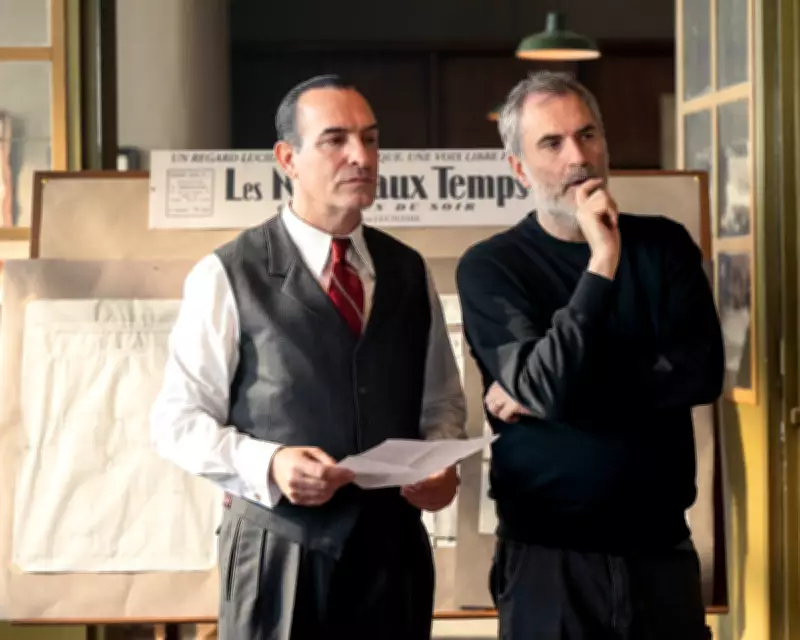
French Director Defends Nazi Collaboration Film Amid 'Historical Gaslighting' Accusations
The director of a controversial French film about Nazi collaboration has angrily rejected accusations of historical whitewashing, describing criticism as "profoundly dishonest" and "a scandal." Xavier Giannoli's Les Rayons et les Ombres (Rays and Shadows) has ignited fierce debate among historians and critics since its March release, with some accusing it of downplaying wartime atrocities.
Film Sparks Historical and Political Controversy
The film recounts the story of Jean Luchaire, a pacifist journalist who became a Nazi collaborator during France's Occupation, serving as commissioner for information and propaganda in the Vichy regime. Luchaire was executed for treason in 1946 after his newspaper Les Nouveaux Temps disseminated Nazi propaganda calling for resistance extermination.
"My point of view is to tell the story of a collaborator in his world," Giannoli told French program Quotidien. "The disgusting obscenity of people who were partying under chandeliers eating caviar and petit fours during the Occupation."

The director expressed surprise at the political dimensions the debate has taken, noting polarization along contemporary political lines. He suggested the rise of the National Rally party may have influenced some reactions to the film.
Critics Accuse Film of Moral Ambiguity
Historians and film critics have launched scathing attacks on the production, with some describing it as "a masterclass in historical gaslighting." Critics argue the film:
- Downplays the role of French resistance fighters
- Minimizes the fate of Parisian Jews rounded up for Nazi death camps
- Encourages viewers to empathize with collaborators
- Takes excessive liberties with historical accuracy
Historian Bénédicte Vergez-Chaignon wrote in Le Monde: "The list of 'licences' taken with the historical truth – some of which are quite egregious – is endless. The banality of saying that a character is never entirely good or entirely bad does not justify forcing compassion upon the viewer."
Director and Star Defend Artistic Approach
Giannoli insisted he worked extensively with historians specializing in the period to develop the screenplay, though he emphasized: "A screenplay is not a historical thesis. It's not a documentary."
The film is narrated from the perspective of Luchaire's daughter Corinne, played by Nastya Golubeva, who was also a collaborator jailed after the war for "national indignity."
Oscar-winning actor Jean Dujardin, who stars in the film, supported Giannoli's position: "Dictators are not always monsters or fire-breathers. Great dictators were human and sympathetic in the beginning." He described Luchaire as "a paradox" – a leftwing humanist whose pacifism became extreme.
Box Office Success Despite Controversy
Despite the controversy and its three-hour runtime limiting daily screenings, the film has attracted over 800,000 French cinemagoers since its mid-March release. The commercial success has surprised industry observers given the challenging subject matter and extended duration.
Giannoli maintained the film doesn't attempt to absolve collaborators: "Vichy was moral chaos. The extreme right was at the heart of it, but some leftwing people collaborated and some pacifists. These people want to say the left didn't collaborate … but history is complex, as the film shows."
The director concluded that even today, discussing wartime collaboration remains difficult in France, suggesting his film's controversy reflects ongoing national tensions about this painful historical period.