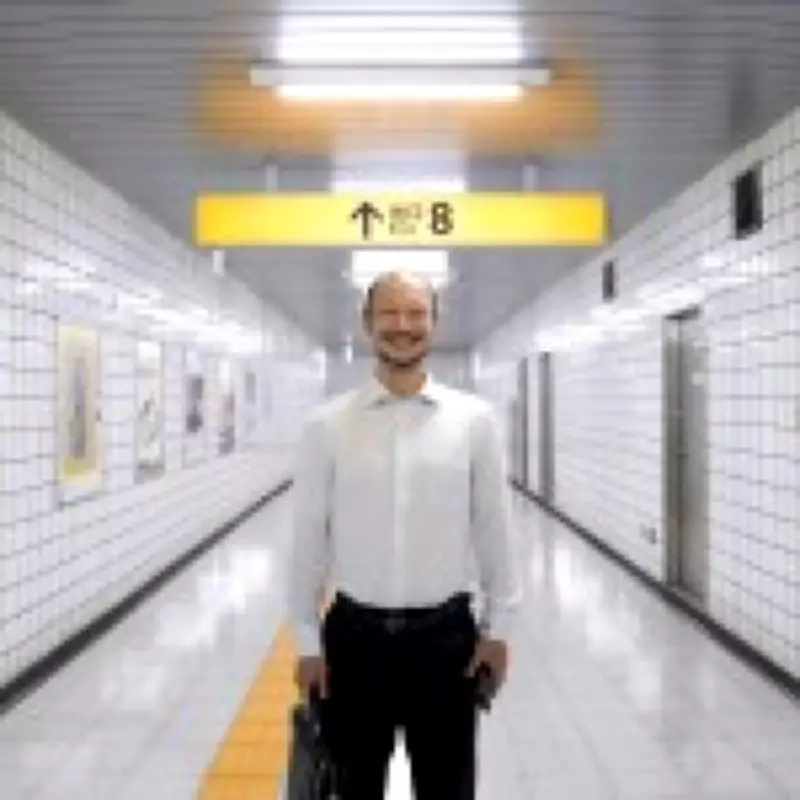
An adaptation of a globally successful video game that premiered at the Cannes Film Festival last May has finally arrived in UK cinemas, and it might just be the most profound horror film of 2026. True genre enthusiasts understand that horror encompasses a wide range of film categories, including drama, comedy, and even romance. However, Exit 8, directed and co-written by Genki Kawamura and based on Kotake Create's 2023 walking simulator game, offers layers of meaning that surpass even the typical multi-faceted horror film.
Already a hit in Japan, the film's premise appears deceptively simple yet deeply unsettling. We follow the Lost Man, played by Kazunari Ninomiya from Letters from Iwo Jima, who is trapped in an endless, sterile subway corridor searching for Exit 8. There is one golden rule: he must not overlook anything out of the ordinary. If he spots an anomaly, he must turn back immediately. If not, he can proceed. But the smallest mistake will reset his progress and send him back to Exit 0.
The Divine Exit Sign
For Kawamura, the Exit 8 sign holds immense power, even shifting the film's visual style from a subjective 'gameplay vibe' to objective camera work when the Lost Man first enters the corridor after stepping off the train. 'The Exit 8 signage is like a divine entity, kind of like Hal from 2001: A Space Odyssey,' the director explained to Metro during an interview at Cannes. 'Suddenly the human is seen by God, and that's why it changes to objective camera cinematography.'

Purgatory and Guilt
The film goes even deeper, drawing inspiration from Dante's Divine Comedy. Kawamura views the subway loop as a representation of purgatory, where a person must confront their sins. 'So your guilt turns inside out, and it manifests as an anomaly – and it also attacks you. And that's a slightly video game and animation type of experience, but I think I was able to bring more artistic and literary elements to it.'
This is only the beginning of Exit 8's hidden meanings. Each anomaly, from a flood of red water to deformed rodents and banging doors, connects to larger themes within the film. One anomaly is even hinted at through the Lost Man's browsing history on his phone.
The Sin of Indifference
Kawamura notes that human beings can be brutal. 'On social media we encounter unpleasant things, but we go, "Oh, that's gross," and then we just click away and pretend we haven't seen it,' he says, pointing out how detached the protagonist is during his initial subway ride. 'Same with the man we see raising his voice towards the mother and the child. You know what's happening, but you pretend that you haven't seen it. So those human qualities are kind of amped up more grotesquely – and that is what is attacking the protagonist as an anomaly.'
The filmmaker, known for Netflix's The Makana and animated hits Your Name and Suzume, was eager to address 'the sin of indifference' in Exit 8, which he calls 'a very contemporary' issue. 'It's our biggest sin right now, whoever our political leaders are, whether there's conflict in other countries, and even if there's a man that's raising their voice or animals are treated very cruelly.'
Daily Loops and Anomalies
Kawamura also believes that our daily lives, especially those involving the same commute to work, can feel like a loop, similar to the trap in Exit 8. 'But I think there's actually a lot of anomalies happening every day, so then the question becomes whether you can catch that? And if you do, that could lead to huge change, so that's one of the themes I wanted to include.'
Another key character is the Walking Man, played by Yamato Kochi, an NPC (non-player character) mobile object that the protagonist encounters. 'When you go on the tube, you see so many people looking at their smartphones. They look like NPC characters to me in a game, and I feel like I don't want to be one of them!' Kawamura insists, sharing how this influenced the character's development because NPCs 'are people as well.'

Inspirations and Creative Process
Kawamura's inspirations for Exit 8 and his defense of horror as a complex genre include Alfred Hitchcock's The Birds, Stanley Kubrick's The Shining, and Kenji Mizoguchi's Japanese 16th-century fantasy Ugetsu. All of these films 'touch on the loss of paternal love,' as does his own work.
The director also reveals that he worried his crew when he first gave them the screenplay, which consisted of only 15 scenes and minimal dialogue. He jokes, 'I would like to say to you that everything was calculated, but that would be a lie!' On the first day of filming, he gathered everyone and said, 'I think all of you probably are a little worried that you can't see what the film is going to be. But I told them, "Don't worry, because I don't know either!"' He laughs.
Building the Film Uniquely
His vision was to build the film on set and during the shooting and editing processes, inviting discussion. He compares this to the modular and minimal approach that Japanese brand Muji uses in its store displays. 'I feel the way we made the film, if that were unique, I thought the film itself will become unique.'
And of course, after watching Exit 8, you will never see your morning tube commute in the same way again. The film is now showing in UK and Irish cinemas.