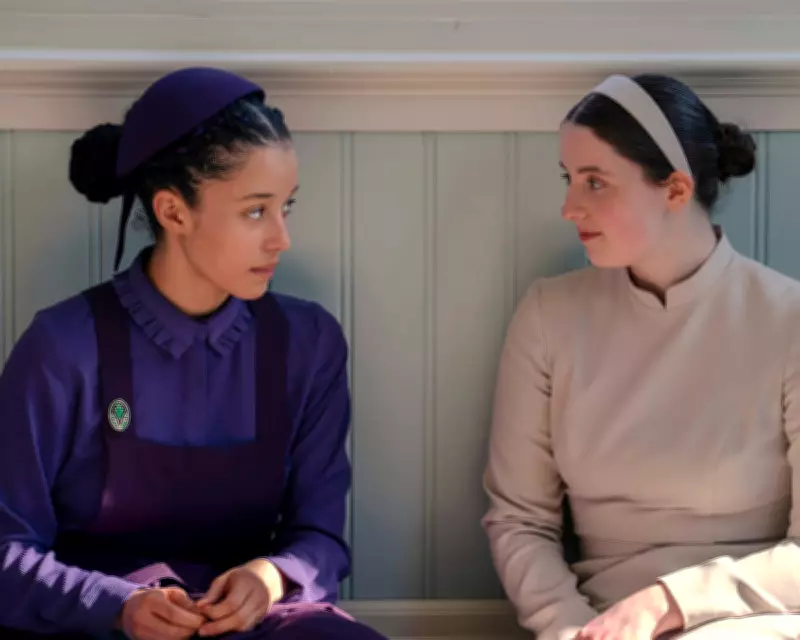
The adaptation of Margaret Atwood's prize-winning 2019 novel The Testaments has returned to television screens, presenting a bleak vision of America as a patriarchal theocracy. This series, the long-awaited sequel to The Handmaid's Tale, arrives alongside Paul Thomas Anderson's Oscar-sweeping film One Battle After Another, set in a militarized America that feels chillingly recognizable. Both works stand as grim parables for our times, yet they are not without hope.
The Unsettling Prescience of Dystopian Narratives
Margaret Atwood has famously stated that all dystopian fiction is "really about now," and the flourishing of this genre underscores its relevance. When Atwood wrote The Handmaid's Tale in 1984, she feared its premise—a U.S. transformed into the theocratic dictatorship of Gilead after a coup—might be too outrageous. However, by the time the TV adaptation debuted in 2017, following Donald Trump's election and the rollback of women's rights, it felt all too believable. Atwood was hailed as a prophet, with the handmaid robes becoming a global symbol of female defiance.
Echoes of Contemporary Scandals and Crises
The Testaments adaptation proves uncannily prescient once again. In the show, girls are groomed as "Plums" for powerful men, echoing the Epstein scandal. Scenes at female detention centers painfully recall the separation of mothers and children at the U.S.-Mexican border. Similarly, One Battle After Another, loosely based on Thomas Pynchon's 1990 novel Vineland, depicts migrant prisons and underground networks. Born from anxieties about repressive governments like Ronald Reagan's, it has been repurposed for Trump's creeping authoritarianism, featuring ICE-like crackdowns and secret Christian nationalist cells.

The Radiant Hope of Young Protagonists
Coincidentally, Chase Infiniti stars as the "lost daughter" in both One Battle After Another (as Willa) and The Testaments (as Agnes). These young women represent the radiant hope for the future. Beyond their political scaffolding, the heart of these stories lies in the all-conquering love of a parent for a child. They are narratives not only of resistance against tyrannical regimes but of humanity triumphing over brutality, highlighting the subversive power of storytelling.
A Wake-Up Call Against Complacency
Dystopian fiction serves as a crucial warning and wake-up call. As paraphrased from June, the protagonist in The Handmaid's Tale TV version, it urges us to look up from our phones before it is too late. By exploring worst-case scenarios, these stories invite us to imagine the best, offering a form of optimism. George Orwell noted in 1943 that humans often describe happiness in terms of contrast. These works remind us to fight battles against complacency, bigotry, and self-interest, steering toward a better world.