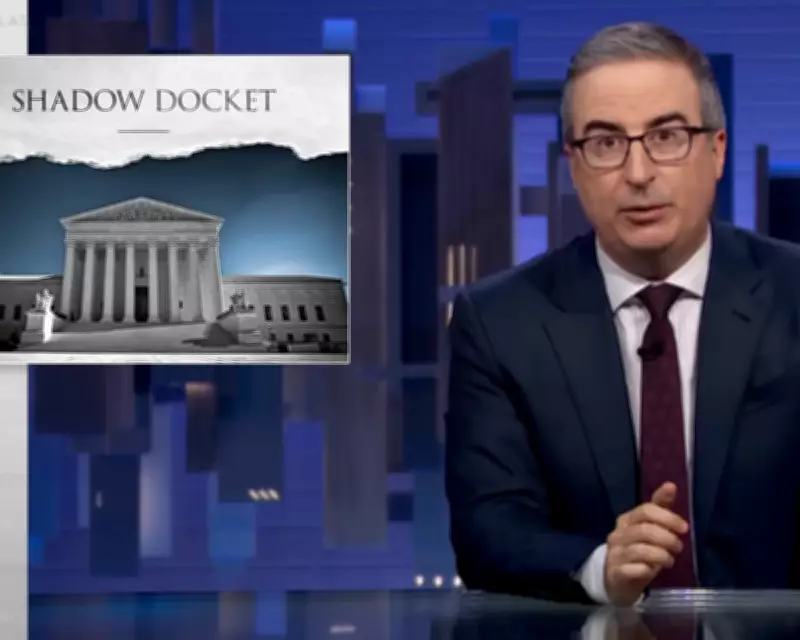
In a recent episode of his HBO show, John Oliver turned his attention to a controversial legal tactic employed by former President Donald Trump: the use of the Supreme Court's shadow docket. The segment, which aired on May 10, 2026, highlighted how Trump's legal team has increasingly relied on emergency applications and unsigned orders to achieve swift judicial outcomes without full briefing or oral argument.
What is the Shadow Docket?
The shadow docket refers to the Supreme Court's practice of issuing orders and decisions without the usual transparency and deliberation. These include emergency stays, injunctions, and summary reversals, often decided without public explanation or recorded votes. Oliver explained that while the shadow docket has existed for decades, its use has surged under Trump, particularly in cases involving immigration, executive power, and election disputes.
Oliver's Critique
Oliver argued that the shadow docket undermines the Court's legitimacy by allowing significant legal changes to occur without proper scrutiny. He pointed to examples such as the Trump administration's attempt to end the Deferred Action for Childhood Arrivals (DACA) program and its efforts to restrict asylum seekers. In these cases, the Court issued brief orders that effectively changed national policy, leaving lower courts and the public without clear reasoning.
The comedian also criticized the conservative majority on the Court for what he described as a willingness to expedite Trump's agenda. He noted that Justice Neil Gorsuch, a Trump appointee, has been particularly active in shadow docket rulings. Oliver's segment included clips of legal experts expressing concern that the shadow docket could set dangerous precedents by allowing the Court to act as a rubber stamp for executive actions.
Impact on Legal Precedent
Legal scholars have warned that the shadow docket's lack of transparency could erode the principle of stare decisis, as these rulings often lack the thorough analysis needed to guide future cases. Oliver highlighted a study showing that shadow docket orders are rarely cited in subsequent decisions, suggesting they have limited legal weight but still carry immediate consequences.
Public Reaction
The segment sparked widespread discussion on social media, with many viewers expressing alarm at the implications for democratic processes. Oliver's characteristic blend of humor and outrage resonated with audiences, as he called for greater accountability and reform. He urged viewers to pay attention to the Court's less visible operations, emphasizing that the shadow docket is not a partisan issue but a structural concern.
In conclusion, Oliver's deep dive into the shadow docket serves as a wake-up call about the evolving nature of the Supreme Court and the potential for executive overreach. As the 2026 midterm elections approach, the issue may become a focal point for debates on judicial transparency and the balance of power.