Rembrandt's Lost Masterpiece Rediscovered in UK Collection, Expert Claims
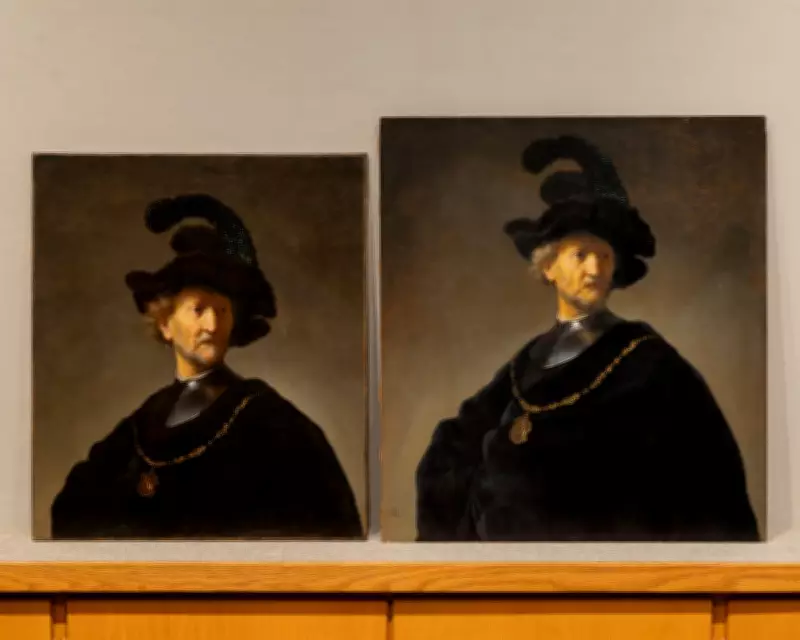
A portrait in a United Kingdom collection, previously dismissed as a mere workshop copy of a renowned Rembrandt painting, has been definitively attributed to the 17th-century Dutch master himself by a leading scholar. This groundbreaking revelation reunites two nearly identical artworks, titled Old Man with a Gold Chain, for the first time in almost four centuries at the Art Institute of Chicago.
Reuniting Twin Portraits After Centuries
The Art Institute of Chicago owns the undisputed version of the portrait, painted on panel, while the slightly smaller canvas version is on loan from Sir Francis Newman, a Cambridge-based entrepreneur. For years, the Newman painting was labeled as a copy by an artist in Rembrandt's workshop, but Rembrandt scholar Gary Schwartz has concluded that both works are authentic creations by the master.
Schwartz emphasized the exceptional quality of the brushwork and noted that many Dutch artists of the period frequently created replicas of their own paintings. He referenced a 1699 observation by a French contemporary of Rembrandt, who stated, "There is hardly any painter [in the Netherlands] who did not repeat one of his works because he liked it, or because someone asked him to make one exactly the same."
Historical Context and Expert Analysis
The contested version was purchased by Sir Francis Newman's great-grandfather as a genuine Rembrandt in 1898 from the London gallery Agnews for a substantial sum. However, when the other painting surfaced in 1912, noted German art historian Wilhelm Bode dismissed the Newman version as "a clever reproduction," offering little substantive reasoning for his claim, according to Schwartz.
Schwartz argued that if Rembrandt had a customer requesting a replica, it would be more logical for the master to recreate it himself rather than assign it to a pupil. "This assumption accounts for the outstanding quality of the canvas," he explained. Technical analyses support this view. X-ray and infrared imaging of the Chicago picture revealed underdrawing with adjustments to the man's costume, which were absent in the canvas version, suggesting a precise, error-free execution typical of Rembrandt.
Scientific Evidence and Ongoing Debate
A study by the Hamilton Kerr Institute at the University of Cambridge found that the UK version's canvas and color pigments match those used by Rembrandt and his studio. It also identified the same oil-bound, double-ground layer present in eight Rembrandt paintings from 1632 and 1633.
Despite these findings, the Art Institute of Chicago maintains that differences in the two works, such as variations in eyelash techniques—tiny brushstrokes in the UK painting versus scratched-through dark paint in the Chicago version—indicate the UK version is a workshop reproduction. However, they acknowledge that "the conversation about the purpose and authorship of these copies continues to evolve."
Owner's Perspective and Future Implications
Sir Francis Newman expressed mixed feelings about the attribution. "My view is it's always been a mystery. I've enjoyed the mystery because it meant I could enjoy it on the wall ... and not have the responsibility of its potential importance," he said. If confirmed as a Rembrandt, Newman intends to donate the painting to a museum, ensuring its preservation and public access.
This discovery challenges long-held art historical assumptions and opens new avenues for re-evaluating other disputed works. As Schwartz noted, "It opens up all sorts of possibilities for looking again at many paintings." The reunion in Chicago marks a pivotal moment in the ongoing study of Rembrandt's oeuvre, highlighting the dynamic nature of art authentication and scholarship.