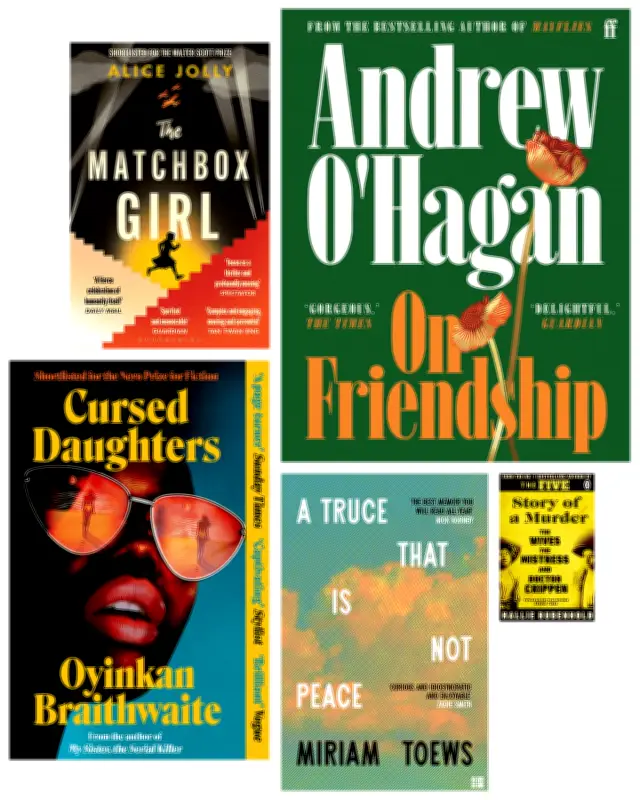
July brings a wealth of new paperbacks, from gripping fiction to insightful memoirs. Highlights include Oyinkan Braithwaite's Cursed Daughters, a follow-up to her hit debut My Sister, the Serial Killer, and Rebecca Wait's Havoc, a macabre tale set in a decaying girls' school. Andrew O'Hagan's On Friendship offers a memoir of relationships, while Miriam Toews' A Truce That Is Not Peace meditates on writing and loss.
Fiction: Cursed Daughters by Oyinkan Braithwaite
Nigerian-British novelist Oyinkan Braithwaite's second novel, Cursed Daughters, swaps true crime for atmospheric spookiness. The Falodun family shares tales of heartbroken women across generations, including Fikayo, whose husband left after her chronic illness; Afoke, who seduced her younger sister's boyfriend; and Feranmi, the matriarch, who got pregnant by a married man and received a curse from his first wife. The curse hovers over main characters Monife, Ebun, and Eniiyi as they grow up and attempt to defy supernatural forces. According to Chelsea Leu, the novel shares a fascination with dark secrets that bind women together.
Fiction: Pan by Michael Clune
American nonfiction author Michael Clune's debut novel, Pan, follows 15-year-old Nicholas, who lives in a cheap housing development inspiring existential terror. When the god Pan possesses him, Nicholas interprets his disabling anxiety as black magic. His friends, also 15, are easy prey for Ian, a college-age man who sets up a small-time cult involving sex, drugs, and animal sacrifice. Sandra Newman notes the novel offers not answers but visions, not growth but revelation, ending without a cure but leaving readers in a larger world.
Fiction: Among Friends by Hal Ebbott
Hal Ebbott's debut novel Among Friends explores the friendship between Amos and Emerson, who met in college and bonded despite surface differences. On Emerson's 52nd birthday weekend, something happens that changes everything, raising questions about whether we can ever truly know anyone. Christopher Shrimpton describes it as a bracingly honest depiction of abuse, family dynamics, and self-deceit, sharply observed and psychologically astute.
Fiction: The Matchbox Girl by Alice Jolly
In The Matchbox Girl, narrator Adelheid Brunner is brought to a children's hospital by her grandmother, unable to cope with her fixations on matchboxes. There, she becomes the object of study by Dr Hans Asperger, whose research in 1930s Vienna laid groundwork for understanding autism. Adelheid learns to present herself to thrive, eventually leaving the hospital and returning as a ward assistant during WWII. Natasha Walter notes the synergy with Naomi Klein's Doppelganger, both exploring what makes us human and destroys that humanity.
Fiction: Female, Nude by Rhiannon Lucy Cosslett
Rhiannon Lucy Cosslett's second novel, Female, Nude, is set in summer 2019 on an idyllic Cyclades island. Sophie Evans, working in a museum shop and trying to make her way as an artist, is commissioned to paint a nude portrait by friend Alessia. When beautiful waiter Ky appears, simmering rivalries turn toxic. Christobel Kent praises the sensual detail and serious-minded interrogation of art, calling it energetic and ambitious.
Fiction: Everything Will Swallow You by Tom Cox
Tom Cox's Everything Will Swallow You features depressed nature writer Billy Stackpole, who wishes for a big sloppy cardigan. Listening in incognito is Carl, a magical sea creature with 24 fingers who can pass for a large brown dog, speaks six languages, and knits. Carl is half of an odd couple with record dealer Eric. Toby Litt calls it a materially hopeful state-of-England novel, noting social fabric may fray but we remain warm and woolly.
Fiction: Havoc by Rebecca Wait
Rebecca Wait's Havoc is set in 1984 at St Anne's, a decaying girls' school in Eastbourne. When Ida Campbell arrives with a full scholarship and baggage, she hopes for salvation but finds the school not the refuge she expected. Christobel Kent notes echoes of St Trinian's and Ealing comedy, with an unsettling undertone edging towards Shirley Jackson territory. The novel features excellent pacing, deliciously thick plot, and bold darker threads.
Thriller: The Persian by David McCloskey
Former CIA analyst David McCloskey's fourth novel, The Persian, centres on Jewish Iranian dentist Kam Esfahani. Dissatisfied in Sweden, he accepts an offer from Mossad's Caesarea Division to return to Tehran and run a fake dental practice as cover for sowing chaos in Iran. He enlists double agent Roya Shabani, widow of a scientist killed by Israelis. The book takes the form of confessions Kam writes for his torturer. Laura Wilson calls it tragically topical and utterly gripping, with cynical tone and mordant humour.
Essays: On Friendship by Andrew O'Hagan
Andrew O'Hagan's On Friendship comprises eight essays reworked from a Radio 4 series. He recalls a lost childhood friend from 1970s North Ayrshire, former colleagues at the London Review of Books, and his adult daughter's imaginary friend. He considers why actors, politicians, and Republicans make bad friends, and how friendship is shaped by bereavement and the internet. The most intriguing item concerns the late Irish novelist Edna O'Brien, whom he met in 2009. Anthony Cummins notes the memoir leaves you wondering about the larger autobiography O'Hagan might write.
Memoir: A Truce That Is Not Peace by Miriam Toews
Miriam Toews' A Truce That Is Not Peace is a meditation on writing, suicide, guilt, and silence. Asked why she writes, Toews mentions teenage letters to her sister Marjorie, who suffered from depression and killed herself in 2010. Their deal was: "You live. And I'll write." Despite sadness, there's laughter in the family, including a picnic episode where their boat disappears and they laugh. Blake Morrison calls it a triumph, noting Toews' work is so intimate you worry you're intruding, but she welcomes you in.
True Crime: Story of a Murder by Hallie Rubenhold
Hallie Rubenhold's Story of a Murder recounts the 1910 case of Dr Crippen and his wife Belle Elmore. After Elmore disappeared, Crippen told friends she went to America and died of pneumonia. The discovery of a dismembered corpse under the cellar floor sparked an international murder case, called "the crime of the century." Anthony Quinn notes Rubenhold's indefatigable research, but the book cannot supply a convincing answer to why Crippen killed, often admitting to dead ends.
Biography: Gwyneth by Amy Odell
Amy Odell's Gwyneth: The Biography opens with the $66 jade egg sold by Goop, which promised health benefits upon insertion. The book offers insight into Paltrow's relationships, family, friendships, iconic films, and creation of Goop. Emma Brockes notes the difficulty: Paltrow is a charmless subject who never rises to monstrous, an OK actor and so-so businesswoman, leaving the question of why she was elevated in the first place.