Isaac Julien's Visionary Installation Transforms London's Cosmic House
Renowned video artist Isaac Julien has unleashed a spectacular new work at London's iconic Cosmic House, creating a bombastic and intellectually charged environment that challenges conventional notions of identity and human connection. The exhibition, titled "All That Changes You. Metamorphosis," represents Julien's continued exploration of visual poetry through film, this time within the extraordinary architectural context of one of London's most significant postmodern spaces.
The Cosmic House: An Architectural Marvel
The Cosmic House itself serves as more than just a venue—it becomes an integral character in Julien's narrative. Originally transformed beginning in 1978 by postmodern theorist Charles Jencks and garden designer Maggie Keswick, this Victorian townhouse was reimagined as a physical manifestation of cosmic order. Visitors encounter remarkable features including a "solar stair" with precisely 52 steps spiraling from a "black hole" foundation through four symbolically themed floors, while the kitchen cleverly remixes classical Indian architecture to create architectural puns about seasonal transitions.
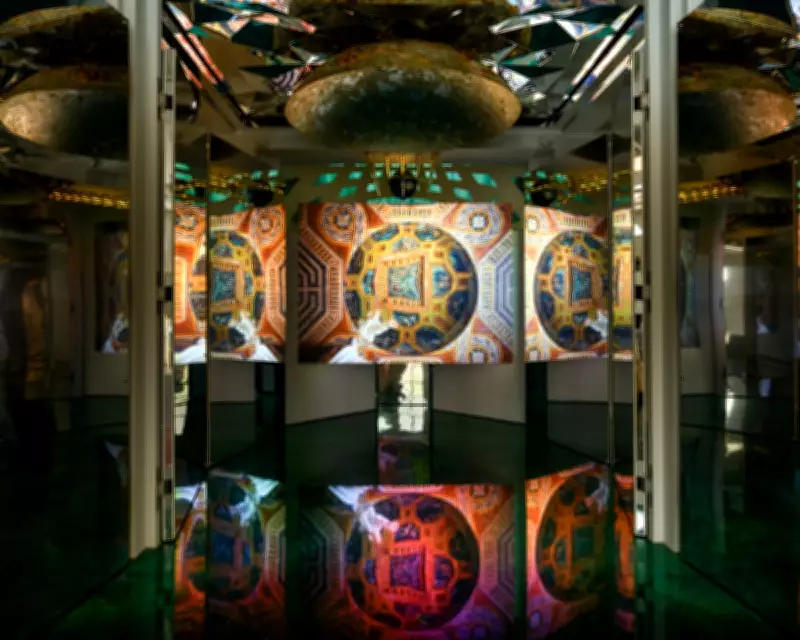
Within this intellectually charged environment, Julien's 25-minute film finds its perfect home in a basement space dedicated to sun worship. The installation features a single screen surrounded by a kaleidoscope of standing mirrors, creating an immersive experience that reflects both the film's content and the house's philosophical underpinnings.
A Cinematic Journey Through Time and Space
Julien's film presents Sheila Atim and Gwendoline Christie as science-fiction deities who traverse multiple environments including a Renaissance palazzo, a modernist glass residence, and the Cosmic House itself. Their meandering conversation touches on profound themes including the potential end of the world, the mechanics of time travel, and the fundamental nature of divinity.
The visual landscape proves equally ambitious, featuring unexpected encounters with cyborg starfish, gleaming spaceships, dramatic firestorms across the sun's surface, and bioluminescent sea creatures with neon tentacles. This visual excess creates what some might consider pretentious spectacle, but for those willing to engage with Julien's vision, it offers a gateway to deeper philosophical exploration.
Philosophical Foundations and Literary Influences
The film's intellectual framework draws significantly from Octavia E. Butler's seminal work "Parable of the Sower," which has gained renewed relevance among contemporary artists for its setting in a dystopian United States between 2024 and 2027. Butler's protagonist Lauren develops an idiosyncratic faith centered on the principle that "everything is changing, and because God is everything, then God must necessarily be change."
Julien translates this concept into visual poetry, exploring the interconnectedness of all existence through what might initially appear as esoteric imagery. The film navigates the delicate boundary between platitude and revelation, drawing promiscuous references from sources ranging from Ovid's "Metamorphoses" to contemporary ecofeminist philosophy.
Contextual Transformation and Revolutionary Implications
Interestingly, the work's reception shifts dramatically depending on its exhibition context. When presented last month as an immersive five-screen installation at Victoria Miro gallery, the film came across as aggressively bombastic. However, within the more domestic, intellectually charged environment of the Cosmic House—a space that celebrates magpie intellectualism and immoderate philosophizing—the work reveals subtler revolutionary dimensions.
In our current cultural moment, fixated on assigning individuals to rigid identity categories, Julien's film insists that no identity remains fixed. The goddesses in his narrative metamorphose into various forms including gamboling horses and hovering drones, symbolically crossing boundaries that separate humans from other species, people from each other, and different forms of intelligence.
Beyond Identity Politics: Embracing Difference
This represents a fascinating evolution for Julien, who first gained recognition for magnificent films charged with queer Black desire. His current work might initially appear as a manifesto against identity politics, but closer examination reveals a more nuanced position. The solidarity Julien advocates emerges from embracing difference rather than denying it, supported by what he terms "imaginative empathy."
As Lauren observes in Butler's novel regarding her apocalyptic survival group: "It was from the differences between us, not the affinities and likenesses, that love came." This love, Julien suggests through his visual narrative, prevents groups from internal conflict that leaves them vulnerable to external conquest or tyranny.
Contemporary Relevance and Philosophical Urgency
The film opens with philosopher Donna Haraway, whose presence underscores the work's contemporary urgency. Like Butler, Haraway argues that humanity cannot survive current disasters by building higher walls around increasingly smaller groups. Instead, we must "stay with the trouble," embrace inevitable change, and build new relationships across traditional boundaries.
Julien's ambitious work delivers a simple yet profound message through complex visual means: we cannot reverse time, circumstances will never return to previous states, and our survival depends on recognizing our fundamental interconnectedness. The exhibition continues at the Cosmic House through December 18, offering London audiences an opportunity to experience this challenging yet ultimately hopeful vision of human potential.