From Cave to Canvas: How Dogs Became Art's Most Profound Gaze
In the Ardèche region of France, Paleolithic artists created a spectacular bestiary on the walls of the Chauvet cave approximately thirty-five thousand years ago. Their focus centered on apex predators, featuring numerous lions alongside mammoths and woolly rhinoceroses. While dogs were conspicuously absent from these ancient depictions, the soft sediment on the limestone floor reveals something equally remarkable: canid pawprints positioned next to human footprints.
This discovery suggests that, about ten thousand years after the art was created, a boy and a dog likely stood together, gazing up at the walls in shared wonder. Here was a moment of mutual contemplation, possibly followed by a glance to observe each other's reactions. This profound connection between humans and canines forms the foundation of American cultural historian Thomas Laqueur's luminous new book, The Dog's Gaze.
The Boundary Between Nature and Culture
Laqueur argues that dogs were the first animals to live companionably with humans, marking what he identifies as the boundary between nature and culture. This threshold status has uniquely qualified dogs to play a rich, symbolic role throughout Western art history. Simply including dogs in a painting—whether snuffling for picnic crumbs in Seurat's La Grande Jatte or trooping home in Bruegel the Elder's Hunters in the Snow—allows artists to imbue their images with additional resonance and layered meaning.
From this compelling starting point, Laqueur takes readers on a beautifully illustrated journey through canine representation in art. The tour spans from the shitting cur in Rembrandt's etching The Good Samaritan to Jeff Koons' contemporary balloon dog, with a stop at cinema superstar Lassie along the way. However, Laqueur's special interest lies in those artistic moments where dogs are actively engaged in looking.
Two Scenarios of Canine Observation
Laqueur identifies two primary scenarios in art where dogs perform this observational function. Either the dog peers deeper into the scene as if attempting to decipher what is occurring, or it turns to look directly at the viewer, seemingly asking "are you seeing this?" or even "can you believe it?" This canine gaze serves as a powerful narrative device that bridges the gap between artwork and audience.
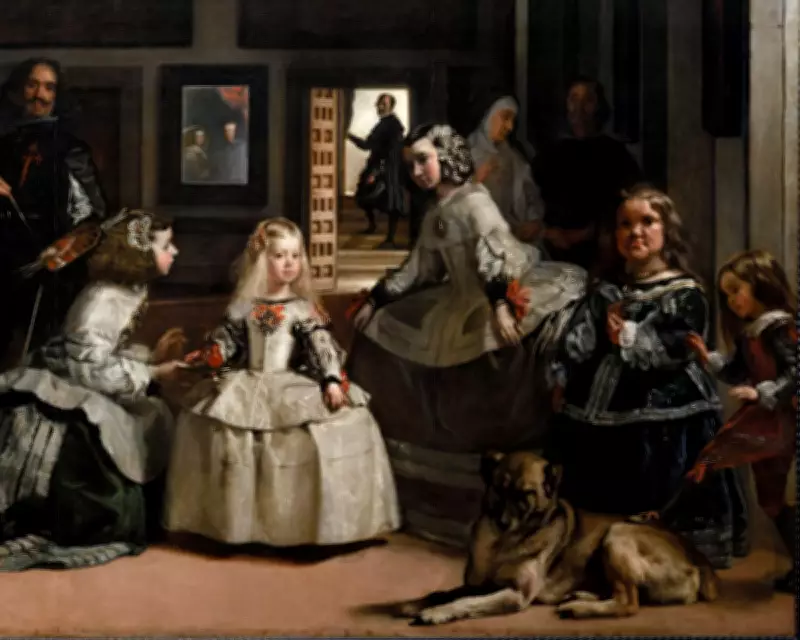
A prime example appears in Diego Velázquez's masterpiece Las Meninas, set at the bustling Madrid court of Philip IV. In the bottom right-hand corner, a sleepy mastiff provides compositional grounding amid the surrounding kerfuffle. Ladies-in-waiting fuss with the Infanta's dress, the court chamberlain hovers in an open doorway, the king and queen appear in a mirror reflection, and Velázquez even paints himself into the scene.
The mastiff's droopy-eyed glance out of the frame toward the viewer is both matter-of-fact and just the right side of cynical. It seems to communicate: "Don't worry about all the tricks of perspective unfolding above my head—you and I know which way is up." Remarkably, in the extensive scholarly commentary that has surrounded Las Meninas over the past 350 years, this mastiff has rarely received proper attention.
Picasso's Canine Reinterpretation
One artist who did notice the mastiff was Pablo Picasso. In 1957, he produced a series of paintings riffing on Velázquez's masterpiece. In fifteen of these works, the Spanish mastiff has been replaced by Picasso's beloved dachshund, Lump. This faintly ludicrous canine romps through Picasso's Cubist universe, consistently looking out of the frame with what Laqueur describes as a "brazen" gaze.
Lump's expression seems to challenge viewers to make sense of scenes that don't even pretend to offer stable meaning. Through this substitution, Picasso highlights how dogs in art can serve as viewers' alter egos—creatures who navigate complex visual worlds alongside human observers.
The Dog as Viewer's Entry Point
By the conclusion of this clever and beautiful book, Laqueur persuasively demonstrates that dogs in Western art frequently function as entry points or alter egos for viewers who might otherwise feel overwhelmed or outclassed by grand artistic scenes. Consider Veronese's spectacular The Wedding Feast at Cana, which features no fewer than six dogs on duty.
While pious canines look on entranced at the miracle unfolding before them, a little scruff in the corner shows more interest in the scraps that tipsy guests might drop to the floor. Through this generous artistic gesture, Veronese allows greedy, snuffling viewers to find their place within the sacred scene.
Despite the painting's wild success, Veronese faced unexpected challenges when attempting similar canine inclusion. Ten years later in 1573, when he tried to incorporate a dog into his interpretation of The Last Supper, the Inquisition accused him of blasphemy. Unperturbed, the artist simply changed the title to The Feast in the House of Levi and ensured the dog remained in the picture.
Thomas Laqueur's The Dog's Gaze offers a brilliant interpretation of canine representation throughout art history. From ancient cave footprints to contemporary masterpieces, dogs have served as our companions not just in life, but in our shared contemplation of artistic wonder.