Racheal Crowther's Unnerving Installation Merges Military Hardware with Sensory Manipulation
Visitors to London's Chisenhale Gallery are immediately confronted by an olfactory assault that defies easy categorization. The air carries a strangely sweet yet acrid chemical aroma, hovering somewhere between buttered candy and Parma Violets with an unsettling industrial edge. This sensory disorientation serves as the perfect introduction to Irish artist Racheal Crowther's first institutional exhibition, where baby pink gentleness collides violently with hard-edged military aesthetics.
A Military Health Unit in Pastel Surroundings
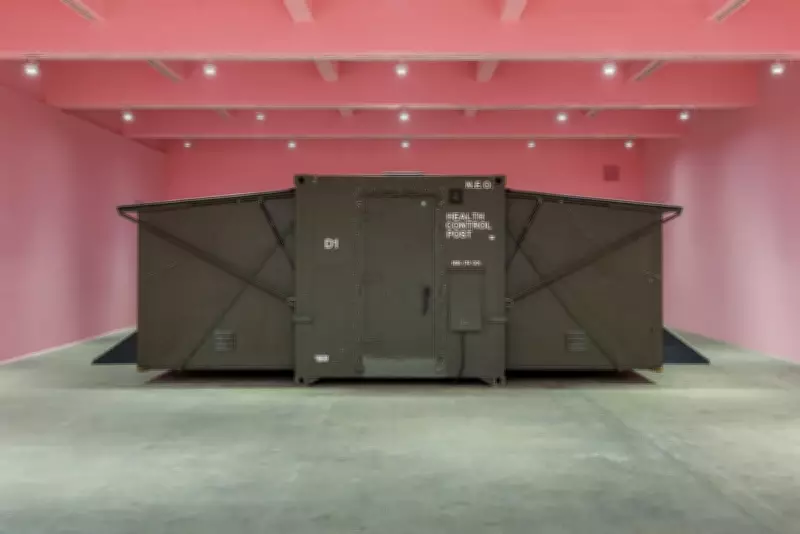
The gallery space has been transformed with walls and ceilings painted in soft pastel tones of Baker-Miller pink, a color experimentally used in US jail cells to calm aggressive inmates. Dominating this soothing environment stands a massive US-made army mobile health unit, identical to those deployed by British forces in conflict zones. Visitors must walk through this imposing structure as if reporting for medical assessment by fatigued military personnel, their bodies potentially becoming mere assets to be processed by the state apparatus.
Inside the health unit, the sensory experience shifts dramatically. The initial sweet odor gives way to an overpowering rubber stench that fills the confined space. Throughout the unit, remnants of its original purpose remain visible: chemical warning signs, triage questionnaires, evacuation protocols, and resuscitation diagrams. Yet these elements offer only fragmented hints rather than complete narratives, creating an atmosphere reminiscent of Mike Nelson's paranoid installations but with Crowther's distinctive psychological edge.
Military History and Psychological Warfare
Crowther acquired the mobile health unit through a military auction, discovering among its discarded paperwork evidence of its deployment during decontamination efforts following the 2018 novichok nerve agent attack on former double agent Sergei Skripal. This revelation transforms the installation's rubber scent from mere sensory detail to potentially sinister implication, forcing viewers to question whether they're smelling industrial materials or something more dangerous.
The exhibition's central tension emerges from this juxtaposition: a structure designed to preserve life within contexts of war and conflict, representing both care and exploitation simultaneously. Crowther masterfully explores how health becomes instrumentalized when controlled by state and military interests, asking fundamental questions about who benefits when individuals are made fit and strong through institutional systems.
Scent as Psychological Manipulation
Crowther's olfactory composition represents a sophisticated exploration of scent as psychological warfare. The initial sweet odor derives from substances associated with powdered milk production, representing synthetic, industrially-produced sustenance that saves lives while remaining fundamentally artificial. Mixed within this is hexadecanal, a natural compound abundant on newborn babies' skin that research shows reduces aggression in men while triggering it in women.
This chemical manipulation demonstrates Crowther's broader investigation into how basic human experiences—color and scent—can be industrialized, militarized, and weaponized against populations. The entire installation functions as an exploration of psychological operations (psyops), examining how sensory environments might be engineered to control behavior and emotional responses.
Between Care and Exploitation
Walking through Crowther's installation creates profound cognitive dissonance as visitors navigate the ambiguous territory between nurturing care and systemic exploitation. Are they being soothed by pastel colors and familiar scents, or manipulated through calculated sensory engineering? The exhibition offers no easy answers, instead immersing viewers in a head-spinningly paranoid environment that challenges assumptions about institutional benevolence.
This milk-vomit-reeking military industrial exploration feels like the most disturbing conspiratorial internet threads made physically manifest. Crowther has created conceptual installation art that stings the nostrils, scrambles cognitive processes, and generates profound suspicion toward institutional healthcare systems. The exhibition remains on view at Chisenhale Gallery through June 14th, offering London audiences an opportunity to experience this uniquely unsettling interrogation of state-controlled wellness.