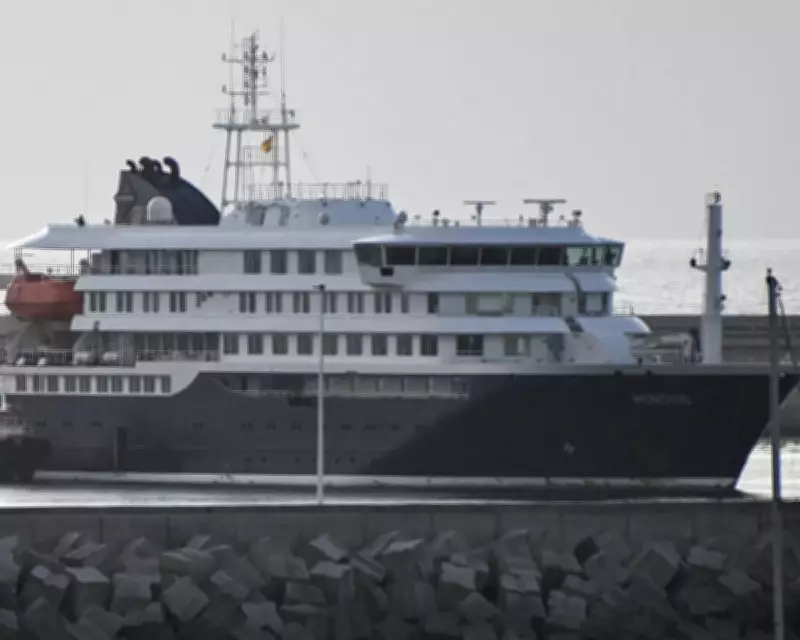
The MV Hondius, a small cruise ship that became the center of a global commotion after a hantavirus outbreak killed three people, has finally been evacuated. The remaining 149 passengers and crew were taken off the ship on Sunday, ending their ordeal as the vessel anchored near the Granadilla commercial port in Tenerife, Canary Islands.
Tourists Drawn to the Scene
On a dusty hill overlooking the Atlantic Ocean, groups of tourists and locals gathered to witness the evacuation. Some used binoculars, while others snapped photos on their phones of the ship just a few hundred meters away. Among them were Amy Byres and Emma Armitage from Sheffield, who were on holiday for Byres's 22nd birthday. "We've got some time to kill before our flight later," Armitage said. "It was either this or lay by the pool all day," added Byres. The pair had followed the story on TikTok throughout their trip, combining whale-watching and quad biking with fascination for the trapped passengers.
Evacuation Process
Down at the dock, the mood was more somber. Passengers emerged in small groups, wearing face and hair coverings and large blue ponchos over their clothes. They clutched small plastic bags with few possessions, as their luggage had to remain on the ship for decontamination in the Netherlands. Many had been confined to their cabins for days after the deaths of a Dutch couple and a German passenger. The cause was diagnosed as hantavirus, a disease usually carried by rodents, though rarely spread person-to-person. Health officials emphasized it was a known pathogen, not a new disease like Covid-19.

International Response
The evacuation was led by the World Health Organization (WHO) and coordinated by the Spanish government, which offered Tenerife as a base. Passengers and crew from 23 countries were repatriated. Boats shuttled passengers to shore, where health workers in hazmat suits and face masks loaded them onto coaches. Inside, plastic sheets covered seats, and hazard tape marked unusable seats, reminiscent of the Covid-19 pandemic. Passengers were not allowed to sit next to each other.
Quarantine and Testing Concerns
The WHO recommended a 45-day isolation from the last contact point, 6 May, but could not enforce it. The UK and Spain implemented hospital quarantines, but many countries did not. No PCR testing was conducted onboard; only temperature checks were performed. Hantavirus has an incubation period of up to eight weeks, raising concerns about undetected spread. Dr. Tedros Adhanom Ghebreyesus, WHO director general, assured that the outbreak was "not the start of a Covid pandemic" and that allowing passengers to travel with self-isolation would not cause further outbreaks. The US approach, relying on self-isolation, drew particular alarm after the country's withdrawal from the WHO last year. Spanish health secretary Javier Padilla Bernáldez noted that the European Commission and ECDC were trying to coordinate, but each country had its own policies.