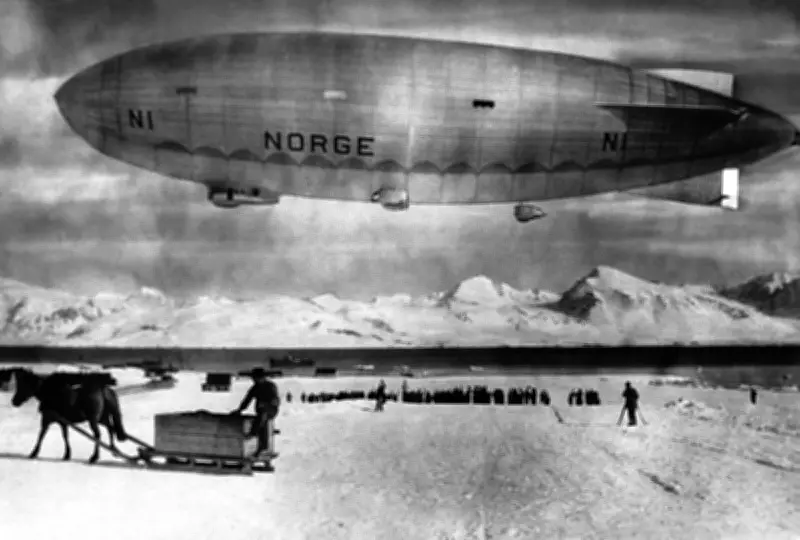
On 12 May 1926, the airship Norge, an Italian-built dirigible, completed the first undisputed visit to the North Pole. The crew included Norwegian explorer Roald Amundsen, American financier Lincoln Ellsworth, and Italian aviator Umberto Nobile. Departing from Spitzbergen, Norway, the Norge flew over the pole and continued 3,000 miles to Teller, Alaska. At the pole, national flags were dropped, but Amundsen later noted that the Italian flags were larger than the others, hinting at tensions between him and Nobile.
Safe Arrival in Alaska
According to wireless messages, Captain Amundsen and the airship arrived safely in Alaska on 17 May 1926. After leaving King's Bay, Spitsbergen, the Norge made a forced landing at Teller, 73 miles northeast of Nome. The airship was deflated and shipped to the United States. Amundsen and Ellsworth reached Nome, where a party member reported that no polar land was discovered.
Reception in Norway and Italy
News of the Norge's arrival sparked celebrations in Norway and Italy. In Oslo, streets were decked with flags, and the government sent congratulations. In Rome, crowds gathered at Colonel Nobile's home, where his wife appeared on the balcony to thank them. The Italian prime minister instructed legations to congratulate the American and Italian governments.

Editorial: Amundsen's Luck and Skill
An editorial on 17 May 1926 praised Amundsen as shrewd and lucky. His decision to use an airship after previous seaplane adventures reflected his adaptability. The journey, though risky, was considered less dangerous than the R34's Atlantic crossing. The editorial noted that the first half of the flight was uneventful, with only pack-ice and fog. It questioned whether Amundsen would now turn to Everest for his next challenge.
Challenges During the Flight
Riiser Larsen, second in command, described the 72-hour voyage. Thin ice and open water were found at the pole, but no land. The airship descended to 630 feet for observations. Over Point Barrow, ice formed on propellers and tore the gasbag, causing helium to escape. The Norge became heavy but reached Teller before losing too much gas.
Commander Ellsworth reported seeing open water at the pole, settling a long-standing geographic question. He also saw rocky islands, not considered land. An American flag was dropped at the pole, joining those from Peary and Byrd.