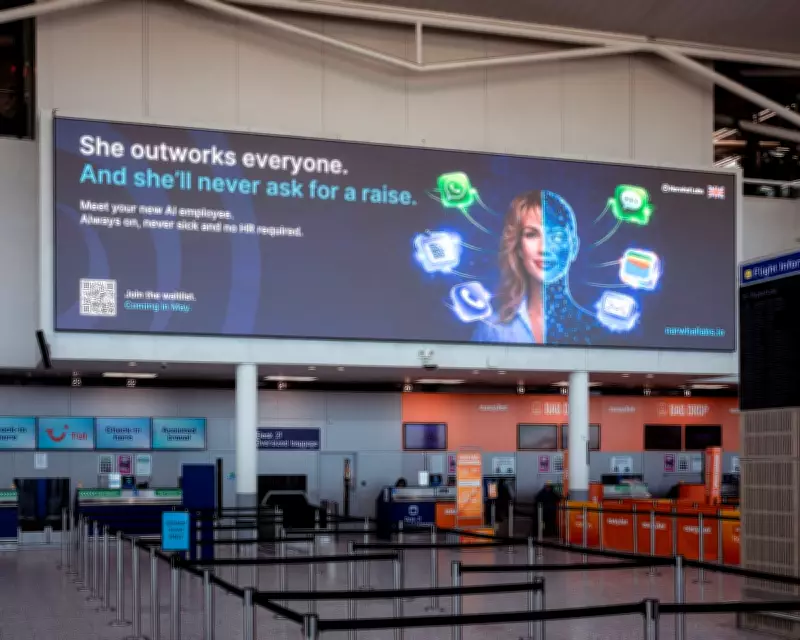
UK AI Company Under Fire for 'Misogynistic' Airport Advertising Campaign
A British artificial intelligence firm that recently secured substantial investment funding is facing significant backlash over an advertising campaign described by critics as blatantly misogynistic and sexist. Narwhal Labs, based in Bristol, has drawn sharp criticism for advertisements promoting their AI technology with problematic messaging about female workers.
Controversial Campaign Details and Complaints
The Advertising Standards Authority has confirmed receiving at least seven formal complaints regarding Narwhal Labs' campaign, which features advertisements depicting a woman alongside the tagline: "She outworks everyone. And she'll never ask for a raise." Additional text in the advertisement reads: "Meet your new AI employee. Always on, never sick and no HR required."
Another advertisement in the same campaign shows the same woman with the statement: "Working 9-5? She works 24/7. And she starts for free." The advertisements had been prominently displayed on large banners above the bag drop area at Bristol airport before being removed following concerns raised about their content.

Strong Criticism from Equality Campaigners
Rebecca Horne, head of communications and campaigns at Pregnant Then Screwed, an organization dedicated to ending workplace discrimination, delivered particularly scathing criticism of the campaign. "This advert is misogyny with a marketing budget, a textbook case of sexist labour stereotypes dressed up as 'innovation'," Horne stated.
"It pushes the toxic idea that the ideal worker is a woman who is endlessly available, compliant, unpaid and without needs. It exposes how deeply sexism is baked into our workplaces and now into our technology," she continued. "When you sell a 'perfect worker' as a woman who never rests or asks for more, you're not selling progress, you're selling the same old misogyny in a shiny new wrapper."
Company Response and Broader Campaign
Narwhal Labs, which recently announced £20 million in investment funding including backing from former CFC Underwriting director Jonathan Swann, issued a statement addressing the controversy. "We understand the strength of feeling our campaign has generated," the company stated. "It was never our intention for the billboards to be perceived as misogynistic or racist, and we take that concern seriously."
The company defended their broader campaign approach, noting that their advertisements depict people from various demographics. "Our billboards depict people from a wide range of demographics. Different genders, backgrounds, and identities ... this was never about one group losing out to another," the statement explained. "This is something far broader: humans versus machines. The impact will not be selective. It will not discriminate. And the debate it has sparked is exactly the one we need."
Additional Campaign Elements and Technology
The controversial campaign includes additional advertisements featuring different demographics. One advertisement shows a black man with a moustache alongside text playing on Lionel Richie lyrics: "Hello, is it leads you're looking for? He'll find them, call them, and follow up. While you sleep."
Narwhal Labs has developed a platform called DeepBlue OS that utilizes agentic AI technology, which differs from generative AI systems like ChatGPT by operating autonomously without requiring human prompting. The company claims their technology can handle inquiries, contacts, appointments, and documents without human intervention.
Regulatory Position and Industry Context
The Advertising Standards Authority is currently assessing the complaints to determine whether grounds exist for further action, though no formal investigation has been launched at this stage. A spokesperson for Bristol airport confirmed that the third-party company responsible for airport advertising removed the controversial advertisements after concerns were raised about their content.

Narwhal Labs used their statement to call for specific legislation regarding AI implementation, including rights for consumers and employees to know when they're interacting with AI rather than humans, requirements for businesses to invest in reskilling affected workers, and regulations defining where AI can and cannot replace human roles in sensitive sectors like care, education, and public safety.
"While governments hesitate, the technology is accelerating," the company warned. "When as much as 80% of white-collar work is at risk within the decade, silence is no longer a neutral position. The real question is not whether AI will replace jobs. It's what we choose to do about it."