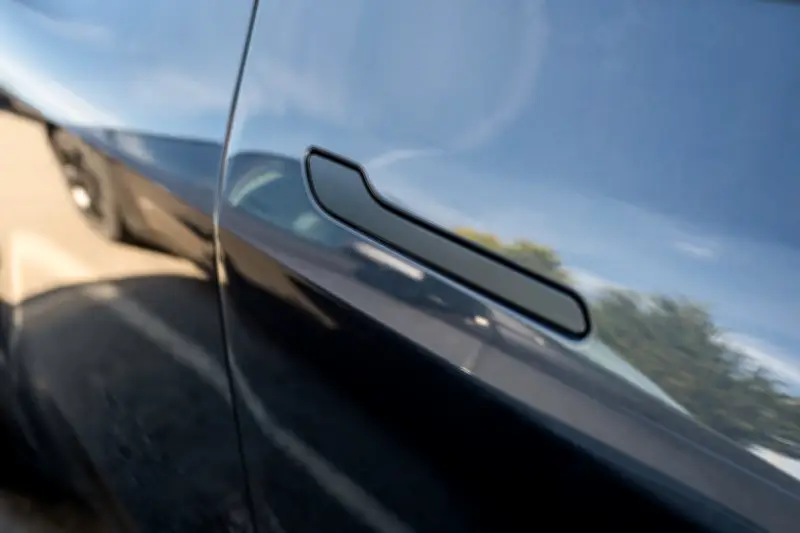
China has announced a world-first ban on hidden or retractable electric car door handles, citing safety concerns after several deadly accidents where power failures trapped occupants inside burning vehicles. The ban, effective from 1 January 2027, requires all new cars sold in China to have a mechanical release on both the inside and outside of every door except the boot, according to regulations announced in February by the Ministry of Industry and Information Technology.
As of April 2026, about 60% of China's 100 bestselling 'new-energy vehicles' – EVs, hybrids, or fuel cell-powered cars – had hidden handles, according to China Daily. The design, popularised by Elon Musk's Tesla Model S in 2012, has been adopted by many manufacturers for its sleek, flush-mounted look.
What are the new requirements?
Under the new Chinese regulations, the outside of every door must have a recessed space measuring at least 6cm by 2cm by 2.5cm for a hand to grasp and manually open the door. Inside, there must be signs showing occupants how to manually open the door. The ban applies to both press-to-release hidden handles and electrical pop-out or retractable handles, as reported by Bloomberg. Some manufacturers with already approved models have a two-year grace period to update designs.
Tesla had already flagged design changes. In September last year, chief of design Franz von Holzhausen told Bloomberg that the company was looking to combine electronic and manual door-release mechanisms to make them more intuitive in 'a panic situation'.
Implications for Australia
Australia imports all its cars, and there has been a recent influx of Chinese-made EVs due to their affordability. 'About 60% of all new vehicles sold in Australia are made in China but that's because they're very good at making cars now, and Australians love a bargain,' says Chris Jones from the Australian Electric Vehicle Association (AEVA). Every car in the Top 10 EVs sold in May this year was primarily built in China, with manufacturers Tesla, Jaecoo, Geely, BYD, and Zeekr behind the top models, according to Carsguide.
Jones notes that the Chinese ban won't extend to flush-mounted door handles that can still be operated manually, which are the kind typically seen in Australia, so the ban may not apply to models currently popular in the country. However, he says it's a good time to reconsider the Australian Design Rules – the national standards governing vehicle safety, anti-theft, and emissions. 'I think there is a perfectly reasonable case to mandate a manual mechanism on both inside and outside the vehicle for front and rear doors,' he says. 'The Chinese government has recognised this flaw and the potential for disaster when extracting casualties from a crash, so are regulating accordingly.'
Current Australian rules
A spokesperson for transport minister Catherine King says all road vehicles, including EVs, must have doors that can be opened without the use of tools. In practice, this means all car doors must be operational by hand. Although vehicles are tested for this function after both side and frontal impact crashes, this only applies to the outdoor handles as 'there is usually no way to test the internal door handle following a crash test' using a dummy.
King's spokesperson says the government has provided the independent safety assessor Ancap with $16.3m in funding over 5 years to increase their door handle assessment as part of their Star Safety Rating Program. Carla Hoorweg, Ancap chief executive officer, says the Australian Design Rules haven't kept up with technology and don't prescribe enough detail. 'That's what we want to make sure the rules are really clear on – that there has to be a manual override from the inside and the outside,' she says. 'It's both, so that occupants can get out and so first responders can get into the vehicle. The objective is reducing the risk of entrapment after a crash.'
Risk of 'stock dumping' in Australia
The issue made headlines again earlier this month after the peak body for car and truck dealers – the Australian Automotive Dealers' Association – released a report warning of the 'risk of stock dumping following China's approach to EVs with flush door handles'. While cars rejected by the Chinese are unlikely to be literally 'dumped' here – their steering wheels would be on the wrong side for Australian roads – Hoorweg says there is a risk that cars with less safe door handles could end up being sold here. 'If there's a lot of door handles floating around and they're cheap because they can't sell them in China, what are you going to do with them?' she says.