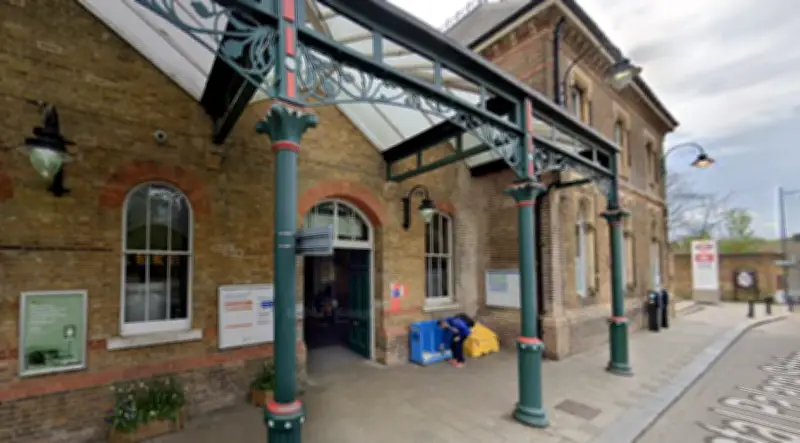
Crystal Palace railway station, a busy hub in south London, was originally built to serve the Victorian Crystal Palace, which was destroyed by fire nearly 90 years ago. The station continues to operate and preserves the name of the once-grand edifice, serving as a living memory of a significant piece of London's architectural history.
The Palace's Illustrious Past
The original Crystal Palace was an architectural marvel of the Victorian era, crafted from glass and iron by Joseph Paxton for the Great Exhibition of 1851 in Hyde Park. The vast structure, showcasing global inventions and technologies, was later dismantled and reassembled on a grander scale at Sydenham Hill in south London, opening in 1854.
Instantly, it became a major attraction, drawing millions of visitors. To manage the throngs of people, Crystal Palace Low Level station was opened in June 1854, providing direct rail connectivity.
Twin Stations for a Singular Attraction
In its heyday, the Crystal Palace was served by two railway stations. The original Low Level station, which opened in 1854, is still in operation. A second station, Crystal Palace High Level, was inaugurated in August 1865, located on the opposite side of Crystal Palace Parade.
This station was linked to the palace via an elaborate pedestrian subway, offering an impressive entrance for first-class passengers. However, the High Level station closed to passengers on September 20, 1954, and was demolished in the early 1960s.
The Tragic End of the Crystal Palace
The Crystal Palace met its demise on November 30, 1936, consumed by a fierce fire that began in the evening and swiftly engulfed the enormous structure. Despite the valiant efforts of hundreds of firefighters, the building was almost entirely destroyed, marking the end of an era for the area.
The fire not only obliterated a magnificent piece of architecture but also ended the palace's reign as one of the capital's greatest attractions. Although the building was never reconstructed, its name lives on through the surrounding neighbourhood, the railway station, and the park.
Remnants of the Past
Crystal Palace Park still holds echoes of the past. Visitors can explore the surviving terraces, sphinx sculptures, and other remnants of the historic palace. One of the most notable surviving structures is the Crystal Palace Subway, which once linked the High Level railway station to the palace.
The Grade II* listed subway, with its striking vaulted ceilings and decorative brickwork, underwent a major restoration project, completed in September 2024, preserving its historic essence for future generations. Although not open for unrestricted public access, the subway can be explored during organised open days.
A Living Legacy
Crystal Palace railway station continues to serve passengers across south London and beyond, connecting them via London Overground and Southern National Rail services. The station's proximity to Crystal Palace Park allows visitors to roam the grounds once occupied by the monumental Victorian landmark.
More than 170 years after it first opened, the station's name continues to echo the memory of one of London's most celebrated lost attractions. For those interested in learning more about the historic site and the subway, further information is available on the Crystal Palace Park website.
The legacy of the Crystal Palace railway station is a testament to London's rich historical tapestry. Despite the palace's absence, the station stands as a beacon of the past, preserving the memory of a time when the Crystal Palace was a pivotal part of London's cultural and architectural landscape. The continuation of its operation, more than a century later, highlights the enduring nature of its historical significance.