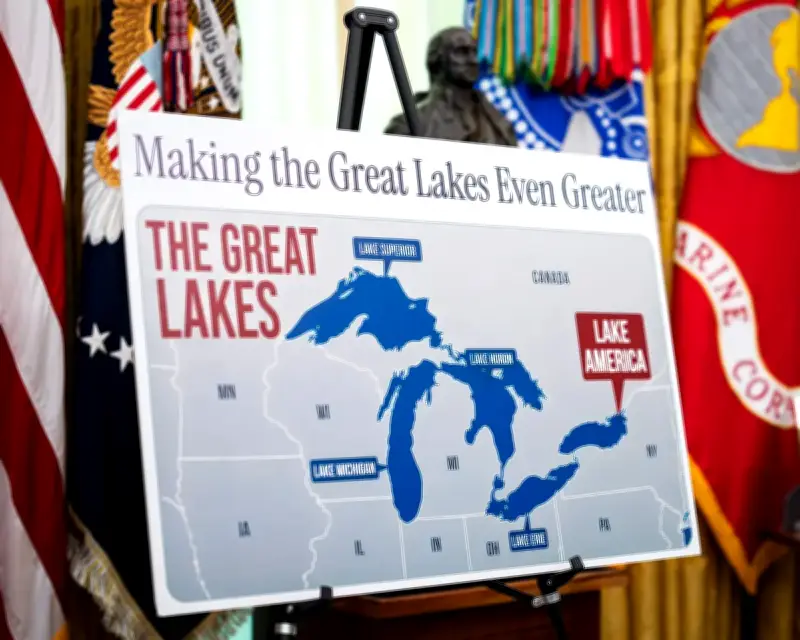
Apple has complied with President Donald Trump's executive order to rename Lake Ontario as “Lake America” for US users of its Maps application, a move that comes amid an escalating trade dispute with Canada. The change took effect following Trump's official declaration last week, with the tech company reportedly deliberating whether to submit after receiving a personal request from the president.
Apple Maps Update and Global Variations
The Apple Maps app now displays the new name for the lake, which straddles the border between New York state and the Canadian province of Ontario, for all users within the United States. However, Apple users in other countries will continue to see the original “Lake Ontario” designation, preserving the traditional name for international audiences.
Apple's decision follows a weekend move by its competitor, Google, which had already updated Google Maps to reflect the Lake America branding. Google cited Trump's executive order and its established practice of using names assigned by the US Geographic Names Information System (GNIS) as the basis for the change.
Canadian and Indigenous Reactions
Canadian Prime Minister Mark Carney has publicly rejected the renaming attempt, taking to social media to emphasize that the lake's name originates from the language of the Indigenous Wendat people. Carney noted that the name predates both the Canadian Confederation and the US Declaration of Independence, underscoring its deep historical and cultural significance.
The executive order, signed by Trump on 27 August 2026, did not mention his ongoing trade feud with Canada. Instead, Trump framed the renaming as an effort to honor “the policy of my Administration to recognize the extraordinary contributions of the American people and the rich heritage of our history by naming great natural landmarks for our shared achievements.”
Trade Dispute Context and Tariffs
The renaming comes against a backdrop of heightened tensions between the two nations. Late last month, trade talks between Washington and Ottawa collapsed, prompting the US to impose a 50% tariff on several Canadian imports. Trump further threatened an additional round of 50% duties on Canadian steel, trucks, cars, and auto parts, slated to take effect in the new year. In retaliation, Carney introduced 25-50% tariffs on hundreds of US goods.
While the executive order avoided direct references to the trade conflict, the timing has been widely interpreted as a retaliatory gesture following Canadian officials' denouncement of Trump's sweeping tariffs and their promises of reciprocal measures.
MapQuest's Defiance and Public Response
In a notable act of resistance, MapQuest, the pioneering online mapping service, openly rejected Trump's request to rename the lake. On Tuesday, it was reported that MapQuest had reached the No 1 spot on Apple's App Store after posting a screenshot of Lake Ontario on social media last Thursday with the caption: “We're not changing it.” This act of defiance propelled the app to become the most in-demand navigation tool in the US.
Google Maps, which had previously adopted the “Gulf of America” moniker for the body of water formerly known as the Gulf of Mexico, continues to display that name despite its limited adoption outside official US government usage. The digital rename of Lake Ontario follows a similar pattern, with Google stating that US users will see “Lake America,” users in Canada will see “Lake Ontario,” and those outside both countries will see both names.