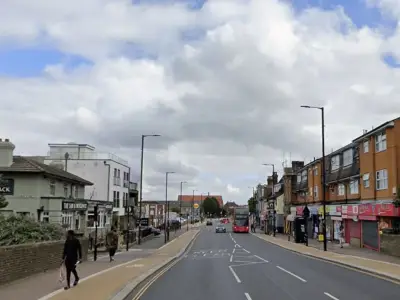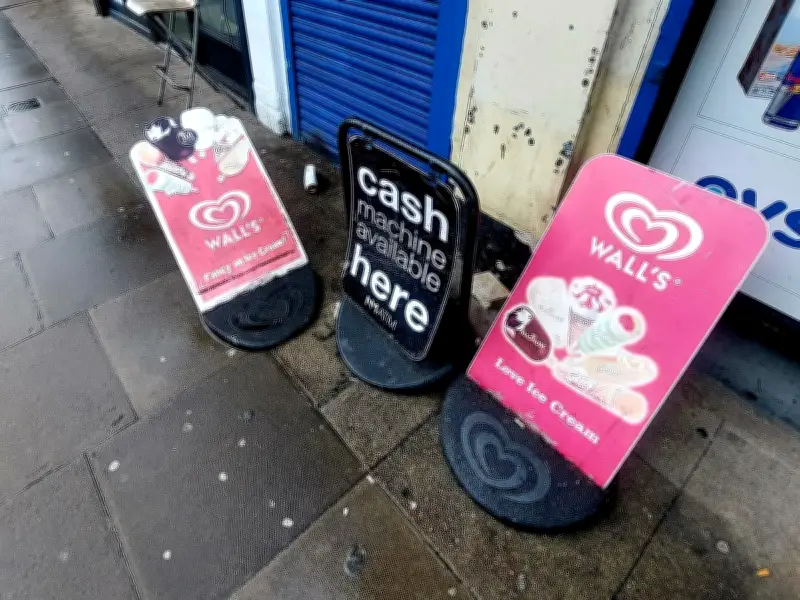
Hammersmith and Fulham Council will enforce a 12-month ban on advertising A-boards along Uxbridge Road from October, following persistent resident complaints about pavement obstructions. The trial, approved by Cabinet Member for Climate Emergency and Travel, Cllr Nicole Trehy, will inform a potential borough-wide ban on the advertising boards.
Resident concerns and campaign group response
The council said it had received concerns from residents about A-boards, particularly along Uxbridge Road, which runs from the junction with Ariel Way to the border with neighbouring Ealing. The campaign group Fix Uxbridge Road welcomed the decision, with spokesperson Vikki stating: “Successful high streets depend on people being able to reach shops, move between them and enjoy spending time there. Businesses can advertise through shopfronts, windows, awnings, digital channels and coordinated street signage without placing obstacles in pedestrian routes.”
Vikki added: “A thriving high street is one that everyone can use. Clear the boards. Clear the way. Make our high streets accessible to everyone.” The group has long argued that A-boards create unpredictable obstacles for blind and partially sighted people, wheelchair users, older residents, and parents with pushchairs, forcing pedestrians away from the building line and closer to traffic.
Current licensing and enforcement challenges
Hammersmith and Fulham Council currently charges £275 per year for a highways licence to place an A-board. However, a 2025 survey suggested there were up to 950 unlicensed A-boards across the borough. Council officers noted in a report: “In practice, however, licences are generally not applied for, and the absence of a licence has rarely been enforced through the issue of a fine. The council has usually sought to deal with unauthorised A-boards by asking businesses to remove them.”
The report highlighted that Uxbridge Road has been the subject of a particularly high number of complaints, ranging from concerns for blind and partially sighted residents to the degradation of the street environment. The council’s Law Enforcement Team (LET) has undertaken recent work on Uxbridge Road, with further targeted engagement and enforcement activity proposed. Officers stated: “This should be supported by a clear policy position and a consistent escalation process, so that businesses understand what is expected and residents can see that obstruction and clutter are being addressed.”
Business survey and consultation findings
A survey on the impact on businesses along Uxbridge Road received just five responses. Two respondents claimed the effect would be negative if A-boards were removed, while three believed the council should ban them from the highway. Feedback on A-boards in private forecourts differed, with four respondents believing they should continue to be allowed in that setting. A meeting with the Disabled Residents Team (DRT) found support for restrictions, at a minimum, on A-board use.
Officers wrote: “A-boards can provide a useful and low-cost form of advertising for businesses, but their uncontrolled use on the public highway creates street clutter, can obstruct pedestrians and raises particular accessibility concerns for blind and partially sighted people. The evidence from Uxbridge Road demonstrates that the current approach has not resolved repeated resident complaints or secured sustained compliance.”
Campaigners call for borough-wide ban and legislative reform
Vikki told the Local Democracy Reporting Service (LDRS): “A pavement should be a safe route to walk through, not an advertising space. Fix Uxbridge Road strongly welcomes the council’s consultation and the 12-month trial prohibition on Uxbridge Road. We support Option 2: a borough-wide ban on A-boards across the highway, including private forecourts that legally form part of it. That said, Option 2 must be the beginning, not the limit, of the council’s ambition.”
She added: “The ultimate objective should be clear: no A-board should obstruct, endanger or intimidate people using a pavement or publicly accessible forecourt regardless of where an invisible property boundary happens to fall.” Vikki also called on the council to request that the Government reforms legislation to give local authorities “clear powers to restrict or prohibit obstructive A-boards on private land adjoining the pavement.”
A Hammersmith and Fulham Council spokesperson said: “Local people have expressed concerns about obstructions from A-boards - specifically in Uxbridge Road. By reducing clutter on the high street and making it more attractive and accessible for pedestrians, we hope to increase footfall past the many excellent businesses on the road.” The trial will run for 12 months from October, with the council consulting on a potential borough-wide ban.