London Cable Car Defies Critics, Proves Infrastructure Vision Pays Off
What is your favorite piece of transport infrastructure in London? The Regent Street Monorail? The Thames Viaduct Railway connecting Westminster to London Bridge? Or perhaps King's Cross Aerodrome? These might sound like fanciful ideas, but they were all genuine proposals at various points in London's history that never materialized.
A History of Unbuilt Ambitions
The archives of London planning are filled with grand projects that never left the drawing board. Watkin's Tower was envisioned as a Wembley rival to Paris's Eiffel Tower. The Barbican Pyramid promised a more elegant alternative to the brutalist complex that eventually rose. The Great Victorian Way proposed a ten-mile glass-covered loop around central London integrating shops, residences, and railways. Charing Cross Heliport and multiple versions of a Grand Central station also joined this list of unrealized dreams.
"Some of these ideas were inspired, some were simply unlucky in their timing, but most were just plain bonkers," notes James Ford, a former transport policy adviser at City Hall. "Public officials face the challenging task of filtering the inspirational from the merely hair-brained."
The Cable Car's Controversial Journey
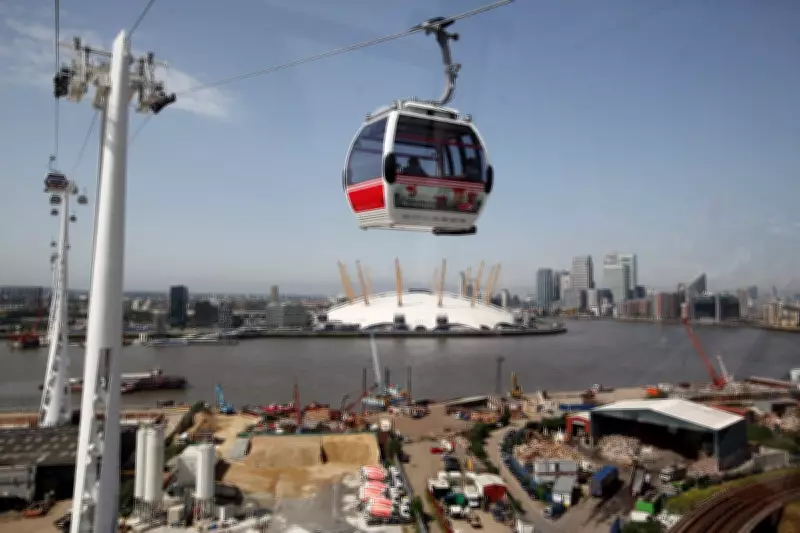
Among the flood of proposals that crossed Ford's desk during his time at City Hall was the London Cable Car, now known as the IFS Cloud Cable Car but originally branded as the Emirates Air Line. First conceived in the late 1990s, the project connecting Greenwich's O2 Arena to the Royal Docks faced immediate skepticism.
"At every internal meeting to discuss it, the price seemed to increase by another £5 million," Ford recalls. Upon completion, critics dubbed it the "dangleway," dismissing it as an impractical, expensive white elephant that would never attract significant ridership.
Design writer Douglas Murphy has characterized former Mayor Boris Johnson's legacy as "some of the most remarkably odd public works anywhere in the world in recent years," citing both unrealized projects like the Thames estuary "Boris Island" airport and built-but-controversial structures like the ArcelorMittal Orbit.
From Skepticism to Success Story
Contrary to all predictions, the cable car has become an undeniable success. Ford himself admits his initial skepticism was misplaced after experiencing the journey firsthand. "I've taken a 'flight' on the Cable Car and loved every second," he confesses, joining 14 million passengers who have enjoyed the service during its first decade of operation.
The cable car provides efficient transport between the new City Hall building in the Royal Docks and the entertainment district across the river at the O2 Arena. More importantly, it has evolved into a vital catalyst for regenerating Newham, one of London's most economically challenged boroughs.
A Floating Park Validates the Vision
The project's foresight becomes particularly evident with the proposed development of a giant floating park in the Royal Docks. This ambitious attraction promises to draw thousands of additional tourists who will naturally utilize the cable car for access, transforming what was once dismissed as a frivolous indulgence into a strategically vital transportation link.
"Far from being the white elephant it was labeled, the London Cable Car has proven to be farsighted, futuristic, and economically transformative," Ford emphasizes. "The capital owes Boris Johnson a debt of gratitude for this particular vision. I never should have doubted him."
Britain's Infrastructure Renaissance
In an era when commentators frequently lament Britain's "can't build, won't build" mentality—where projects are allegedly thwarted by protected species or Treasury shortsightedness—the cable car stands as a powerful counterexample. It demonstrates that when political leaders demonstrate courage and designs embrace ambition, the dividends can be substantial and lasting.
From a nation once forged in steel by engineering giants like Isambard Kingdom Brunel and shaped in Portland stone by architects like Christopher Wren, Britain has occasionally lost its confidence in grand infrastructure projects. The cable car's success suggests perhaps it's time to reconsider some of those abandoned plans, proving that visionary thinking combined with determined execution can still produce remarkable results in modern Britain.
James Ford served as a transport policy adviser to Boris Johnson during his tenure as Mayor of London, providing him unique insight into the planning and controversy surrounding the cable car project that has ultimately transformed East London's connectivity and economic prospects.