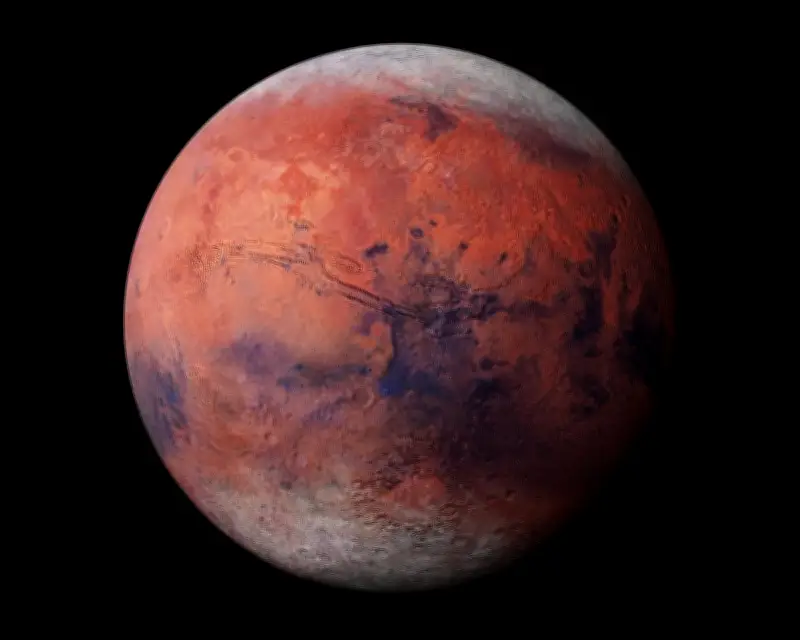
Fifty years after the Viking 1 landing on Mars, a prominent chemist argues that NASA may have overlooked evidence of microbial life. Steven Benner, a former Harvard professor, contends that data from the 1976 mission, long interpreted as negative, actually hints at the presence of organic materials.
The Viking Missions and Their Legacy
On July 20, 1976, Viking 1 became the first successful American lander on Mars, followed by Viking 2. Over six years, the twin spacecraft returned over 50,000 images and mapped 97% of the Martian surface. Their life-detection experiments were designed to find microorganisms, but chief scientist Gerald Soffen famously declared, "No bodies, no life." NASA's official stance is that Viking "provided no definitive evidence for the presence of living microorganisms."
Benner's Challenge to the Consensus
Steven Benner, director of a non-profit research organization and a former NASA collaborator, disputes this conclusion. While reviewing original Viking logs at NASA's Lunar and Planetary Institute in 1999, he noticed anomalies. The Gas Chromatography-Mass Spectrometry (GC-MS) experiment, which heated Martian soil to 500°C, was expected to detect organic compounds. "They thought they found no organic materials," Benner says. But as a chemist, he saw traces of organics that scientists dismissed as contaminants.
Benner's argument gained traction with a later discovery: in 2008, NASA's Phoenix lander found perchlorates in Martian soil. These chemicals destroy organics when heated, meaning the Viking GC-MS likely incinerated any organic matter. "We now know this experiment would have destroyed most organic materials in the soil," Benner explains.
Implications for Extraterrestrial Life
If Benner is correct, the consequences are vast. He proposes two possibilities: either life arose independently on Mars, suggesting a second genesis, or life was transferred between planets via interstellar panspermia. "If we get two for two, life origin on Mars and Earth, it suggests there is microbial life all over the galaxy," he says. Alternatively, if life survived the harsh transfer between planets, it indicates extreme resilience, again implying life on many rocky planets.
Benner emphasizes that microbial life, though microscopic, is crucial. "Microbial life has a lot in common with you and me," he notes. "You do not get intelligent life without it."
Historical Context and Scientific Debate
Benner is not alone. Dr. Gilbert V. Levin, who designed a Viking life-detection test, argued for decades that the mission found life. He died in 2021, marginalized by the scientific community. The late astrobiologist Rafael Navarro-Gonzalez also found that Mars-like soil in Chile's Atacama Desert suggested Viking "may have been blind to low levels of organics."
The scientific community remains divided. "Some say, 'Good guy, Steven. Well done for going out there and taking the arrows,'" Benner says. Others worry about public perception, fearing accusations of NASA seeking funding or promoting crackpot theories. NASA declined to comment on Benner's work, and the European Space Agency said it was unaware of his publication.
The Path Forward
Benner insists no one has disproven his claims, attributing this to the fact that many in the field are geologists or biologists hesitant to venture into chemistry. He vows to continue pressing NASA to acknowledge the issue. "I'm not going to stop until [NASA head] Jared Isaacman goes on television and acknowledges the issue," he says. "Science isn't about total certainty. But right now, nobody is questioning this. They have to be."
The debate underscores a broader shift in Mars exploration: from searching for extant life to seeking water, habitability, and signs of ancient life. Benner's work challenges the scientific community to reconsider what might have been missed, with implications that could reshape our understanding of life in the universe.