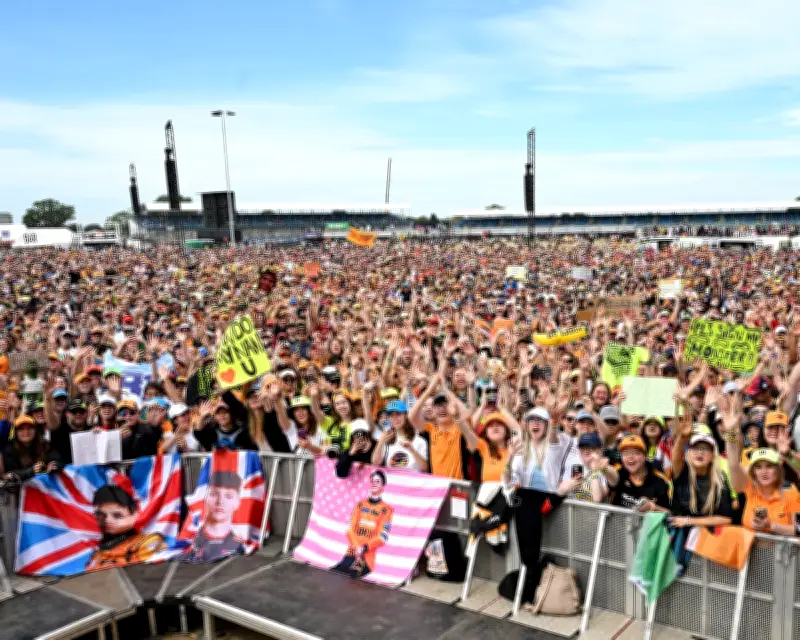
Less than a decade ago, the British Grand Prix was on the brink of disappearing from the Formula One calendar. This July, it will break the attendance record, with 570,000 fans expected through the gates over four days at Silverstone.
The scale of change at the British Grand Prix is immense. The race is expected to sell out its new capacity of 570,000, a record-breaking increase of 50,000 on the previous highest attendance of 520,000 at the Australian GP in 1995. Only Wimbledon, across two weeks, will boast more numbers in the UK summer, making Silverstone the largest event on F1's calendar.
This turnaround in demographics and size was almost impossible to imagine a decade ago when the race was in danger of disappearing. The resurgence of F1 and the fortunes of the old airfield have gone hand in hand. Silverstone's adaptation and innovation have put the track at the vanguard of catering to a demanding, sophisticated, and younger audience.
Female attendance now makes up 43% of sales at the British GP. In the "Landostand" dedicated to British world champion Lando Norris, which has been expanded to accommodate 20,000 this year, women make up more than half of the audience. Stuart Pringle, Silverstone's chief executive, is proud of how they have embraced and encouraged F1's new followers. "Ten years ago people would have scoffed at the concept of nearly a 50-50 male-female split. Unimaginable," he says. "This concept of value for the weekend and a blend of different types of fans is working for us."
Hard as it is to imagine now, in 2017 the circuit activated the break clause on its contract with F1, allowing it to pull out in 2019, with a very real danger that the British GP, on the F1 calendar since 1950, would cease to exist. In 2015 and 2016, it attracted race-day audiences of 139,000 but lost money: £2.8m in 2015 and £4.8m in 2016. The key issue was the escalator clause in the contract with then-F1 chief executive Bernie Ecclestone, under which the fee rose from £11.5m in 2010 to £16.2m in 2017, set to reach £25m by 2026.
Silverstone felt it was unsustainable. Two years of negotiations with F1's new rights owners, Liberty Media, followed. A new deal was signed at the very last minute, on the Wednesday before the 2019 British GP. It gave the circuit a new lease of life, and since then it has thrived. "Pulling the break clause wasn't scary because what would have been scary was to stay on that contract," Pringle says. "Yes, there was uncertainty but it didn't feel like it was going to be any worse where we were. I inked the signature on the Wednesday afternoon before the event started on Friday morning. It went right to the wire and that was nerve-racking."
Pringle was given an OBE this year for his work, an award he insists belongs to the whole organisation. Since 2019, freed from the shackles of a financially crippling deal, they were able to take the event to the next level. As Liberty pursued its new agenda of making F1 meetings destination entertainment events, Silverstone was on board. It saw out Covid, and as F1 rode the wave of popularity of Drive to Survive, adapted to this new, growing audience.
The days of three blokes on a grassy knoll and a burger van are long gone. The British GP is now almost a motorsport Glastonbury, with a host of music, entertainment (Ally Pally-style darts on Sunday with Luke Littler included), food, and facilities to ensure an overall experience beyond the 90-minute race itself. Traditionalists may deride it, but the numbers demonstrate unequivocally that it is popular and has worked.
The range of entertainment is broad. Music highlights this year include David Guetta, Richard Ashcroft, Chase and Status, and James Arthur, with late-night DJ sets from John Newman, Rudimental, Pendulum, and MK. The night at the darts has Luke Humphries, Michael van Gerwen, and Fallon Sherrock alongside Littler. There is a dedicated comedy tent featuring Lou Sanders and Paul Chowdhry, and a big-top stage aimed at a family audience.
They have also addressed every area, including traffic, once arguably the most torturously bad on the entire calendar. The track hires 600 double-decker buses as part of its park-and-ride and rail-and-ride scheme to shift an expected 167,000 people, while camping facilities now accommodate 60,000 around the circuit. These unglamorous logistics, like addressing queues for the loos, are part of making the experience worthwhile and worth the price.
The latter has caused controversy. Popularity has led to soaring demand, and there has been pushback over the cost to attend, notably because prices are far from where they were a decade ago. Pringle robustly defends their position. Having been part of the government's dynamic pricing inquiry, he notes that 60% of customers who buy early tickets pay less than the average and less than if it was legislated to have a flat ticket price. When first on sale, a three-day general admission ticket was £269 and is now £419.
Prices have been rising over time, but that is the case at every popular GP on the calendar, and very few are putting on quite the show Silverstone is managing. "We're committed to putting value into the ticket for the fans," Pringle says. "We're doing pretty well at getting the right sort of thing so that there's something in it for everybody."