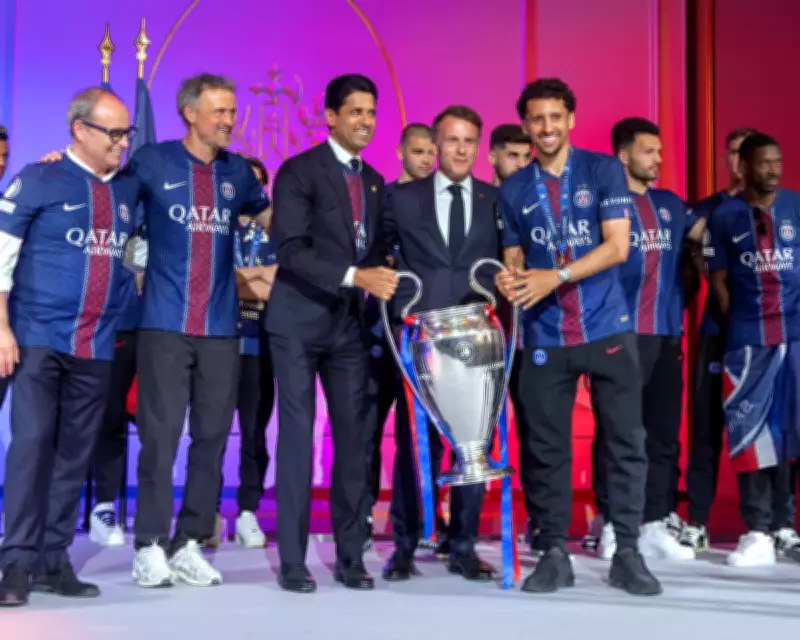
Paris Saint-Germain's re-enthronement as Champions League winners has sparked debate about the true nature of their success. The headline in L'Équipe proclaimed 'Paris est mythique,' but the question remains: are they truly mythical?
In fairness, it would be un-Parisian not to celebrate their champion team as the champions of all champions. The Parisian exceptionalism is justified, as Luis Enrique's PSG has evolved into a sensationally good and beautifully watchable team. Their victory over Arsenal showcased their ability to win through fine details, even when not at their best.
However, the feat must be viewed in context. PSG's domestic league dominance allows them to focus almost exclusively on the Champions League. They have essentially won nine key games from February to May two years in a row, with a team and schedule geared entirely to that spring mini-season.
Another L'Équipe headline captured it better: 'L'Europe a les champions qu'elle merite.' These are the champions European football deserves: beautiful, high-craft, complex, and deceptive. This is elite performance for an overclass world, subverting the traditional route to the top.
Ideally, a European champion should express the strengths of its domestic league. Instead, PSG's domestic league has been bypassed. Nuno Mendes and Marquinhos have played more minutes in the Champions League than in Ligue 1. Ousmane Dembélé started only 11 of 34 Ligue 1 games, essentially a midweek player.
PSG has been recast as a luxury good, an overclass product found behind the velvet rope. Given the sole challenge is to win the Champions League, with domestic matches as tune-ups, we should temper our awe.
This is unfair to Luis Enrique, who created PSG 2.0—a model of drive, focus, and tactical coherence. Désiré Doué embodies a new kind of elite footballer: a details-geek, private chef devotee, and sleep student. Luis Enrique has been empowered and has nailed the tactical architecture, blending Pep-style possession with Klopp's direct attacking energy.
It is both surprising and unsurprising that this transformation happened so quickly. Qatar finally listened to a very good manager. PSG should always have been this good, with no limits on their resources.
PSG is now seen as European football's good guys, the purists. Most neutrals supported them in Budapest, testament to their seductive style of play. But this is a soft-power project for a carbon dictatorship, driven by the same brutal process that built the Qatar World Cup.
There is a further paradox: PSG embodies genuine sporting virtues. The average age of the starting XI is 24, six academy players debuted, and five players are in the France team. They also excel at merchandising and cultural events.
The image-making is as breathtaking as the midfield. PSG expresses Paris perfectly: a delightful illusion, preserving the myth of beauty, art, and culture while hiding real-world grime. Here we have a model of beauty, a never-ending belle époque.