
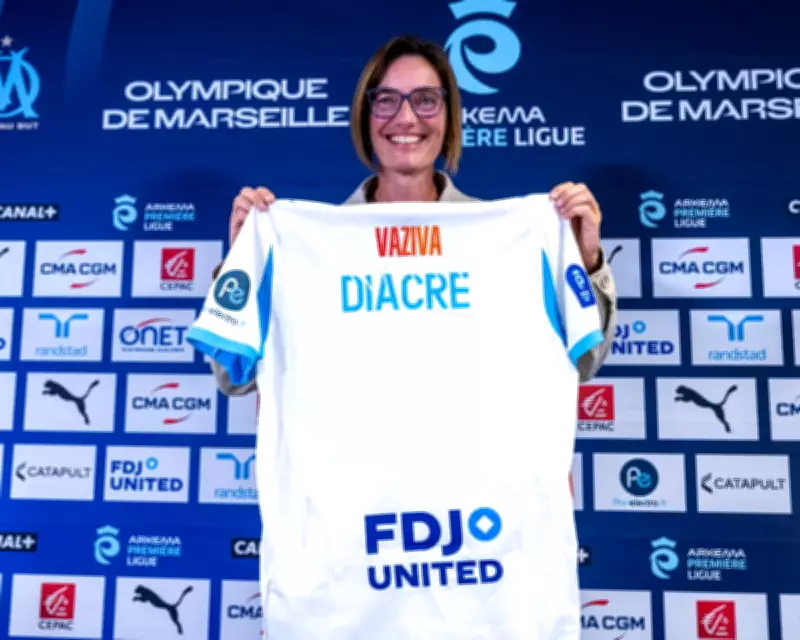
Corinne Diacre, the pioneering manager who previously led the France women's national team and a men's club in Ligue 2, assumed control at Marseille last October. Her appointment marks a significant step for the rebranded and independent women's team, Les Marseillaises, as they pursue an ambitious goal to become an iconic club in women's football.
A Fresh Start with Deep Roots
"Here in Marseille your blood is not red, it's blue," declares Diacre, emphasizing the unique passion of the city. "Even today it can be challenging for some parents to see their girls wanting to play football, but here they don't play football: they play for Marseille. It's perceived as entirely different." Diacre appears content and at ease, revitalized by this new project after a period away from management.
This role represents her first head coaching position since her contract with the France women's team was terminated in 2023. The French Football Federation cited "a very significant divide" with players that had "reached the point of no return." Despite this contentious conclusion, Diacre brings considerable pedigree. She was the first woman in France to earn the senior BEPF coaching licence and the first to manage a men's professional team in a competitive match, taking charge of Clermont Foot 63 in Ligue 2 back in 2014.
Strategic Vision and Long-Term Investment
The team, still owned by American businessman Frank McCourt through McCourt Global following his 2016 acquisition of the broader Marseille club, is receiving a substantial infusion of resources and energy while maintaining strategic connections. Stefano Petruzzo, the CEO leading the women's side, describes the initial state as "in an incubation phase within the club" when he joined in September 2024. Now, they are one season from completing phase one of a comprehensive 10-year vision.
Promotion from the second division was achieved in the first year of the revamp. Currently, Les Marseillaises hold ninth place in the 12-team Première Ligue with five matches left, sitting six points above the relegation zone occupied by Saint-Étienne and Montpellier. Diacre assesses, "We probably need two more wins to stay in the first division, so we have time, we don't have pressure and we've worked hard to obtain this position in the league very quickly."
Developing Local Talent and Building an Ecosystem
A key attraction for Diacre was the opportunity to help shape the women's academy, returning to the developmental roots she cherishes. "When I began to be a coach I didn't know that I could be a pro coach and I was very happy to coach young players and help them grow," she explains. "So, it is in my DNA to work with young people and now I'm reconnected with that work."
Marseille boasts a rich football culture, historically producing male talent for decades, though notably missing out on homegrown legend Zinedine Zidane. The city has also yielded accomplished women's footballers like Louisa Nécib and Maëlle Lakrar, yet this remains a largely underdeveloped resource. Petruzzo emphasizes, "Developing our own talent is not only about having top players that win us matches eventually, it's also about becoming an engine for women's football in Marseille."
He elaborates on this dual approach: "It's both selfish and altruistic. Altruistic, because the role of OM is to do good for Marseille – it's a social role that we have. On the other hand, selfishly, even if we don't develop exclusively players that end up with our pro team, we will develop players that maybe then choose to become coaches, physios, or analysts. So, our role is to develop the next level of women working throughout the game."
Rebranding and Future Aspirations
The rebrand to Les Marseillaises is integral to their ambition. The team retains the classic Marseille logo on their shirts but also features a distinct logo inspired by Marianne. Petruzzo notes, "La Marseillaise and Marianne are probably the most recognizable symbols of France. The Les Marseillaises rebrand is about being true to our heritage, but also revolutionary enough, rebellious enough and different enough to stand out."
The ultimate objective is to evolve into a global women's football powerhouse, competing domestically and in Europe. Petruzzo clarifies, "There's different ways of becoming iconic though, right? We want to do it by representing Marseille and through a sustainable business model, and a sustainable business model takes time, it requires patient capital, good people and building the right attitude and culture."
Commitment and Innovation
Shéhérazade Semsar-de Boisséson, CEO of McCourt Global, expresses strong confidence in long-term investor commitment. "This is going to be a long run, this isn't a quick turn, and it's going to be fun," she states. "Obviously promotion to the top division is huge; that was the biggest challenge and the biggest milestone. There are some clubs who've been in the league a lot longer than we have, so staying in there is the focus."
She highlights the advantage of moving at "speedboat pace" compared to the slower momentum often found in century-old clubs burdened by legacy. This agility allows for innovation that could even benefit the men's team. "On the business side, we're going to try new things," Semsar-de Boisséson adds. "Then there's the opportunity for what I call some reverse engineering. Sometimes the mothership has to learn from the daughter."
With Diacre at the helm and a clear strategic vision, Les Marseillaises are navigating their inaugural top-flight season with eyes firmly set on long-term growth, community impact, and establishing themselves as a formidable force in women's football.