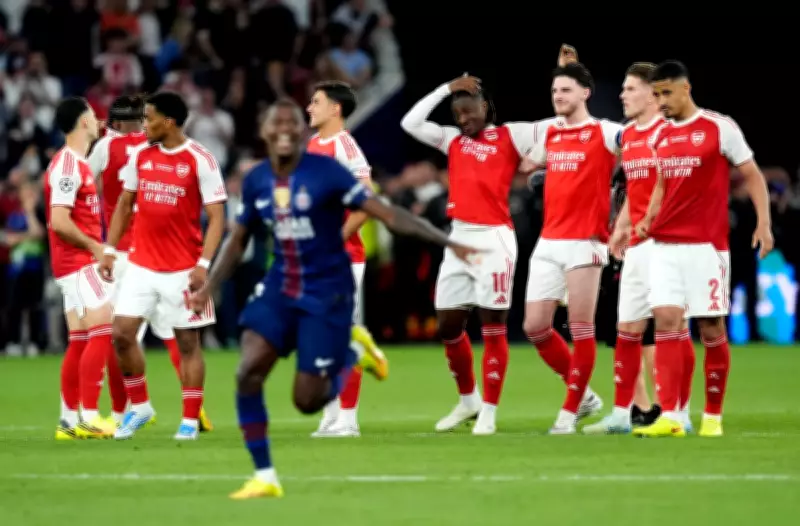
Arsenal's Champions League hopes ended in a heartbreaking penalty shootout loss, leaving fans and players to ponder whether this is the peak of their potential under Mikel Arteta.
The Penalty Shootout Myth
The greatest lie ever told about penalty shootouts is that they are a lottery. In reality, it is a trainable skill involving ball-striking, placement, research, psychology, and nerve. Eberechi Eze's wide shot and Gabriel Magalhães's miss into the Danube illustrate failure under brutal terms. Yet, the second lie is that fortune plays no part. Random factors like divots, bad contact, and goalkeeper guesses—despite preparation—still influence the outcome. That football decides its biggest prizes on such small margins is one of its cruelest traits.
Were Arsenal Unlucky?
After filtering out rage and counterfactuals, Arsenal likely got what they deserved. Losing on penalties after 120 minutes against the defending champions is harsh, but their tactics and mindset largely brought them to this point. Arteta's style aims to narrow outcomes and catch breaks, but a strategy built on defending a 1-0 lead with four center-backs and a low block stands or falls on fine margins. Fine-margins football works until you end up on the wrong side.
Could Arsenal Have Done Differently?
Probably not. Bayern Munich showed the limits of going toe-to-toe with PSG. Arsenal lacks the lawless attack of players like Michael Olise, Harry Kane, or Luis Díaz. Missing their top two right-backs, they finished with a front three of Gabriel Martinelli, Noni Madueke, and Viktor Gyökeres, contextualizing expectations. The resource gap is evident, but so is the priority gap. Arsenal's recent recruitment focused on bolstering the back line and adding depth rather than signing electrifying X-factor players. Perhaps that strategy met its match, exposing fine players like Bukayo Saka, Leandro Trossard, and others on the biggest stage.
Arteta's Post-Match Reflections
Arteta spoke of needing to improve and find different margins, praising Luis Enrique's talent and how it warps the game. There is an assumption that breaking their Premier League drought and pushing PSG to the limit is just the start of a golden age. But what if it isn't? What if this is as good as it gets? A paradox exists: we are told this team has maximized its resources through good coaching and culture, yet also that there is ample room for improvement. If Arteta has squeezed every drop of potential, how likely are further levels? What if the club is already at 105% capacity?
The Road Ahead
The thirst for renewal is strong. New players could bridge the gap, but Liverpool's cautionary tale last summer shows this process is rarely straightforward. World-class players require enhanced wages, new tactics, and different dynamics. Arsenal can count on more hits than misses, but bigger stakes bring bigger risks. Clubs with state backing have fatter margins for error. PSG can shrug off expensive missteps like Neymar, Messi, and Mbappé, while Manchester City spends freely without urgency. Beyond them, Bayern Munich, Barcelona, Manchester United, Chelsea, Liverpool, and Real Madrid have room to improve. Future generations may marvel at Arsenal's luck in reaching a final by beating Bayer Leverkusen, Sporting Lisbon, and Atlético Madrid. Will circumstances be more favorable next time?
Arsenal had a strong claim as Europe's best team this season. While coming close offers comfort, they must realize the window at the highest level is vanishingly small, contingent on luck and skill, with no guarantees of return. If that does not focus minds this summer, nothing will.