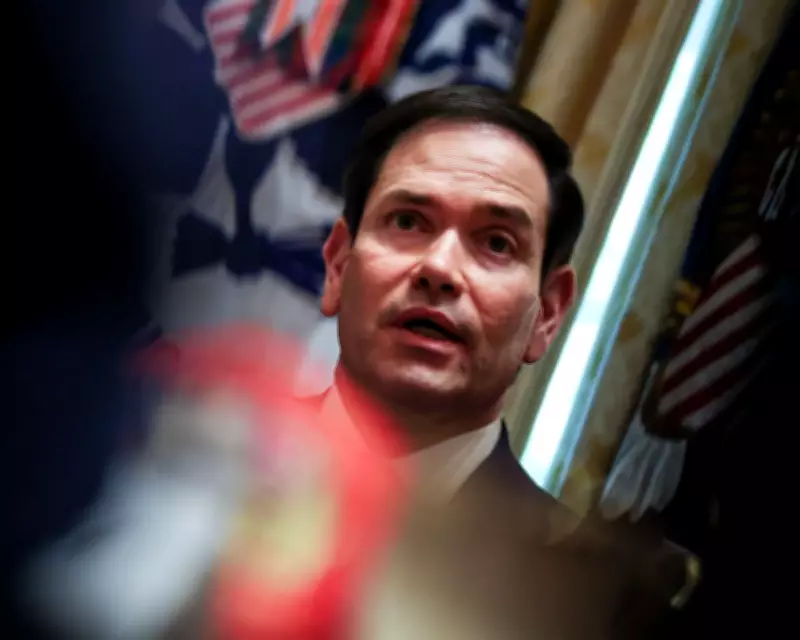
The United States has officially designated Brazil's two largest criminal organizations, the First Capital Command (PCC) and the Red Command, as foreign terrorist organizations. The announcement was made by Secretary of State Marco Rubio on Thursday, a move widely viewed in Brazil as a significant political setback for President Luiz Inácio Lula da Silva, who had strongly opposed the designation, and a boost for his main rival in the upcoming October presidential election, far-right Senator Flávio Bolsonaro.
Flávio Bolsonaro, running in place of his father, former President Jair Bolsonaro—who is under house arrest after being convicted of attempting a coup—spent the week in the United States, where he met with President Donald Trump and Secretary Rubio. The senator had been at a low point in his campaign after leaked audio recordings captured him asking a banker accused of corruption for $26.8 million to fund a film about his father, causing a significant drop in his poll numbers.
In announcing the designation, Rubio stated that the groups are "two of the most violent criminal organizations in Brazil. Their reach extends throughout our region and into our country." Both gangs originated in Brazilian prisons as responses to torture and abuse, and have since grown into some of the largest criminal entities in Latin America. They export cocaine produced in Colombia, Peru, and Bolivia primarily to the United States and Europe, while expanding their operations globally.

Origins and Operations of the Gangs
The Red Command, the older of the two, emerged in the 1970s from interactions between political prisoners jailed by the military dictatorship and common criminals in a Rio de Janeiro prison. The PCC was founded in the 1990s in a São Paulo prison, months after 111 prisoners were killed when police crushed a rebellion at another facility. While both groups compete for control of drug distribution and trafficking routes, they operate differently: the Red Command has a decentralized leadership and resembles the more overtly violent crime factions of Mexico and Colombia, whereas the PCC functions like a corporation with well-defined hierarchies and a low-profile, businesslike approach.
Political Reactions and Implications
President Lula had opposed the US proposal to classify the groups as terrorist organizations, calling it an affront to Brazilian sovereignty and arguing that Brazil already actively combats them. Just hours before the US announcement, Brazil's federal police launched a new operation targeting PCC infiltration into the country's financial sector. Lula has not yet commented on the US decision. In contrast, Flávio Bolsonaro immediately celebrated the move, stating, "On a trip as a presidential candidate, we did more for Brazil and for the security of Brazilians than Lula." Months earlier, he had expressed "jealousy" of US attacks against boats in the Caribbean and eastern Pacific that killed 196 people, suggesting the US could do something similar in Rio's Guanabara Bay. He wrote to US Secretary of Defense Pete Hegseth, asking, "Wouldn't you like to spend a few months here helping us combat these terrorist organizations?"
The US decision, which follows similar designations of organizations in Colombia, Mexico, and Venezuela, had been anticipated for months but was not mentioned during Trump's meeting with Lula at the White House three weeks ago. Flávio's visit to the White House last Tuesday was not on the president's public schedule and, unlike Trump's meeting with Lula—during which the US president praised the Brazilian leftist—was not mentioned by Trump even on social media.
There is still little clarity about the practical consequences of the designation. Analysts fear it could have financial repercussions even for innocent Brazilians, but the move is widely interpreted as another example of growing White House pressure across the region as part of its "war on drugs." A report published this week by the Armed Conflict Location & Event Data Project found that US pressure drove an 18% increase in clashes between security forces and armed groups across Latin America and the Caribbean in 2025.