
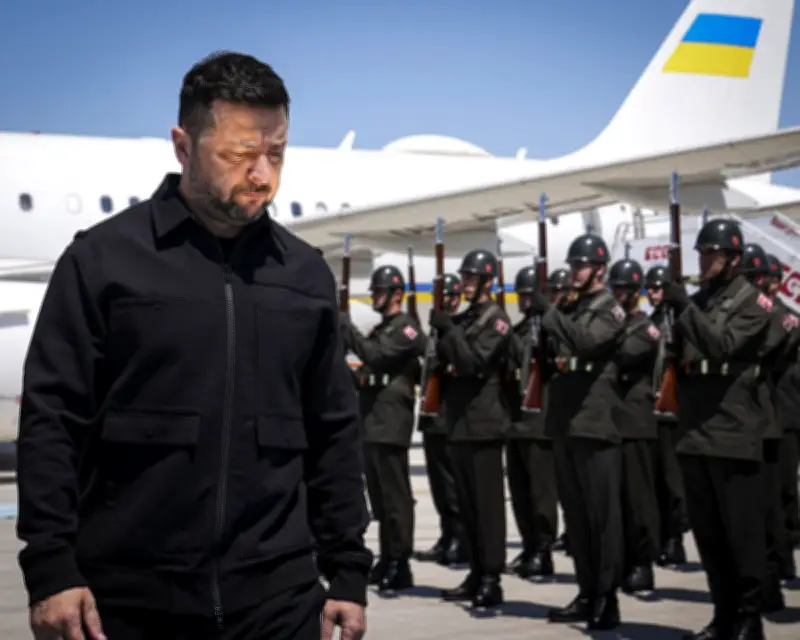
On 26 June, Ukrainian President Volodymyr Zelenskyy ordered a 40-day campaign against Russian targets aimed at “influencing the aggressor state in order to compel it to end to the war.” Since then, Kyiv has sharply escalated attacks on Russia, striking key supply lines in occupied territories, including Crimea, and launching high-profile long-range missile attacks on Moscow and St Petersburg, triggering a fuel crisis.
Why a 40-day campaign?
Orysia Lutsevych, head of the Ukraine Forum at Chatham House, sees Zelenskyy’s framing as an Orthodox Christian reference. “Zelenskyy is the master of narrative performance,” she says. “I think it is a reference to the 40 days in purgatory waiting for the decision to go to hell or heaven. The message is that we already think of you as dead. Now it is your decision whether to save yourselves or not.”
Lutsevych also notes political significance: “Elections for the Duma are in September. Part of the idea is to make Putin understand that it hurts his hold on power by doing everything to bring the war to Moscow and St Petersburg in particular.”
Phillips O’Brien, professor of strategic studies at the University of St Andrews, adds: “It is a psychological campaign. I don’t think there is an expectation that the 40-day campaign will force Russia to surrender. It is a way of saying: ‘We can take the war to you’.”
What does the campaign involve?
While Zelenskyy was initially vague, subsequent comments by Ukrainian officials clarify it encompasses aspects of ongoing efforts: the middle strike strategy disrupting Russia’s supply lines and long-range strikes on military industrial sites, refineries, shipping, and major cities.
Retired Australian General Mick Ryan, writing in his Futura Doctrina Substack, describes it as an “influence operation” to force Russia to end its invasion. “This is a unified campaign of deep strikes against oil refineries, military facilities and major cities intended to press Moscow toward ending the war,” he wrote. Ryan reported that by 5 July, Ukraine claimed to have disabled 42.74% of Russia’s oil refining capacity, with eight refineries hit in a month, over 60 storage tanks destroyed, and cumulative industry losses of $13.5bn.
In one recent week, operations included 13 long- and medium-range strikes on targets such as Saki and Gvardeyskoye airfields, aircraft hangars in Crimea, the St Petersburg oil terminal, the Yaroslavl oil refinery, a refinery in Kaluga region, and the Vysotsk seaport oil terminal on the Baltic.
What has been the impact?
Ukraine’s stepped-up strikes have shocked Muscovites, with towering smoke from burning refineries and large drone flights over Moscow and St Petersburg triggering social media videos. Russians face long queues at petrol stations, with some sleeping in cars for days. In Crimea, strikes on key bridges and roads have caused power cuts and a sense of siege.
The Institute for the Study of War notes potential political frictions: “Ukraine’s successful intermediate- and long-range strike campaigns have forced a reckoning within the Russian ultranationalist information space, causing commentators to blame the Russian federal government for failing to create a cohesive air defence system.”
Does this help Ukraine internationally?
Lutsevych suggests Ukraine’s successes may have shifted attitudes in the Trump administration. After the February 2025 Oval Office scolding, where Trump told Zelenskyy “you don’t have the cards,” last week’s NATO summit in Ankara saw Trump suggest Kyiv could produce Patriot missile interceptors under licence. “That was the biggest visible success of Ankara. It is psychologically important because before it would have seemed unbelievable that the US would give Ukraine the licence for such a sophisticated weapons system,” Lutsevych said.
Where does it go from here?
Speculation includes strikes on key military facilities in Moscow with new ballistic missiles possibly beginning in September. Denys Shtilerman, chief designer of Ukraine’s missile producer Fire Point, said: “First is Moscow … where the military facilities are protected. The most important thing is that I am practically 100% certain they won’t be able to intercept effectively.”
Ukraine may also attempt to retake territory from depleted Russian forces. Lutsevych believes the campaign is likely to continue and perhaps intensify beyond 40 days.




