
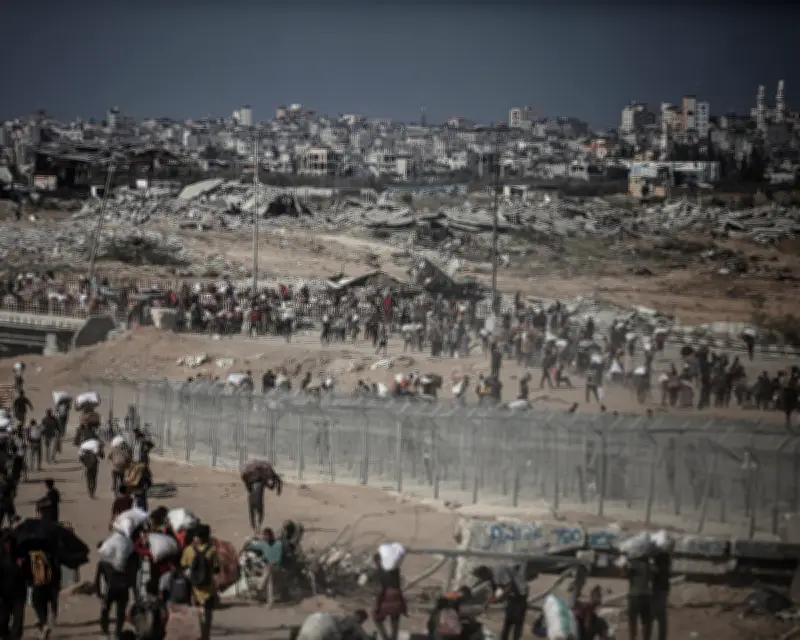
The Gaza recovery plan pursued by Donald Trump's Board of Peace has dramatically shrunk from an ambitious blueprint for reconstructing the entire territory to a small pilot project in the south of the strip. The envisaged pilot scheme involves a temporary camp for a tiny fraction of Gaza's 2 million displaced people, with a Palestinian administration, police, and a small international security force, but is not expected to take shape before the end of the year.
Incremental steps and stalled progress
In recent weeks, a few Moroccan and Kosovan officers have arrived in Israel, intended as the kernel of an International Stabilization Force tasked with protecting the pilot camp. A logistical base for this future force is nearing completion at the Kerem Shalom crossing between Israel and Gaza. However, preparatory work on the pilot camp near Rafah has not begun, nor has construction of the camp's ISF support base. Satellite images show disturbed earth but no new structures. Substantial progress is not expected before Israel holds elections on 27 October, which could bring down Benjamin Netanyahu's far-right coalition government.
Israeli violations and political dynamics
Israel has routinely violated the Trump-brokered ceasefire since it was declared last October, blocking reconstruction work and severely limiting humanitarian aid flows. Western diplomats in Jerusalem believe the best hope for progress is a new Israeli government, but it is unclear whether any successor coalition would be more flexible. One diplomat argued the BoP had no choice but to make the most of limited progress, as an admission of failure would open the way for extreme factions with plans for population transfer and colonization.
There is growing apprehension that Netanyahu, facing electoral defeat, may gamble on a new all-out offensive before the October vote. Israel has carried out frequent strikes killing more than 1,100 Palestinians since the ceasefire and now occupies over 60% of Gaza territory. A return to full-scale war would likely sweep away even the BoP's modest pilot plan.
Disarmament talks and criticism
Israeli officials have suggested a return to war is inevitable because Hamas has refused to disarm. Hamas has said it would lay down its weapons under certain conditions and took part in Cairo talks on disarmament mechanisms. However, progress on decommissioning weapons is unlikely while Israel continues airstrikes and encroachment. The BoP's high representative for Gaza, Nickolay Mladenov, was criticized for echoing Israeli talking points in a UN Security Council report, blaming Hamas without mentioning Israeli violations.
Limited pressure on Israel has been discreet. Aryeh Lightstone, the Trump administration's lead negotiator, wrote to the Netanyahu government in June, calling for relaxation of restrictions on dual-use humanitarian aid and clearance for the ISF and Palestinian police force. The Israeli government has not approved any requests, according to an official.
Pilot camp details and funding
The pilot camp near Rafah would consist of portable cabins for tens of thousands of displaced people, set up in the buffer zone along the ceasefire line. Israeli troops would withdraw, and security would be overseen by the ISF and a vetted Palestinian police force. Training of that force in Egypt has not begun and is expected to take months. The ISF is hoped to be about 5,000-strong, with troops from Morocco, Kosovo, and possibly Albania and Kazakhstan. The legal framework is still being negotiated. An official said late 2026 is a realistic timeline.
Preference for settlement would be given to former Rafah residents, but criteria for vetting are unclear. Critics, including former Israeli PM Ehud Olmert, have denounced the scheme as a "concentration camp" in the making, but BoP officials insist there will be freedom of movement. A wider range of humanitarian relief would be allowed into the pilot camp, but Israel insists on a distinction between humanitarian aid and reconstruction, permitting only the former.
Funding is unclear. Very little of the $17bn originally pledged for Trump's peace plan has materialized. The EU's Palestine Donor Group raised €883m for basic infrastructure, meant to complement BoP projects. The BoP is negotiating for some of the $11bn in Palestinian tax revenue and frozen bank assets seized by Israel to be diverted to project funds. The Palestinian Authority has expressed outrage, with Foreign Minister Varsen Aghabekian stating these are not Israeli funds to withhold. The NCAG was split over the pilot scheme, fearing it would prove divisive among Gaza's 2.1 million Palestinians and create a two-tier humanitarian system.




