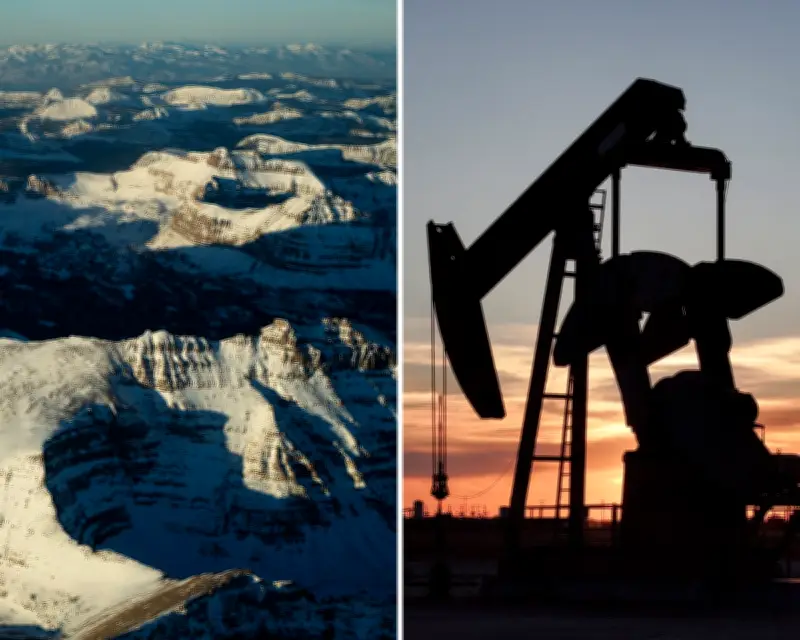
The Trump administration is attempting to shrink public comment periods for fossil fuel leasing on federal land while shifting the financial risks of cleanup to taxpayers and allowing for more planet-warming emissions, according to advocates. It's part of a broader effort to dismantle public input processes and save polluting companies money.
Proposed changes to oil and gas leasing rules
The Interior Department said this week it wants to loosen two Biden-era regulations governing oil and gas drilling on national public lands. One would dramatically lower the fees that firms must pay for future cleanup costs before drilling; the second could allow companies to release more methane, a potent planet-warming pollutant.
The changes would also mean the Bureau of Land Management (BLM) – part of the Interior Department – would no longer be required to assess whether swaths of land proposed for oil and gas leasing have high potential for conflict with other resources such as wildlife habitat. The proposal would slash the public's ability to weigh in on oil and gas permitting.

Reduction in public comment periods
Currently, the BLM must give the public 30 days to weigh in on which tracts of land will be made available in a lease sale. Officials must also draft National Environmental Policy Act documents for each sale, providing an additional comment period of no less than 30 days. Once notice for a lease sale is published, BLM must provide a 30-day 'protest period' for additional public input, amounting to at least 90 days of public participation in total.
If the revisions are finalized, the need for those first two public comment periods would be eliminated completely, and protest periods would last just 10 days instead of 30. That would mean the public would not be able to weigh in on environmental reviews before they are finalized, said Wendy Park, a senior attorney at the Center for Biological Diversity.
'A 10-day protest period is also insufficient for the public to weigh in when there can be dozens of lease parcels in a single lease sale, each with unique resource concerns,' she said. 'It's crucial for the public to be able to have time to raise concerns about specific resources on the ground, especially because BLM staff are not oftentimes necessarily familiar with conditions on the ground and what the effects might be of their decisions.'
Administration defends streamlining
In an emailed comment, an Interior Department spokesperson said: 'The proposed revisions to the oil and gas leasing rule streamline outdated procedures that have slowed the development of reliable, domestic energy in accordance with BLM's multiple use and sustained yield mission.' Interior Secretary Doug Burgum said the changes would ease restrictions that hamstring domestic energy production.
'These targeted updates cut through the red tape that has historically deterred investment, ensuring our public lands remain a reliable engine for economic growth and innovation,' Burgum said. But Park said public input mechanisms boost efficiency in the long term, enabling agencies and communities to 'head off' conflicts early, without needing to file litigation.
Broader attacks on public participation
The Interior Department proposal is just the latest attack on public participation in environmental reviews from the Trump administration. In February, the Forest Service proposed drastically cutting down comment and objection periods for environmental assessments and environmental impact statements, while eliminating the possibility of extensions. Over the past year and a half, BLM also took expanded exemptions for energy producers from environmental reviews. In May, the Interior Department released guidance outlining a process for certain energy projects to circumvent environmental reviews.

Last February, the Council on Environmental Quality rescinded all of its longstanding regulations under the National Environmental Policy Act (NEPA), which require agencies to consider the environmental impact of projects and permits. The agency solicited public comments but said they would have no effect on the final rule. Since that change, agencies including the Department of Agriculture, Interior Department, Surface Transportation Board, Army Corps of Engineers, Energy Department, and National Highway Traffic Safety Administration have all proposed or finalized changes eliminating public comment requirements, Park found.
On Wednesday, the Environmental Protection Agency (EPA) proposed what it called 'minor changes' to its NEPA procedures which would make comment periods for environmental reviews optional.
Critics decry attacks on democracy
'By ignoring public comment [requirements] while propping up companies, they're really attacking democracy in a very clear way,' said Alexa Dietrich, research director at the Union of Concerned Scientists. 'The shrinking of the ability for public input is a hallmark of the administration's approach to deregulation.'
In some cases, the Trump administration has simply stated that comment periods are unnecessary to issue new rules. Last April, President Trump signed an executive order directing the Energy Department to repeal water efficiency standards for showerheads, stating: 'Notice and comment is unnecessary because I am ordering the repeal.'
Just last month, the Office of Management and Budget proposed a sweeping overhaul of rules governing federal grants and financial assistance, offering just a 45-day comment period with no possibility of extension. 'These attacks are so widespread, they've become so pervasive, that they're hard to even track,' Dietrich said. 'The administration is eliminating an important part of our democratic participation.'
Selective application of environmental reviews
Even as it has sought to weaken environmental reviews, the administration has selectively invoked those processes to challenge renewable energy and climate policies, critics say. In August, the Interior Department ordered officials to assess whether unintentional eagle deaths from wind turbines violated environmental protections; weeks later, the Justice Department asked for public comments on state climate laws that 'burden' economies.
'Trump [is] fast-tracking dirty fossil fuel projects without letting communities or experts have a say, while blocking the cleaner, cheaper energy that would actually lower costs for families,' said Alex Glass, a director at Climate Power.
Financial risks shifted to taxpayers
Critics say the Interior Department's latest proposals reflect allegiances to the oil and gas sector, which donated record amounts to Trump's campaign. Among them is a measure that would slash the financial assurances companies must provide to cover the cleanup of spent wells, from the $500,000 requirement established under Biden to $25,000.
'This rollback lets companies put up far less money than cleanup actually costs, so when the wells stop producing and the operators move on, taxpayers and nearby communities can be left with polluted water, leaking methane, and the tab,' said Amy Mall, director of fossil fuels at the Natural Resources Defense Council.
Under the department's proposals, energy firms could also release more methane, a powerful planet-heating gas that is about 30 times as potent as carbon dioxide in its first century in the atmosphere. The Biden-era rule required energy companies to certify that they will capture all of the oil and gas produced by their wells or come up with a plan to reduce their methane releases – but the new proposal would remove that stipulation.
'Make no mistake: Trump is looking out for his big oil billionaire buddies, not American families,' said Glass.