
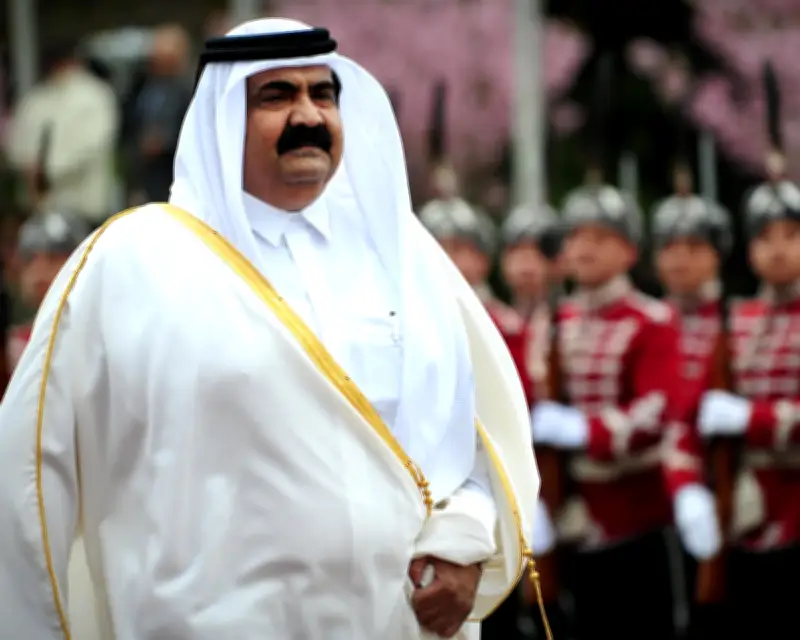
Sheikh Hamad bin Khalifa Al Thani, the former emir of Qatar who transformed his nation into a global economic and media powerhouse, has died at the age of 74. His death marks the end of an era for the small Gulf peninsula, which he single-handedly propelled from regional obscurity to the centre of international geopolitics.
Bloodless takeover and new vision
In June 1995, while his father, Sheikh Khalifa bin Hamad Al Thani, was holidaying in Geneva, Hamad seized power in a swift and bloodless coup. Having effectively run the country for over a decade, the 43-year-old crown prince proclaimed himself emir, permanently altering Qatar's trajectory. Eschewing the traditional finery and aloofness of Gulf monarchs, he governed like a corporate managing director, frequently driving his own car in Doha and dining with minimal security.
A leaked 2008 US embassy cable quoted a source saying: "The Amir seems to be the only one in the Government who has a vision for this country. The details of that vision, however, are not entirely clear to anyone, except perhaps the Amir himself and his closest associates."
Economic transformation and domestic reforms
Hamad bypassed the "oil curse" by aggressively developing Qatar's offshore natural gas reserves, making the state one of the world's wealthiest per capita. Domestically, he delivered Qatar's first written constitution, introduced democratic municipal elections, and elevated women's status. In 1996, he founded Al Jazeera, a satellite news network that expanded into English and Spanish, and in 1998 abolished the information ministry, ending state censorship.
Regional influence and Arab Spring
He maintained US defence ties while championing the Palestinian cause, giving Hamas leaders a base in Doha to moderate their stance. During the Arab Spring, he backed revolutions in Libya and Syria, used Al Jazeera to amplify uprisings, and contributed troops to Bahrain to preserve Sunni rule.
Early life and education
Born in Doha in 1952, Hamad was a member of the Al Thani family, part of the Bani Tamim tribe. His mother died shortly after his birth. A trip to London as a boy exposed him to democracy; he found parliamentary debate so absurd he laughed uncontrollably from the House of Commons balcony. Egyptian teachers influenced his early Nasserist fervour, leading him to throw stones at the British embassy in 1967. Later, he realised these movements had misled his generation, prompting him to replace foreign education with indigenous institutions via the Qatar Foundation.
Military training and succession
He graduated from the Royal Military Academy Sandhurst in 1971, held military posts, and became defence minister in 1977. Over two decades, he managed daily state affairs as his father spent time abroad, burying tribal rivalries and uniting the Al Thani family. He had 24 children with three spouses; his second wife, Sheikha Moza, became his key partner in education and social reforms.
Voluntary abdication and World Cup
In a rare move, Hamad voluntarily stepped down in 2013, handing power to his son Sheikh Tamim. He retired to quiet diplomacy and historical research between Doha and Europe. Their most spectacular soft-power achievement was securing the 2022 men's football World Cup. He is survived by his three wives, 11 sons, and 13 daughters.




