
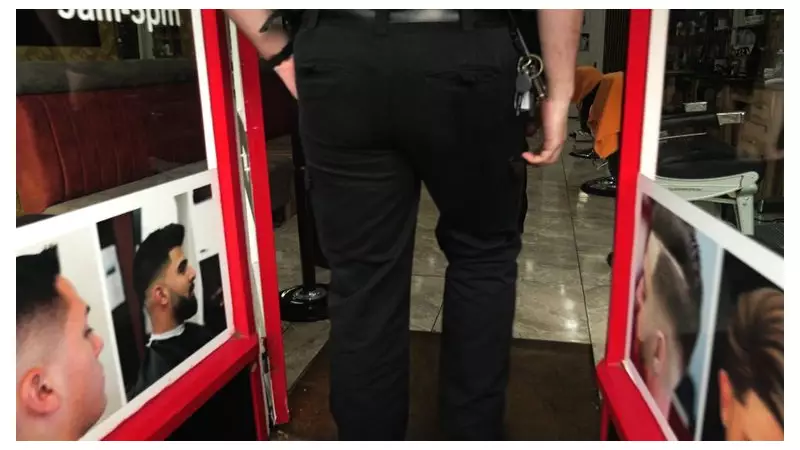
In a stark operation in a Suffolk market town, police have uncovered evidence of suspected modern slavery hidden behind the facade of a seemingly ordinary Turkish barbershop. Sky News Business and Economics Correspondent Paul Kelso was granted exclusive access to the raids in Haverhill on Tuesday 11 November 2025, witnessing first-hand the grim reality behind the 'cash intensive' businesses on Britain's high streets.
A Tale of Two Realities
The barbershop presented a clean and professional front to the world, with bright paint and a local football shirt displayed on the wall. Two impeccably groomed young men told officers they commuted to work from London. However, stepping through a rear door revealed a profoundly different story.
The scene in the dingy stairwell was one of squalor. A bed was crammed onto a landing, with a sofa just large enough to sleep on squeezed underneath the stairs. The floor was littered with empty pizza boxes, food containers, and drink bottles. Personal items, including a pair of socks and a T-shirt, were scattered about, and an unopened prescription sat on a table, indicating that at least one person was living in these conditions, potentially against their will.
John French, the Modern Slavery Vulnerability Advisor for Suffolk Constabulary, stated, "This could be linked to exploitation, this could be linked to some forms of modern slavery. You have to ask yourself when you come across this sort of situation, why would someone want to live in these sorts of conditions?"
Operation Machinize: A National Crackdown
The raid was part of the National Crime Agency's (NCA) Operation Machinize, a nationwide initiative targeting money laundering, criminality, and immigration offences concealed within 'cash intensive' businesses such as barbers, vape shops, and takeaways.
In Haverhill alone, 17 premises were under scrutiny. Across England, the operation has seen over 2,500 sites visited since the start of October, resulting in 924 arrests and the seizure of more than £2.7 million in contraband.
On the same high street, a sweet shop yielded a haul of smuggled cigarettes, while in a nearby Indian restaurant, a young man was found to be working after his student visa had been revoked and his asylum claim rejected.
Sal Melki, the NCA's deputy director of financial crime, explained the broad scope of the criminality they are encountering: "We're finding everything from the laundering of millions of pounds into high-value goods... through to the illicit trade of tobacco and vapes, and people that have been trafficked into the country working in modern slavery conditions. We're seeing a full spectrum of criminality."
Exploitation and Enforcement
Behind a second, padlocked door in the barbershop, officers discovered another room. This one was cleaner but raised further alarm. Notes in Turkish and English were stuck to the wall, and a driving licence with a local address was found. Mr French suggested this could be the living quarters of an 'Alpha' – someone previously exploited who has been given a degree of trust to act as a supervisor, a key target for police to isolate from other potential victims.
The multi-agency approach involved officials from the council, fire safety, Trading Standards, and immigration enforcement. Even where criminal charges are not immediately applicable, poor living conditions can lead to penalties under planning and building regulations, including fines and forced closure.
The operation concluded at a small supermarket, where another hidden bedroom was found in a space no larger than a broom cupboard. A man behind the counter, who claimed to be from Brazil via Pakistan, was handcuffed after admitting to working illegally on a visitor visa. His luggage was found in a storeroom. An immigration officer confirmed he would be taken to a detention centre and "administratively removed" from the UK.
The raids in Haverhill, a town that has missed out on the county's broader prosperity, highlight a disturbing undercurrent of exploitation operating in plain sight on British high streets, with the NCA vowing to disrupt these operations and support legitimate, thriving businesses in their place.




