
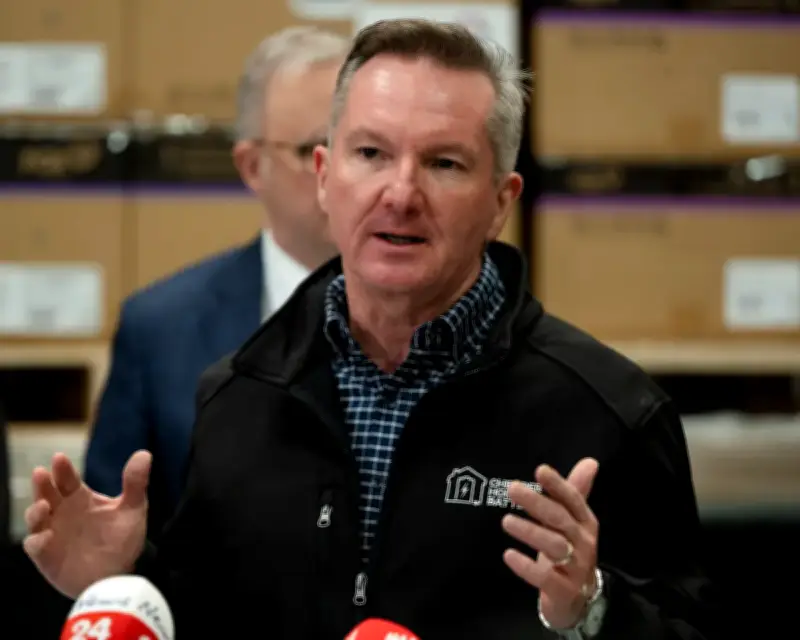
Federal Labor’s new national laws on datacentre power supply will not include carve-outs for Queensland and the Northern Territory, with states eager to use coal and gas required to make their case to the national regulator, according to Energy Minister Chris Bowen.
The minister told Guardian Australia on Friday that the only concession agreed at Wednesday’s meeting of national cabinet was that existing coal and gas supply could be used on the condition it could be shown to be cheaper than renewables. This clarification came after the Northern Territory’s chief minister, Lia Finocchiaro, and Queensland’s premier, David Crisafulli, both claimed wins following the meeting.
Commonwealth to legislate consistent standards
“The Commonwealth, as we always said we would, will be legislating nationally consistent commonwealth legislated datacentre standards, which will require in every state and territory 100% renewables, backed by firming,” Bowen said. “That was the case, is the case, will continue to be the case.”
The only change or concession made is that where a state-owned government instrumentality feels it can provide energy cheaper than renewables, it can apply for an exemption, but the Commonwealth will decide whether to grant that or not. The Australian Energy Regulator will be required to consider every application, with state or territory governments obliged to prove a non-renewables option is cheaper.
Bowen called that “a very hard thing to do”. He added, “Any suggestions of a wholesale carve-out for Queensland and Northern Territory is not accurate.”
State leaders claim wins, but Bowen refutes
After the talks in Sydney, Prime Minister Anthony Albanese described the decisions as allowing flexibility for governments with state-owned power systems. Finocchiaro said gas from the massive Beetaloo basin project would now be available for datacentre power, while Crisafulli said his government could control the energy mix due to state-owned systems.
However, Bowen insisted there would be no carve-out for any state or territory. A communique signed by the leaders indicated further consultation, with the federal government continuing work on “consistent mandatory standards” for energy, water and land use.
Growing demand and emissions data
The meeting followed the latest forecast from the Australian Energy Market Operator showing datacentre power use is projected to increase seven-fold over the next decade. Bowen told the National Press Club earlier this month the federal government would override state governments that oppose new national rules on datacentres, using powers in the Australian Constitution.
Separately on Friday, Bowen released the latest quarterly data on Australia’s carbon emissions, showing a 1.6% drop in the year to March 2026, led by solar, wind and batteries replacing coal and gas generation. The drop reflects a 5.6 million tonne cut in electricity emissions, as well as a 300% increase in battery power discharge.
Bowen said there was more work to do in transport and still “a long way to go” in the overall transition. So far, emissions are down 25% on the June 2005 baseline, coming as Labor works to achieve a 43% reduction by 2030. The government’s longer-term emissions reduction target is a 62% to 70% cut by 2035.




