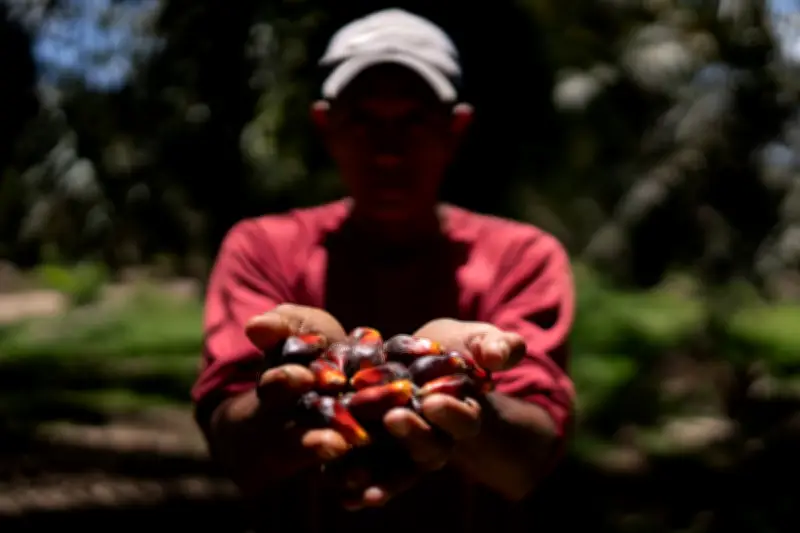
On 21 May, gunmen entered a palm oil farm in Rigores, a small community in the Bajo Aguán valley in Honduras, and opened fire, killing 20 people. The massacre, which left only three survivors, including 15-year-old Orlean, has spotlighted a 30-year conflict over land in this fertile region, where small-scale farmers, or campesinos, face violence from palm oil corporations and drug traffickers. Now, the new rightwing government of President Nasry “Tito” Asfura, backed by Donald Trump, has passed laws that campaigners say criminalize land defenders, shifting danger from hitmen to the state itself.
Roots of the Conflict
The conflict traces back to a 1992 land reform law that allowed large palm oil companies to buy up campesinos’ smallholdings. Peasant farmers’ organisations allege the land was fraudulently taken and have sought to reclaim it through lawsuits and occupations, while companies dismiss the claims as illegal. The violence has been exacerbated by drug-trafficking networks that use the valley as a corridor for cocaine, entangling the land conflict with organised crime.
According to the Honduran Commission for Human Rights (Conadeh), the conflict has claimed more than 200 lives, mostly campesinos, making it one of the bloodiest in a country already notorious for violence against land defenders. Global Witness consistently ranks Honduras among the world’s most dangerous countries for environmental and land activists.

Recent Escalation
Violence has flared again: May was the deadliest month in Bajo Aguán since conflict monitor Acled began collecting data in 2018. Weeks after the massacre, a campesino leader was killed in nearby Santa Rosa de Aguán. The new government’s legal reforms, including a penal code change allowing criminal groups to be designated as terrorist organisations, have been criticised for their open-ended definition.
“Under this law, any group exercising their democratic right to peaceful protest can be labelled terrorist,” says Lucía Vigil from the Centre for the Study of Democracy (Cespad). Yoni Rivas, spokesperson for the Plataforma Agraria, a regional network of campesino organisations, faces daily death threats and travels in an armoured car provided by the state on the orders of the Inter-American Commission on Human Rights. “But with a law like this, danger no longer only comes from the hitmen who follow me around, it comes directly from the state,” he says.
Legal Strategy Against Activists
Two weeks after the terrorism law, the government approved a law prioritising agribusinesses in land rights cases, justifying immediate police intervention against protesting communities. Lucas Mantelli, a lawyer at the pan-American Centre for Justice and International Law, says the laws are interlinked and part of a strategy “shaped out of a partnership between business groups, elites and the Honduran state to benefit agribusiness at any cost, with complete disregard for the rights of environmental and land defenders.”
The approach mirrors that of former president Juan Orlando Hernández, a convicted drug trafficker pardoned by Trump, under whom nearly $72m was invested in the palm oil industry despite human rights allegations. Campaigners say the military and police turned a blind eye to abuses, while under the leftwing Xiomara Castro, who left office this year, a commission for agrarian security was set up, leading to fewer violent evictions. “Violence under [Castro] did not decrease, but at least there were some attempts to address the conflict,” Vigil says. “Now, we are returning to a period of state repression towards any civic dissent.”
Lack of Accountability
In Rigores, few believe the government protects them. Conadeh estimates nine out of 10 killings and abuses are never investigated in Bajo Aguán. When the massacre occurred, families rushed to the site, identifying loved ones among the 20 bodies. Before police arrived, they took their slain relatives, a common practice driven by distrust and to avoid paying an alleged $300 release fee. Investigators later exhumed bodies for autopsies, but as Santiago, who lost three daughters, says: “It is not as if they are going to find who was really responsible for the killings.”