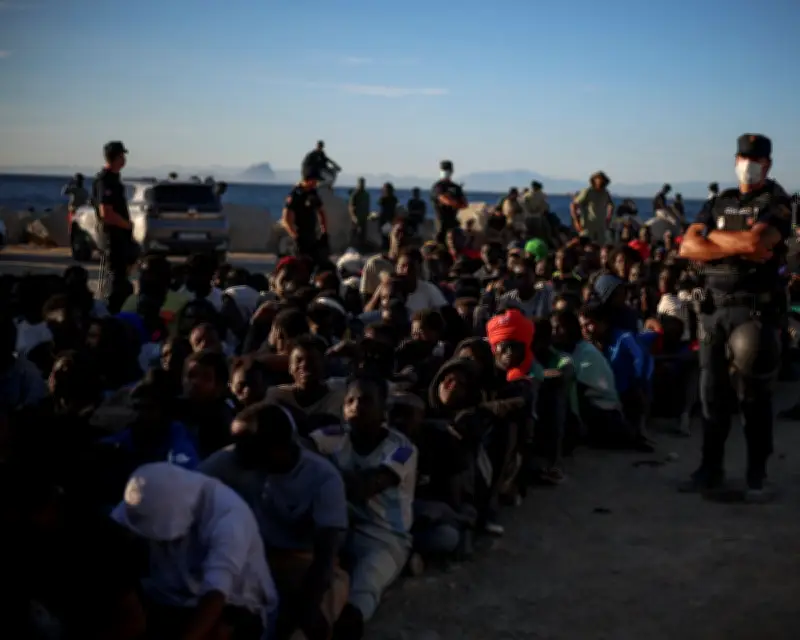
European Union migration commissioner Magnus Brunner has criticised Spain’s plan to regularise undocumented migrants as “definitely not a good signal for the rest of Europe”, in a rare note of discord following an emergency meeting aimed at resolving divisions over the Ceuta crisis.
Ceuta Crisis: A Test of Resilience
Speaking after EU interior ministers held a hastily arranged video conference on Tuesday, Brunner acknowledged that the past few days had been “a test of our resilience” and the EU’s external border. He noted that the situation was under control, with no migrants moving to mainland Spain and the border-free Schengen zone unaffected.
The meeting was intended to draw lessons from the politically divisive crisis, which saw tens of thousands of migrants arrive in the tiny Spanish territory in north Africa last week. Spain’s government said at least 75 people died trying to reach the territory, although Ceuta authorities on Monday put the death toll at 88, with at least 11 more on the Moroccan side of the border.

Spain's Regularisation Plan Under Fire
Brunner’s criticism focused on Spain’s plan to regularise 500,000 undocumented migrants and asylum seekers, a scheme that has attracted nearly 1.2 million applications. He said that while the EU could not currently see a direct link between events in Ceuta and the regularisation plan, the policy was “definitely not a good signal for the rest of Europe”.
“I do understand that it is a member state’s competence. And I do understand that Spain did it because it’s mainly about Latin Americans speaking the same language, having the same culture, but the signal for the rest of Europe is not a good one, definitely not,” Brunner added.
Divisions Among Member States
The criticism came after 22 EU member states, organised by Italy and Denmark, signed a letter implicitly criticising Madrid’s regularisation plan as a “pull factor” for “illegal migration”. Spain’s interior minister, Fernando Grande-Marlaska, described the EU meeting as constructive, saying member states had recognised Madrid’s “immediate and efficient” response.
Brunner declined to criticise Italy’s decision to reintroduce air and sea border checks with Spain for one month, following Spanish Prime Minister Pedro Sánchez’s remarks that such moves were informed by “prejudice, fake news, ignorance and political interest”. Brunner said any suspension of Schengen rules had to be proportionate and temporary, adding: “I have some understanding of this reaction of the Italians, because the citizens are concerned.”
EU Looks to Strengthen External Borders
Ministers broadly endorsed a five-point plan set out by European Commission President Ursula von der Leyen, which proposed further action to strengthen Europe’s external borders, including an early-warning system and better cooperation with non-EU countries on migration. A statement published by the EU council after the meeting said there was “a common understanding of the need to continue relentlessly fighting migrant smuggling networks, to reinforce returns, to strengthen EU borders, to build deep partnerships with third countries, and to improve foresight”.
Ministers also emphasised the need to improve “situational awareness, which could be achieved by further developing early-warning systems such as pre-frontier intelligence and social media monitoring” and efforts to “counter malicious external actors engaged in foreign information manipulation and interference”, the statement said. The EU’s foreign policy service was investigating the possible role played by Russian disinformation, but it was too early to reach conclusions, Brunner said.
Migration Numbers and the Road Ahead
Migration has been a deeply divisive issue for the EU since the 2015-16 crisis, when more than a million people sought asylum in the union. Despite fewer people making irregular crossings, tensions remain high as far-right and nationalist parties seek to outflank mainstream rivals on the issue.

The EU’s border agency, Frontex, reported 178,000 irregular border crossings in 2025, down 26% on the previous year and the lowest since 2021. Irregular arrivals in Spain (36,683) were significantly lower than in Italy (66,328) and Greece (51,399), as well as attempted and successful crossings to the UK (65,891), according to Frontex.
Brunner emphasised the need to implement the EU’s migration pact, playing down a suggestion from Greece that further emergency measures were required. Greek Prime Minister Kyriákos Mitsotákis, in an article for Politico, said countries should be able to suspend asylum applications for newly arrived people when facing “exceptional situations of extreme and disproportionate pressure”. Europe was facing the “deliberate instrumentalisation of migration by state and non-state actors”, he wrote, saying the pact did not provide the tools for these scenarios.
Brunner disagreed – “the pact does offer solutions for this” – while not ruling out changes, saying EU leaders would discuss a “strategic way forward”.