The European Union should establish a new "integrated partnership" status for like-minded countries that want deep cooperation without full membership, according to Fabian Zuleeg, chief executive and chief economist at the European Policy Centre. This would allow countries such as Canada, the UK, Japan, and South Korea to combine with the EU on geopolitical and geo-economic necessities without signing up to a predetermined constitutional outcome.
Beyond Existing Models
Zuleeg argues that existing models like the European Economic Area (EEA), which Iceland and Norway participate in, are insufficient. The proposed "integrated partnership" would extend beyond the economy to include defense, security, economic security, and foreign policy, making them as fundamental as trade and the single market. The main criterion would be geopolitical rather than geographical, meaning a country would not have to aspire to EU membership or even be situated in Europe to qualify.
The proposal comes in the wake of Iceland's EU referendum result last month, where voters refused to reopen accession talks. Zuleeg interprets this not as a distancing from Europe but as a rejection of the binary choice between full membership and staying outside the bloc. He suggests that some countries want to be inside the European tent without necessarily becoming members.

Addressing the Accession Queue
There are currently nine countries seeking full EU membership, but the EU will struggle to deliver on its promises within a reasonable timeframe. Political resistance to expansion could intensify if key national elections next year shift the EU's majority political outlook. Internal reforms, budgetary concerns, and the complexities of accession could leave some countries waiting for years.
Zuleeg emphasizes that all sides would benefit from giving these queueing nations another option. Ukraine and the western Balkan countries should not remain stranded in a geopolitical waiting room simply because the EU lacks the political will or administrative bandwidth to admit them. However, safeguards are essential: this advanced partnership must be a bridge to membership for those seeking it, not a "car park" that allows existing EU governments to renege on promises if they become electorally unpopular.
Canada as a First Candidate
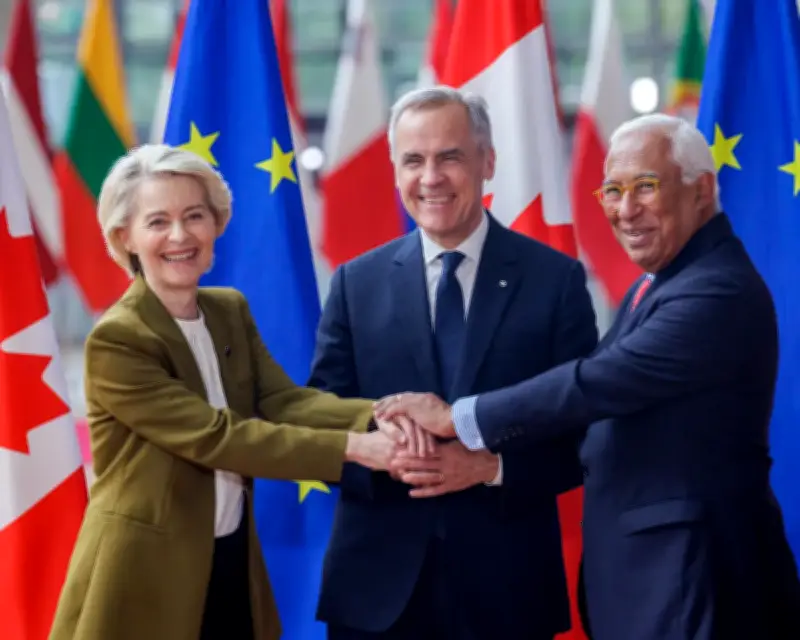
Zuleeg identifies Canada as a prime candidate for integrated partnership. He urges that the EU-Canada summit in October should go beyond another list of deliverables and start establishing a special status so deep that Canada could eventually become the equivalent of an EU member state in all but name. He suggests that European Commission president Ursula von der Leyen should announce this in her annual state of the union address this week.
Canadian prime minister Mark Carney has expressed interest in a "unique alliance" with the EU, particularly as Canada's relationship with the US is strained. However, Zuleeg cautions that integrated partners should not get a free ticket to EU policy benefits without corresponding obligations and costs.
Geopolitical Necessity
The case for this new architecture is becoming easier to make as democracies face increasingly aggressive behavior from authoritarian powers. Middle powers risk being isolated, divided, and picked off individually. As Carney has argued, they must act together in response to the rupture of the old international order. Integrated partnership could help operationalize this argument.
Zuleeg also points to a more uncomfortable reason for new geopolitical architecture: it cannot be assumed that countries, even those joined through the EU, will always continue on a like-minded path. France or Germany could in the future be governed by illiberal anti-European forces. A network encompassing democratic EU members and their close partners could then become a political counterweight, helping to preserve collective action when consensus inside the EU becomes impossible.
The European project emerged from the ruins of the second world war. Now, in a different geopolitical context, ambitious mechanisms are needed for bringing like-minded democracies together. Full EU membership cannot be the only route to deep integration. Maximum integration without a predetermined end point should become the objective.

Iceland's vote, driven by concerns over fisheries and other totemic national issues, shows why new thinking and geopolitical ambition are needed. Geography should no more determine who can be inside Europe's tent than the time it takes to conduct painstaking enlargement negotiations. The decisive question is whether Europe can club together with all countries prepared to defend democratic principles together.