
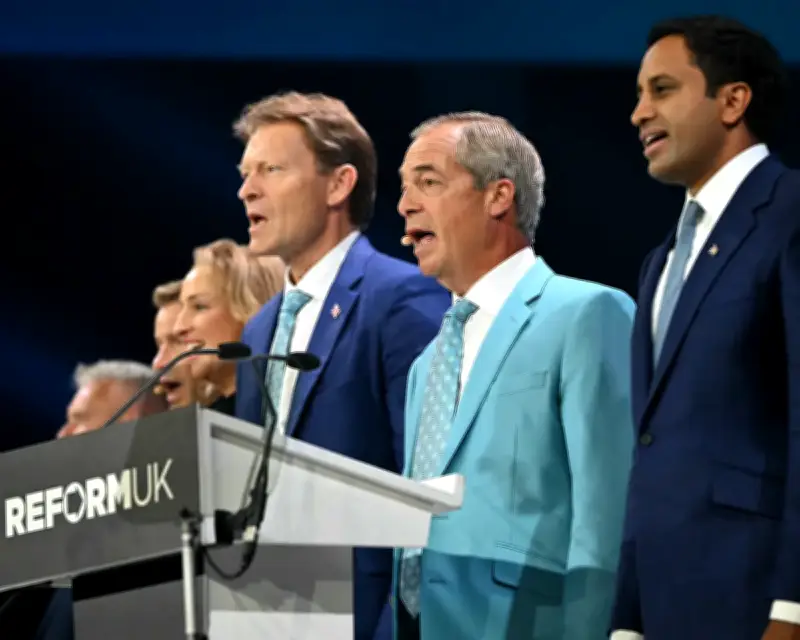
Reform UK's deputy leader, Richard Tice, Nigel Farage, and the party's shadow home secretary, Zia Yusuf, sang the national anthem at Reform's conference at the NEC in Birmingham on 5 September 2026. The image of unity, however, masks a growing internal debate about the party's direction and leadership.
Farage's Defense: Present but Not Involved
Nigel Farage didn't know. He wasn't told. Sure, he was right there at the table when the undercover reporter he believed to be a rich American's son spelled out very clearly how he hoped to channel his father's money to Reform, in ways that certainly don't sound too lawful. But he wasn't listening, you understand. God forbid that the man who insists his party takes compliance very seriously, and who never stops warning that the establishment is out to get him by any means possible, should actually pay attention to the details of a donation offered bang in the middle of a byelection that was fought over – of all the luck, eh? – some other questionable donations.
Farage's defence is essentially that he was present but not involved, as Jeremy Corbyn once famously said of attending an event where someone laid a commemorative wreath for members of the terrorist group behind the 1972 Munich Olympics atrocity. It didn't work for Corbyn, any more than claiming to have tried cannabis but never inhaling worked an age ago for Bill Clinton, in part because some people just didn't believe it. But mostly, perhaps, because critics found it revealing even that Corbyn would be at the kind of gathering where such things might happen. Most aspirant prime ministers take good care to avoid moving in circles where someone might end up venerating terrorists, or explaining exactly how they intend to get around the law. For good reason, it turns out.
Internal Tensions and Leadership Questions
What we are being asked to accept, in the instance caught on camera, is that at best Farage has been astonishingly sloppy; that he just turned up, tuned out, thanked the guy without even really knowing what for, and then went happily on his way. Take Farage at his own word and he is describing someone curiously semi-detached. Someone who, despite repeatedly claiming his enemies will stop at nothing to stitch him up, puzzlingly doesn't seem to take such basic precautions against entrapment as noticing what's actually going on around him. Someone for whom fighting a byelection in which nobody else of note is standing, bar a talking bin, is apparently so all-consuming that he can't possibly be expected to concentrate on talking to donors as well.
If that degree of walking and chewing gum is a stretch, imagine what a shock running the country might be. No wonder some in Reform are starting to ask themselves if, deep down, that's what he even wants. What would Reform look like without Nigel Farage? Once upon a time that would have been a ridiculous question – without him, it would simply fall apart – but the party now is not quite what it used to be. Among the faithful, the fact he doesn't seem to take the job too seriously is still part of his charm, and many Reform supporters will be nothing but indignant on his behalf at the undercover tactics used to catch him out.
But there are also people in Reform these days who have seen the very real possibility of seizing power to enact an agenda not seen before in Britain, just as Alternative für Deutschland is starting to do in Germany and as the National Rally's Marine Le Pen and Jordan Bardella (the star turn at Reform's party conference this year) threaten to do next year in France. They won't want to let that opportunity slip through their fingers.
Rival Factions and the Road Ahead
Having lost its lead in the polls, Reform finds itself ironically in a version of the dilemma Labour faced a few months ago: torn between those who think recovery depends on tacking left (in this case towards Tory voters who are Reform-curious but worry that it seems too extreme or sleazy) or tacking right (towards Rupert Lowe's Restore, now consistently taking small but damaging chunks out of them, and other far-right groupings). Events like last weekend's sinister black-shirted, paramilitary-style show of force in Dover by the previously little known Patriot Platform group – which even the government took a surprisingly long time to condemn in the decisive terms that chief secretary to the Treasury Emma Reynolds eventually did on Monday morning, after what looked like copycat demonstrations in Portsmouth – may now start to push those tensions into the open.
Are these their people, or not? Having ripped open Pandora's box by saying what others would not on immigration, there would be a grim irony in Reform struggling to deal with the furies unleashed, if only the whole thing wasn't so frightening for everyone else. Farage ended up calling the Dover mob “disgusting” because of their balaclavas, while suggesting he absolutely shared their anger about small boat crossings (now, of course, down to a seven-year low). But is covering your face at a protest the only line Reform won't cross?
Some of its supporters clearly do want a leader prepared to say what Farage won't, a niche that Zia Yusuf, Reform's home affairs spokesperson, evidently aims to fill. Others more recently arrived from the old Conservative party might prefer a leader who treads a hard line on immigration, welfare and woke, but with some rougher edges sanded off (or so Robert Jenrick clearly hopes). Crucially, some in both camps will see the departure of close aide Dan Jukes – who along with head of policy, James Orr, has taken the rap for this latest donor scandal, though both deny wrongdoing – as an opportunity to replace Farage's loyal and protective sidekicks with people less tied to him personally.
Historically, anyone daring to fly this close to Farage's sun has got their wings scorched. But what if that sun doesn't burn quite so brightly any more? What if the political judgment that always served him so well in the past is now fractionally off-key? For now, the idea that there could be an election any minute – forced, perhaps, by some future bond market crisis – is perhaps imposing a measure of discipline on the party. But what if that imaginary snap election never materialises?
For now, these are all still very much “what ifs”. Given his miraculous capacity for resurrection, it is a mistake to underestimate Farage or count him out when he is down. But until recently, even the idea of Reform without its leader seemed ridiculous; he was Reform, to the point that without him it would cease to meaningfully exist. In the current climate, that assumption may no longer be safe. Bardella, after all, got his big break when Le Pen was brought down by a financial scandal. It's time the other parties thought harder about the shape Reform might take without its maker, rather than assuming the battle begins and ends with him.




