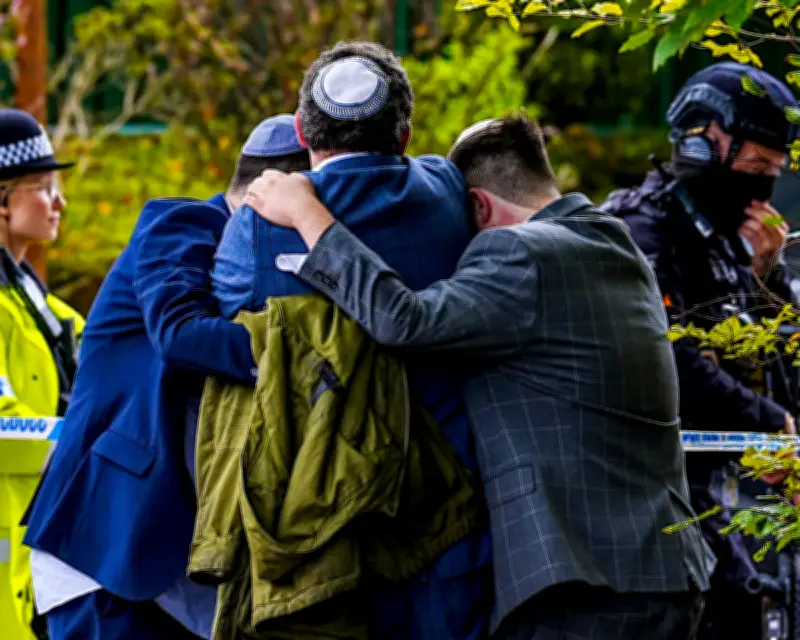
The government's announcement of more than £250m over three years to protect Jewish communities in England and Wales is welcome, but policing and security alone cannot provide a sustainable or dignified future for British Jews, writes David Davidi-Brown, chief executive of the New Israel Fund.
Security funding welcomed but not a solution
When arsonists attacked Finchley Reform Synagogue earlier this year, the physical damage was mercifully limited. But the fear travelled much further. For years, it was my community: I sang at Friday night services, taught b'nai mitzvah students, and its former rabbi officiated at my wedding. Seeing it targeted felt painfully personal, part of a pattern that has led to British Jews changing routines, concealing symbols of our identity and wondering whether the places we gather in can be kept safe.
The government's announcement of more than £250m over three years to protect Jewish communities in England and Wales is therefore welcome. Communal leaders have recognised the difference it can make after the murders at Heaton Park synagogue, the stabbings in Golders Green and repeated attacks on Jewish people and institutions. The Community Security Trust said it had come "not a moment too soon."

Beyond security: education and cohesion
But as many Jewish representatives and government officials have acknowledged, policing and security alone cannot provide a sustainable or dignified future for British Jews. A country where Jewish children pass security guards to enter school, and worshippers expect police outside synagogues, should not mistake better protection for a solution. Success must also mean confronting the conspiracies, dehumanising ideas and extremist movements creating the threat.
Anti-Jewish racism damages Jewish life first and most directly. But the fundamentalism sustaining it also corrodes democracy and relations between communities. The government is right that protection must sit alongside education and cohesion work.
Solutions Not Sides: building empathy
The charity Solutions Not Sides (SNS) demonstrates what this looks like in practice: pairing Israeli and Palestinian peacebuilders to work directly with young people, moving them from abstraction and stereotype towards human connection. The results are striking. In the week after the 7 October 2023 attacks on Israel, students in north-west England who had previously written of hatred towards Israelis expressed sympathy for the victims of the attacks after taking part in an SNS session. At a summer camp last year, students who arrived describing Palestinians as "terrorists" and "aggressive" left expressing sympathy for the suffering in Gaza and appreciation for the Palestinian speaker they had met.
We need more of this work, building the empathy and critical thinking that make young people resistant to the polarisation on which both antisemitism and Islamophobia depend.
Collective blame and community relations
Frightening events, overseas or on British streets, are repeatedly used to stigmatise whole populations. Recent events in Southampton and Belfast showed what can happen when malicious actors attach an individual crime to a community, spread the most inflammatory version online and present neighbours as enemies. I would urge fellow progressives to understand that this is how many Jews feel when campaigns they may otherwise sympathise with make sweeping accusations against all Israelis and then extend responsibility to Jews.
That is why, in the wake of the most recent far-right unrest, I welcomed the Board of Deputies of British Jews' condemnation of violence and intimidation directed at ethnic minorities, faith communities and immigrants. Horrific crimes must not become tools for blaming uninvolved people. This does not mean pretending every hatred is identical. Antisemitism, Islamophobia and anti-immigrant racism have distinct histories and forms. Precision matters. But so does recognising how fear becomes collective blame.

Report findings and the way forward
The government's security funding announcement comes soon after the publication of a report, Britain Under Strain, by the former counter-extremism commissioner Sara Khan. Only 38% of respondents thought Britain was safe for Jewish people and 28% believed Jews hold most of the world's wealth and power. Among British Muslims surveyed, 20% have a negative opinion of Jews, more than twice the rate of the general public.
Those findings must be confronted honestly but not turned into ammunition for collective blame. The same report found that 85% of British Muslims favour integration and 88% mix comfortably with people of other faiths. The lesson is not that one minority should fear another. It is that prejudice must be identified where it exists, challenged without euphemism and addressed through education, leadership and sustained contact.
Social media and community responsibility
Social media companies have a particular responsibility. Their platforms reward outrage and enable misinformation and collective blame. They should enforce rules against incitement, disclose how recommendation algorithms work and let independent researchers study how hatred spreads during crises.
Faith communities must challenge prejudice within their own ranks, rather than speaking out only when their own members are targeted. Progressives and anti-racists must name antisemitism clearly, including when outrage at the Israeli government hardens into hostility towards Israelis generally or collective blame of Jews.
Measuring success
The government deserves recognition for responding to an immediate danger. But success cannot be measured by how permanently we surround Jewish life with police. It must be when fewer officers are eventually needed: when Jewish children can enter school, worshippers can attend synagogue and queer Jews can join Pride without wondering whether their identity makes them a target.
British Jews need protection now. We also need all parts of society to be determined to confront the hatred that made this investment necessary.