
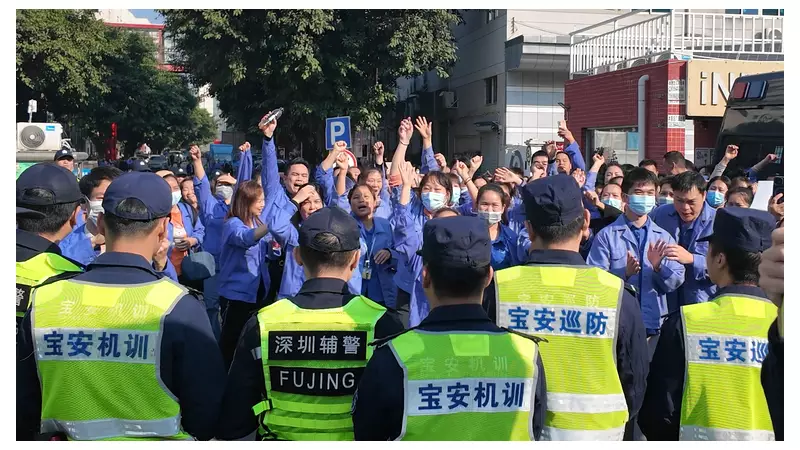
In a stark illustration of the challenges of reporting from within China, a Sky News team was forcibly detained and had their camera seized while attempting to document a factory workers' strike in the southern city of Shenzhen.
A Tense Standoff on the Streets of Shenzhen
The incident occurred in an industrial area of Shenzhen, where hundreds of workers from the Yi Li Sheng audio equipment factory had gathered for a fourth day of strike action. The employees, clad in blue overalls, were protesting a sharp reduction in their hours and take-home pay, which they claim no longer covers basic living costs in one of China's most expensive cities.
"Last month my wages were only 1900RMB (£200)," one distressed woman told reporters. "It's impossible! How can you survive in Shenzhen on that wage?" The factory has not responded to the allegations.
As the Sky News crew approached, the striking workers, recognising them as foreign media, began cheering and chanting. The reaction from Chinese authorities was immediate and forceful. Team members were physically pulled aside, camera lenses were blocked, their equipment was seized, and they were forced into cars and driven away from the scene. While physically unharmed, the team described the ordeal as a frightening sign of how determined the state is to control the narrative.
Data Reveals a Dramatic Surge in Unrest
Such scenes are rarely captured, as protests in China are typically shut down swiftly and scrubbed from domestic social media. However, evidence suggests they are far from isolated. According to exclusive analysis for Sky News, documented protest incidents in China rose by 48% in the first eleven months of 2025 compared to the same period in 2024.
This data comes from the China Dissent Monitor (CDM), a research group linked to the US-based NGO Freedom House. CDM documented over 5,000 cases in 2025 alone. The group gathers information by monitoring Chinese social media, but admits the true scale of unrest is likely much higher. "Real-world protests are much higher than what we capture," said CDM's research lead, Kevin Slaten.
The driving force behind most demonstrations is economic hardship. Since June 2022, a significant 85% of incidents charted by CDM were related to economic grievances, such as unpaid wages, land disputes, and issues with property purchases.
The Risky Fight to Preserve Evidence
Preserving and disseminating evidence of these protests falls to a small number of activists operating from outside China. One such individual, known only as Li, runs a popular X account called "Teacher Li is Not Your Teacher" with 2.1 million followers, where he shares protest videos. He lives in hiding and claims his family in China has been threatened for his work.
He argues that economic downturn, social instability, and increased government control create a cycle of discontent. "Expressing dissatisfaction openly is a thing hidden under a kind of 'red terror'," Li stated.
While overtly political protests targeting the Communist Party remain rare—the 2022 "White Paper Protests" against COVID restrictions being a notable exception—localised anger can quickly escalate. An August protest in Jiangyou over a school bullying incident spiralled into violent clashes with police after crowds felt their concerns were ignored.
The Chinese government maintains that protest is legal and that dissidents do not represent mainstream society. It has sanctioned Freedom House. Nevertheless, the data and firsthand experiences from the ground in cities like Shenzhen indicate that economic pressures are fuelling a visible and growing wave of dissent that authorities are increasingly anxious to conceal from the world.




