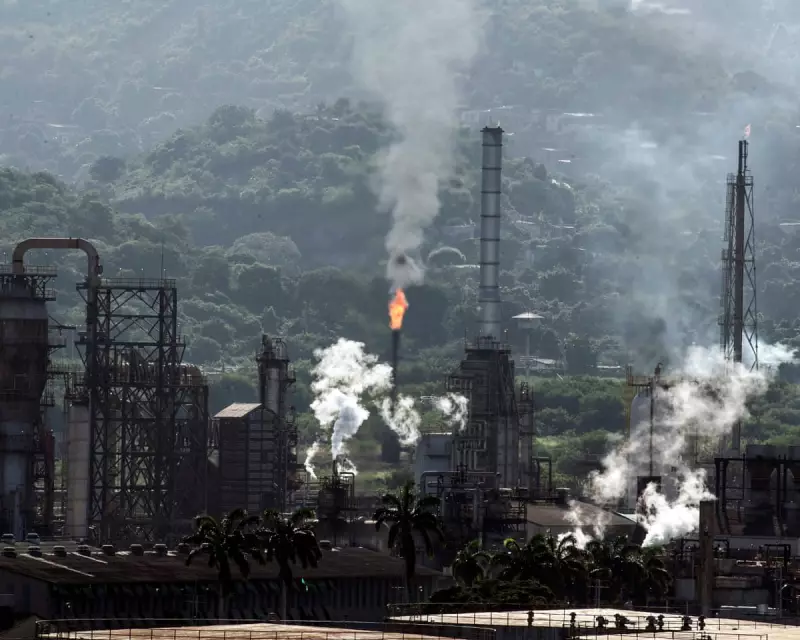
Former US President Donald Trump has declared that Venezuela will hand over $2bn worth of its crude oil to the United States. This flagship negotiation aims to redirect supplies away from China while assisting Venezuela in avoiding further production cuts mandated by global agreements.
Details of the Venezuela Oil Agreement
In an online post, Trump stated: "This Oil will be sold at its Market Price, and that money will be controlled by me, as President of the United States of America, to ensure it is used to benefit the people of Venezuela and the United States!" The announcement, made on Tuesday, represents a significant shift. Venezuelan government officials and the state oil company PDVSA have so far declined to comment.
The deal comes after a US pressure campaign, including a blockade imposed by Trump, left Venezuela with millions of barrels stranded on tankers and in storage. This campaign culminated over the weekend with the toppling of President Nicolás Maduro, who was seized by US forces. While top Venezuelan officials have labelled Maduro's capture a kidnapping and accused the US of attempting to steal the nation's vast oil reserves, the apparent agreement signals the government is responding to Trump's demands to open up to US oil companies or face potential further military intervention.
Greenland Ambitions and International Backlash
Simultaneously, Trump and his advisers have reignited discussions about acquiring Greenland. A White House statement on Tuesday confirmed they are exploring "a range of options," explicitly noting that using the US military remains "always an option."
White House press secretary Karoline Leavitt emphasised the move as a "national security priority" vital for deterring adversaries in the Arctic. However, this long-running desire has faced immediate and fierce pushback from European leaders.
Greenland's Prime Minister, Jens-Frederik Nielsen, urged Trump to abandon his "fantasies about annexation," calling the US rhetoric "completely and utterly unacceptable." Danish Prime Minister Mette Frederiksen had previously warned that any US attack on a NATO ally would mean the "end" of the alliance and post-Second World War security architecture.
Other Key US Political Developments
Amid these foreign policy moves, several domestic actions have drawn criticism:
- The Trump administration is freezing over $10bn in federal childcare and family assistance funds to states including California and New York, citing concerns about fraud.
- The Department of Justice has released less than 1% of documents related to the late financier Jeffrey Epstein, prompting accusations of "lawlessness" from Democrats.
- Immigration authorities have deployed more agents to Minnesota, describing it as their "largest operation to date" against the state's immigrant populations.
- Democratic senators accuse the administration of abandoning efforts to combat child exploitation and human trafficking by diverting law enforcement to immigration enforcement.
These events collectively paint a picture of an administration pursuing aggressive and controversial policies on multiple fronts, with significant implications for international relations and domestic governance.