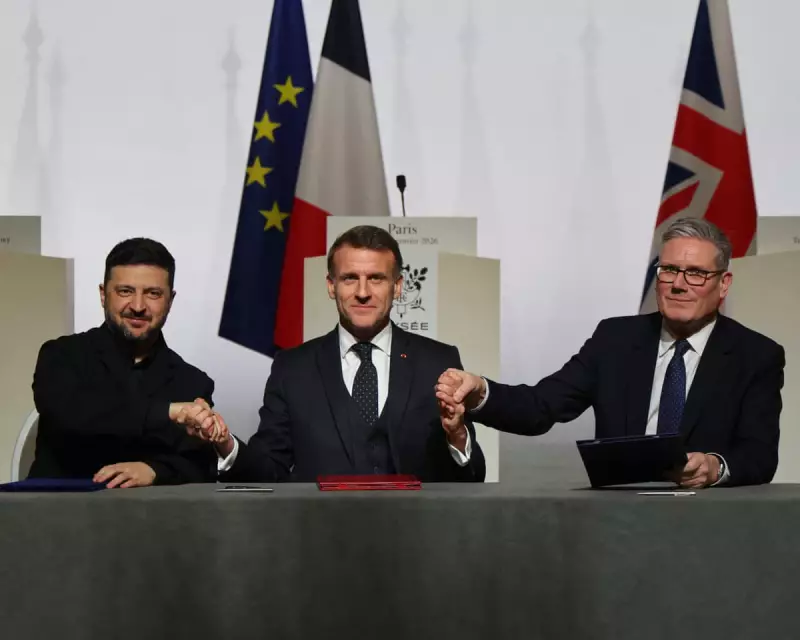
In a landmark move, the United Kingdom and France have declared they are prepared to deploy military personnel to Ukraine in the wake of a future ceasefire agreement. This significant commitment was unveiled following a high-stakes summit in Paris, attended by over two dozen world leaders from the coalition supporting Ukraine.
A Trilateral Declaration of Intent
The pivotal announcement came after hours of negotiations on Tuesday evening, culminating in the signing of a trilateral declaration of intent by French President Emmanuel Macron, UK Prime Minister Keir Starmer, and Ukrainian President Volodymyr Zelenskyy. The document paves the way for British and French forces to be stationed on Ukrainian soil once hostilities formally cease.
Prime Minister Starmer outlined the plan, stating, "Following a ceasefire, the UK and France will establish military hubs across Ukraine." He was quick to temper expectations, however, clarifying that this planned ground force is not intended for direct combat with Russian troops should Moscow reignite an invasion. President Macron emphasised the force's purpose would be "to provide reassurance after the ceasefire" and would be positioned "a long way behind the contact line." Specific details regarding the size and scope of the potential deployment were not immediately provided.
Coalition Dynamics and US Stance
The Paris gathering, hosted by President Macron, assembled an impressive roster of 27 heads of state or government from the so-called "coalition of the willing." The United States was represented by envoy Steve Witkoff and Donald Trump's son-in-law, Jared Kushner, who asserted that President Trump "strongly stands" behind the discussed security protocols.
Witkoff addressed concerns about the reliability of US support, stating the security guarantees are "as strong as anyone has ever seen" and designed to deter further attacks. He affirmed, "The president does not back down from his commitments... We will be there for the Ukrainians." This reassurance comes amid European anxiety over Trump's recent foreign policy focus shifting to Venezuela and his threats towards Greenland, which have strained transatlantic relations.
Despite the broad coalition support, not all nations are ready to contribute boots on the ground. Italy's Georgia Meloni and Poland's Donald Tusk stated their countries would not send troops. German Chancellor Friedrich Merz indicated German forces could participate but would be based in neighbouring countries, not inside Ukraine itself.
Sticking Points and Russian Opposition
The path to this potential deployment remains fraught with obstacles. President Zelenskyy acknowledged that the issue of Ukraine ceding territory remains a major sticking point in ongoing peace talks with the US. "We have a number of ideas that could be helpful," he said, adding he was prepared to discuss directly with President Trump if negotiators failed.
Witkoff concurred, noting territory "will be the most critical issue" and expressing hope for compromises. Meanwhile, the Kremlin has repeatedly and categorically opposed any NATO soldiers being based in Ukraine as part of any settlement. Russian officials have shown little appetite for a quick deal, instead demanding a comprehensive settlement addressing the conflict's "root causes."
Prime Minister Starmer acknowledged the challenging reality, stating, "We are closer to [peace] than ever but of course the hardest yards are still ahead... We can only get to a peace deal if Putin is ready to make compromises. Putin is not showing he is ready for peace." With Moscow appearing content to continue fighting, the prospect of a negotiated ceasefire followed by a Western force deployment seems unlikely in the immediate future.
President Zelenskyy stressed the fundamental importance of the British and French commitment, arguing that the very existence of the coalition depended on such tangible pledges. "Speaking frankly as president, even the very existence of the coalition depends on whether certain countries are ready to step up their presence," he said. "If they are not ready at all, then it is not really a 'coalition of the willing.'"